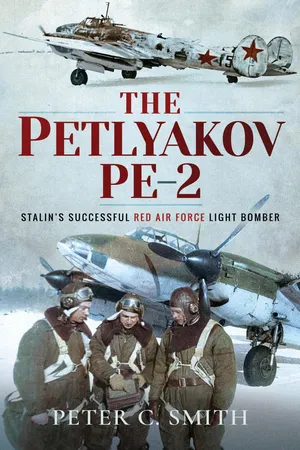
The definitive book on the development and deployment of the Soviet Union's supreme dive-bomber—with rare archival and private photos.
During the Second World War, the Petlyakov Pe-2 Peshka was the Soviet Union's main dive- and light-bomber in operations across the Eastern Front. It became a mainstay of the Soviet counteroffensive that led to the fall of Berlin. They also led the way in the brief but annihilating Manchurian campaign against Japan in the closing days of the war in 1945.
Conceived by a team of top aircraft designers whom Stalin had incarcerated on political charges, the Peshka had originally been designed as a high-altitude twin-engine fighter plane. But due to the outstanding success of the German Stukas in the Blitzkrieg, it was quickly transformed into the fastest dive-bomber in the skies.
Only a handful had reached front lines by the start of Operation
Barbarossa in June 1941. But by 1945, more than 11,000 of the type were built, including many variants. Many of these remained in service with the air forces of Yugoslavia and the Warsaw Pact countries into the 1950s. Using official sources, including the official Pe-2 handbook, as well as rare color and black-and-white photographs from both official and private collections, this is the definitive record of the Pe-2.
- 336 pages
- English
- ePUB (mobile friendly)
- Available on iOS & Android
eBook - ePub
About this book
Trusted by 375,005 students
Access to over 1.5 million titles for a fair monthly price.
Study more efficiently using our study tools.
Information
Chapter One
Inspiration Imprisoned
To most people in the West who have been fortunate enough not to know at firsthand what it is like to live under a true dictatorship, it will appear incredible that one of a nation’s leading aircraft designers, was, on the eve of the greatest and most bitter war in that country’s history, callously incarcerated in a prison camp by his paranoid and demonic leader. Unfortunately for many thousands of perfectly innocent and dedicated Soviet citizens, this was standard treatment from Marshal Josef Stalin, probably the most evil and ruthless person thrown up by the twentieth century, in an age when such monsters have become commonplace and where contempt for human rights, indeed for human life, is almost routine. Even this nightmare existence was more than the fate suffered by millions more of the Russian people during those terrible years of misrule.1
Nonetheless, incredible or not, the man who designed one of the most successful, and certainly one of the fastest, dive-bombers of the Second World War, an aircraft that played a major part in ‘The Great Patriotic War’ and which continued to serve in the front line for the first post-war years of the ‘Cold War’ that followed, did much of his work behind barbed wire, and did it well enough to have his (totally unjustified) incarceration commuted just before his tragic death.
Vladimir Mikhailovich Petlyakov was a great Russian aircraft designer, and his work went back many years, but the Peshka (Chess Pawn) proved to be his masterpiece.2 With this sleek and aerodynamically excellent twin-engined aircraft, he, without any previous experience in this field, proved that a dive-bomber did not have to be a slow aeroplane, and that precision bombing could be carried out without sacrificing speed and styling. This, unfortunately, was in direct opposition to the line that RAF experts had been stating for the previous ten years so that, when, later, British Hawker Hurricane fighters based in North Russia during the war, told of their great difficulty in keeping up with the Pe-2s they were supposed to be escorting,3 there was disbelief at the Air Ministry. Reporting of the Pe-2’s great success and magnificent war record was deliberately played down and muted in Britain, the emphasis being always on the exploits of the Ilyushin IL-2 Shturmovik, whose low-level methods were more in harmony with acceptable British practice. In fact, despite detailed reports on the Peshka by serving RAF officers being sent to Whitehall, the Air Ministry stated publicly that they had ‘no information to indicate that its contribution is in any way outstanding’.4
The Dive-Bomber in the Soviet Air Force
The Soviet Air Force (Voenno-vozdushnye sili or VVS) came late to the dive-bomber, their name for which was Pikiruyushchi Bombardirovochny. Although communist ‘historians’ claimed that their nation invented everything from the tank to the jet engine, there was little or no interest in this form of attack until the late 1930s. The British had used dive bombing in actual combat as early as March 1918, and the American Air Force had experimented with it between 1919 and 1921 and the French Navy in 1920-21; the main exponents had become the United States Navy and Marine Corps, the German Luftwaffe and the Japanese Navy in the period 1925-35.5

The pre-war scenario of Soviet battle tactics, with low-flying ground-attack biplanes supporting a tank advance. This was advanced thinking before Stalin’s purges of the High Command turned the clock back. (Soviet Official)
The earliest Soviet experimentation with the dive-bomber type was the production of the VIT-1 and VIT-2 aircraft, experimental machines that were built and tested in the period 1933-38.6 However, the chief thrust of their light bomber design in this period culminated in the twin-engined Tupolev SB.7 Of standard construction, this did not fare so well in the pre-war clashes between the Soviet Union and the Japanese, during the July/August, 1938, clash at Lake Khasan, and the even more intense Nomonhan incident that began on 11 May 1939 and did not finally fade out until 16 September. Losses had been heavy and accuracy in bombing indifferent and plans were put in hand to produce a dive-bomber variant of the SB, following demands for such an aircraft from Stalin himself in 1939. This became the SB-RK, (also known as the Arkhangel’skii Ar-2 as A.A. Arkhangel’skii, who was Tupolev’s young deputy, worked on the project), dive-bomber. The conversion took place during 1940-41 and was extremely basic; it was only intended as an interim solution until proper dive-bombers could be designed from the ground up. Some 210 standard three-seater SBs, powered by the M105R engine, were fitted with dive brakes. They did not perform outstandingly in their new rôle, partly because the aircraft themselves were not designed for the job, and partly because only the haziest concepts of what dive-bombing involved were taught to their aircrews.
This latter was to be a recurring problem with all air forces that adopted dive-bombers or dive-bombing late, no matter what the merits of their aircraft. Thus the US Navy used the Douglas SBD Dauntless to enormous effect in the Pacific War, but the US Army Air Forces failed to do the same with their version of the same aircraft, the A-24 Banshee.8 The highly-successful North American A-36A Apache dive-bomber was later used by the USAAF, but the correct and best way to use them had to be learnt the hard way, during actual combat, as teaching of the subject itself was rudimentary and, indeed, at first resulted in orders to wire their dive brakes shut. This order was very soon reversed when the aircraft got into action, but it reflected the same attitude and outlook.9 Similarly the RAF squadrons that later used the Vultee A-36 Vengeance to such good effect at Kohima and Imphal during the Burma campaign, equally had to start almost from scratch in devising their own dive-bombing techniques, such had been the opposition to any use of such an obvious Army support weapon and method by the Air Ministry.10

The twin-engine Arkhangel’skii SB-RK (Ar-2) late 1930s fast bomber. Two hundred of these were fitted with dive-brakes in an attempt to turn them into dive-bombers, but this experiment was not a success. (Soviet Official)
Therefore, the SB-RK, although used during the early stages of the war with Germany in 1941-42, was not a success and no more SBs were produced. There were also problems with production and maintenance of the type. Other options were tried. Stalin put pressure on Andrei Nikolaevich Tupolev, the doyen of Soviet aircraft designers, but himself also imprisoned, to come up with a brand-new dive-bomber. This concept hoped to combine both dive-bombing and horizontal bombing capability in one twin-engined, three-crew monoplane that would have a speed equal to front-line fighter aircraft, the Samolet-103. Tupolev’s team of designers (also incarcerated in the TsKB-20 ‘Special Prison’) came up with an aircraft that bore much superficial resemblance to the Pe-2, whose initial designation was the ANT-58.11 Impetus to come up with a successful dive-bomber was given by practical demonstrations of their effectiveness taking place at the other end of Europe at this time.
With the advent of the Spanish Civil War (1936-39) there was considerable involvement by many of the great military powers. While Britain and France declared a policy of strict neutrality and ‘Non-Intervention’ the Germans and Italians were eager to support General Franco’s Nationalist armies, while the Soviet Union was equally determined to back the Republican cause, increasingly dominated by the communists and fellow-travellers as it was. As the fighting spread, this support led to a more and more active involvement of their own forces, with the German ‘Legion Kondor’ using the war as a kind of combat dress rehearsal for their newly created Luftwaffe, and the Soviets trying out their latest aircraft designs also. Both sides learned valuable lessons, not only about the qualities and limitations of their own aircraft, but also of the potential of their most likely opponents’ aircraft as well. One lesson the Soviet Air Force took on board from this involvement was the accuracy and potential of the dive-bomber, as ably demonstrated by the Junkers Ju. 87A and B models in this conflict.12
Tupolev Tu-2
So Tupolev’s new design was eagerly awaited. Powered by two Mikulin AM-37 twelve-cylinder liquid-cooled engines, which developed 1,400hp and fitted with three-bladed variable-pitch propellers, this twin-tailed mid-wing cantilever monoplane, the ANT-58, could carry a crew of three, pilot, navigator/bomb-aimer and radio operator/gunner, along with 1,000kg (2,204lb) of internally carried bombs and a further 2,000kg (4,409lb) externally under the wings at speeds of up to 395mph (635km/h). Slatted, electrically-operated dive brakes were to be fitted on production models, beneath the outer wing panels.13 This more than met the specification asked of it, and the first flight took place on 29 January 1941, with test pilot M.P. Vasyakin at the helm. Alterations in internal layout and crew accommodation were required, and the engines were far from reliable. This led to a considerable delay before the second prototype took to the air in May 1941, just a few weeks before the German invasion.
The type was progressively modified and improved with better (radial) engines and propellers, and finally entered service as the Tu-2 with three pre-production aircraft, in September 1942, but a full production model, the Tu-2S (S = Seriinyi–Series), did not join frontline combat squadrons until early 1944, and then was only very rarely employed for dive-bombing. This was, in part, due to its size, but also because the shift of the factories manufacturing it called for a great reduction in complexity of construction to get them into service and the dive brakes were among many features generally sacrificed. One unique variant appeared as late as 1947 in the dive-bomber configuration; this was the UTB-2P (P = Pikiruyushchi). The UTB was the Sukhoi-designed training version with two Ash-21 engines. This particular machine was fitted with ‘Venetian Blind’ type slatted dive brakes on the underside of the wings outboard of the engine nacelles but was only used for experimental purposes.
The I-16 SPB
A rather more bizarre approach to the dive-bomber solution was made by Vladimir S. Vakhmistrov, from the Soviet Nauchno-ispytatel’ny (Scientific Test Institute). As long ago as 1932, he had envisaged long-range heavy bombers toting into battle their very own defending fighters, which would be slung below them on underwing cradles. (The Americans were trying the same thing with fighters cradled beneath airships at this time.) Although this brainwave eventually came to naught, the idea was modified to give the normally short-range dive-bomber the extended range needed to hit distant targets, but with the dive-bomber’s accuracy.
This concept was the I-16 SPB (Skorostnyi Pikiruyushchii Bombardirovshcik, or Fast Dive Bomber). The first suggestion for such an aircraft, based on work on the Aviamatka PVO (Protivovozdushnaya Oborona– Protective Air Defence Mother Plane, or AMPVO concept), was made on 14 August 1936.14
The actual dive bombers themselves were again conversions, this time from the standard Polikarpov I-16 Ishak (Donkey), a stubby little, radial-engined monoplane, which had seen combat in Spain but was by now outclassed in the air in its intended rôle. Two of these fighters had their main offensive armament of two cannon removed to save weight, and retained only a pair of machine guns for their own limited self-defence. They could carry a 550lb (250kg) FAB-550 (Fugsasnaya AviaBomba, or demolition bomb) bomb under each wing in their new configuration. This increased each fighter’s payload by half-a-ton. They featured reinforced wing-spars for strength, reinforced ribs in the wing joints which carried overwing suspension spindles and underwing bomb racks. An extra fuel tank, to feed oil to the dive-bombers from the mother ship, was also a new feature.
The Soviet method was to carry out a very steep diving attack, 80 degrees, which was defined by the position of the edge of the cockpit top. The new aircraft proved very stable in such a dive, and reached a sustained dive speed of 403mph (650km/h). Recovery from the dive was at 6,500 feet (2000m) at 4G load, and did not exceed 2,000 feet (600m) with 6G. The target was shaped like a battleship and by the end of the range-bombing trials high accuracy was being achieved, with ‘a staggering compactness of bomb hits–with sometimes less than 10ft (3 m) between them’.15
Despite these good results the political situation saw the suspension of further trials until 1939 when the first of twenty Z-SPBs, as the new Zveno composite mother plane and parasite were designated, started to join both the Air Force and the Navy. But the type aroused little enthusiasm in the upper command of the Air Force, they having alre...
Table of contents
- Cover
- Title
- Copyright
- Contents
- Introduction
- About the Author
- Dedication
- Acknowledgements
- Chapter 1 Inspiration Imprisoned
- Chapter 2 Many Starts, Many Endings
- Chapter 3 Sotka becomes Peshka
- Chapter 4 The Pe-2 Described
- Chapter 5 The Pe-3 fighter variant
- Chapter 6 First Combat
- Chapter 7 Counter-Attack
- Chapter 8 New Tactics, New Defences, New Confidence
- Chapter 9 Tilting the Scales–Stalingrad to the Donets
- Chapter 10 Heroines of the Skies
- Chapter 11 The Fighting Finns
- Chapter 12 Production Line Progression
- Chapter 13 The Great Offensive–June 1944
- Chapter 14 On to Berlin!
- Chapter 15 Action in the Far East
- Chapter 16 Variations on a Theme
- Chapter 17 Pe-2 Colour Schemes
- Chapter 18 The Final Developments
- Chapter 19 The Peshka in Foreign Service
- Chapter 20 The Survivors
- Appendix 1 Pe-2 Units
- Appendix 2 Pe-2 Unit Commanders
- Appendix 3 Pe-2 Pilot Biographies
- Appendix 4 Glossary
- Appendix 5 Some Pe-2 Aces
- Appendix 6 Further reading
- Notes
Frequently asked questions
Yes, you can cancel anytime from the Subscription tab in your account settings on the Perlego website. Your subscription will stay active until the end of your current billing period. Learn how to cancel your subscription
No, books cannot be downloaded as external files, such as PDFs, for use outside of Perlego. However, you can download books within the Perlego app for offline reading on mobile or tablet. Learn how to download books offline
Perlego offers two plans: Essential and Complete
- Essential is ideal for learners and professionals who enjoy exploring a wide range of subjects. Access the Essential Library with 800,000+ trusted titles and best-sellers across business, personal growth, and the humanities. Includes unlimited reading time and Standard Read Aloud voice.
- Complete: Perfect for advanced learners and researchers needing full, unrestricted access. Unlock 1.5M+ books across hundreds of subjects, including academic and specialized titles. The Complete Plan also includes advanced features like Premium Read Aloud and Research Assistant.
We are an online textbook subscription service, where you can get access to an entire online library for less than the price of a single book per month. With over 1.5 million books across 990+ topics, we’ve got you covered! Learn about our mission
Look out for the read-aloud symbol on your next book to see if you can listen to it. The read-aloud tool reads text aloud for you, highlighting the text as it is being read. You can pause it, speed it up and slow it down. Learn more about Read Aloud
Yes! You can use the Perlego app on both iOS and Android devices to read anytime, anywhere — even offline. Perfect for commutes or when you’re on the go.
Please note we cannot support devices running on iOS 13 and Android 7 or earlier. Learn more about using the app
Please note we cannot support devices running on iOS 13 and Android 7 or earlier. Learn more about using the app
Yes, you can access The Petlyakov Pe-2 by Peter C. Smith in PDF and/or ePUB format, as well as other popular books in History & Military & Maritime History. We have over 1.5 million books available in our catalogue for you to explore.