Discover the fundamentals and intricacies of a subject at the interface of chemistry and biology with this authoritative resource
Chemistry and Biology of Non-canonical Nucleic Acids delivers a comprehensive treatment of the chemistry and biology of non-canonical nucleic acids, including their history, structures, stabilities, properties, and functions. You'll learn about the role of these vital compounds in transcription, translation, regulation, telomeres, helicases, cancers, neurodegenerative diseases, therapeutic applications, nanotechnology, and more.
An ideal resource for graduate students, researchers in physical, organic, analytical, and inorganic chemistry will learn about uncommon nucleic acids, become the common non-canonical nucleic acids that fascinate and engage academics and professionals in private industry.
Split into 15 chapters covering a wide range of aspects of non-canonical nucleic acids, the book explains why these compounds exist at the forefront of a new research revolution at the intersection of chemistry and biology. Chemistry and Biology of Non-canonical Nucleic Acids also covers a broad range of topics critical to understanding these versatile and omnipresent chemicals, including:
* A discussion of the dynamic regulation of biosystems by nucleic acids with non-canonical structures
* The role played by nucleic acid structures in neurodegenerative diseases and various cancers
* An exploration of the future outlook for the chemistry and biology of non-canonical nucleic acids
* An introduction to the history of canonical and non-canonical structures of nucleic acids
* An analysis of the physicochemical properties of non-canonical nucleic acids
Perfect for biochemists, materials scientists, and bioengineers, Chemistry and Biology of Non-canonical Nucleic Acids will also earn a place in the libraries of medicinal and pharmaceutical chemists who wish to improve their understanding of life processes and the role that non-canonical nucleic acids play in them.
- English
- ePUB (mobile friendly)
- Available on iOS & Android
eBook - ePub
Chemistry and Biology of Non-canonical Nucleic Acids
About this book
Trusted by 375,005 students
Access to over 1 million titles for a fair monthly price.
Study more efficiently using our study tools.
Information
1
History for Canonical and Non-canonical Structures of Nucleic Acids
The main points of the learning:
Understand canonical and non-canonical structures of nucleic acids and think of historical scientists in the research field of nucleic acids.
1.1 Introduction
This book is to interpret the non-canonical structures and their stabilities of nucleic acids from the viewpoint of the chemistry and study their biological significances. There is more than 60 years' history after the discovery of the double helix DNA structure by James Dewey Watson and Francis Harry Compton Crick in 1953, and chemical biology of nucleic acids is facing a new aspect today. Through this book, I expect that readers understand how the uncommon structure of nucleic acids became one of the common structures that fascinate us now. In this chapter, I introduce the history of nucleic acid structures and the perspective of research for non-canonical nucleic acid structures (see also Chapter 15).
1.2 History of Duplex
The opening of the history of genetics was mainly done by three researchers. Charles Robert Darwin, who was a scientist of natural science, pioneered genetics. The proposition of genetic concept is indicated in his book On the Origin of Species published in 1859. He indicated the theory of biological evolution, which is the basic scientific hypothesis of natural diversity. In other words, he proposed biological evolution, which changed among individuals by adapting to the environment and be passed on to the next generation. However, that was still a primitive idea for the genetic concept. After that, Gregor Johann Mendel, who was a priest in Brno, Czech Republic, confirmed the mechanism of gene evolution by using “factor” inherited from parent to children using pea plant in 1865. This discovery became the concept of genetics. At the almost same time in 1869 as Mendel, Johannes Friedrich Miescher, who was a biochemist in Swiss, discovered nucleic acids as a chemical substance of the gene identity. He named it “nuclein” (later, it was named “nucleic acid,” which exists acidic substance in nucleus) and made the opportunity to study nucleic acid chemistry. However, it would be doubtful if he realized that nucleic acid is the gene identity. After that, it was needed to take a lot of time to conclude that the gene identity is proved the chemical substance.

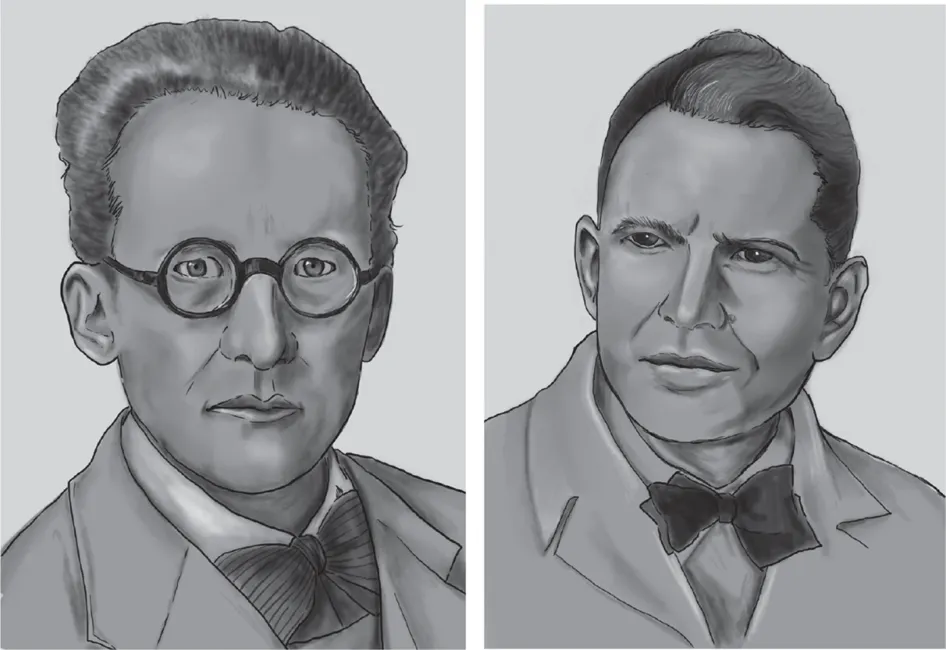
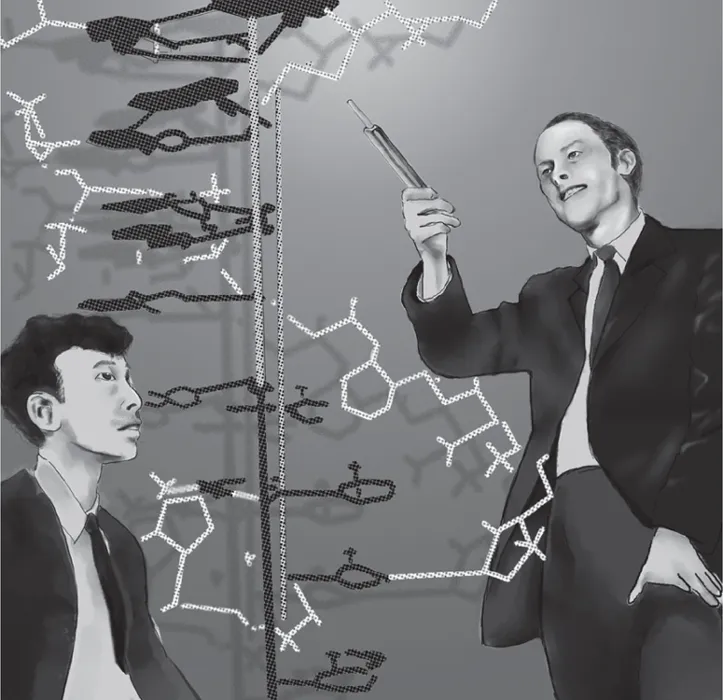
Erwin Rudolf Josef Alexander Schrödinger, who was a great physicist, pioneered to go after the mystery of gene. He published a book titled What Is Life? in 1944 [1]. This book invited the study of the gene to many researchers. He mentioned in the book that he believed a gene – or perhaps the whole chromosome fiber – to be an aperiodic solid, although he also mentioned that gene is probably one big protein molecule. After the 1950s, chemistry regarding nucleic acids had been developing. One of the organic chemists was Erwin Chargaff, who was a professor at Colombia University in the United States and born in Austria. He discovered that from the result of paper chromatography targeted to the different types of DNA, the number of guanine units equals the number of cytosine units and the number of adenine units equals the number of thymine units [2]. It is called Chargaff's rules. On the other hand, analysis of the superstructure of nucleic acids was also proceeding. At the beginning of the 1950s, at King's College London, the results of X-ray crystal analysis were accumulated by Maurice Hugh Frederick Wilkins, Rosalind Elsie Franklin, and others. Finally, based on their result, Watson and Crick who worked at Cavendish Laboratory in Cambridge and proposed the model of double helix structure of DNA (Figure 1.1 and see Chapter 2), published as a single-page paper about DNA double helix in Nature issued on 25 April 1953 [3]. By discovering DNA double helix structure, Watson, Crick, and Wilkins were awarded the Nobel Prize in Physiology or Medicine in 1962.
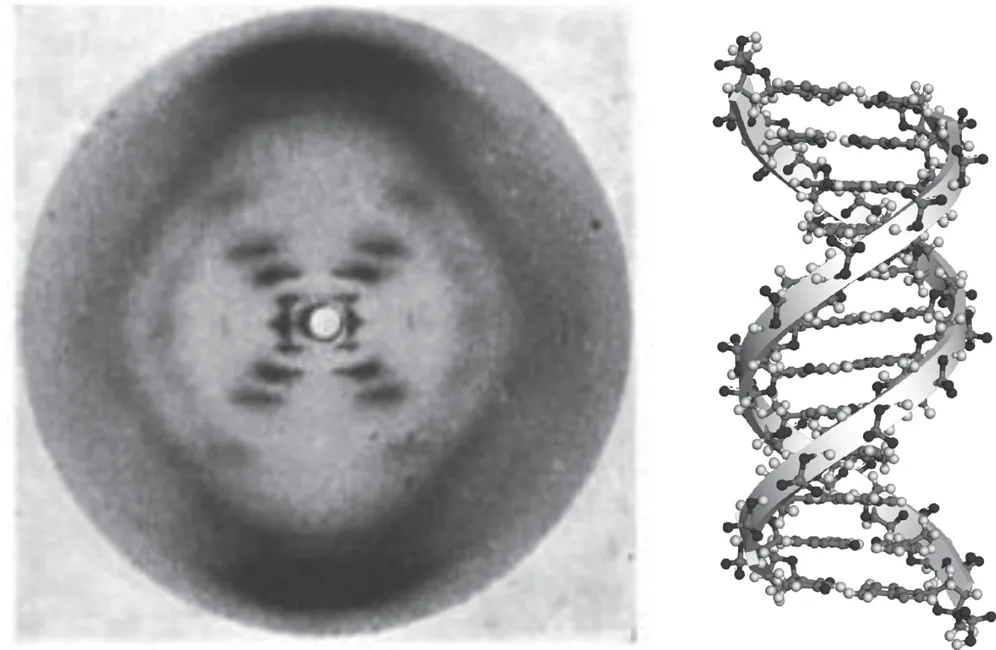
Figure 1.1 The diffraction pattern of the canonical DNA duplex and its chemical structure.
Source: Kings College London.

1.3 Non-Watson–Crick Base Pair
Although the discovery of Watson–Crick base pairs is famous, we need to make sure that Watson and Crick initially “proposed” their model. Moreover, Watson and Crick were not the first researchers who proposed the structure of nucleic acids. The physicist Linus Pauling, who earned the Nobel Prize two times in his career, first proposed the helix model of nucleic acids with his associate Robert Corey [4]. However, the structure was fault: it was a triple helix having negatively charged phosphates located at the core of the helix, which could not exist in nature. After the proposal of Watson–Crick base pairs, the race for determination of the helical structure of DNA had been started using purine and pyrimidine monomers. The first such study was reported in 1959, when Karst Hoogsteen – an associate of Robert Corey at Caltech – used single-crystal X-ray analysis to determine the structures of cocrystals containing 9-methyladenine and 1-methylthymine, where methyl groups were used to block hydrogen bonding to nitrogen atoms otherwise bonded to sugar carbons in DNA [5]. However, the structure was ...
Table of contents
- Cover
- Table of Contents
- Title Page
- Copyright
- Preface
- 1 History for Canonical and Non-canonical Structures of Nucleic Acids
- 2 Structures of Nucleic Acids Now
- 3 Stability of Non-canonical Nucleic Acids
- 4 Physicochemical Properties of Non-canonical Nucleic Acids
- 5 Telomere
- 6 Transcription
- 7 Translation
- 8 Replication
- 9 Helicase
- 10 Dynamic Regulation of Biosystems by Nucleic Acids with Non-canonical Structures
- 11 Cancer and Nucleic Acid Structures
- 12 Neurodegenerative Diseases and Nucleic Acid Structures
- 13 Therapeutic Applications
- 14 Materials Science and Nanotechnology of Nucleic Acids
- 15 Future Outlook for Chemistry and Biology of Non-canonical Nucleic Acids
- Index
- End User License Agreement
Frequently asked questions
Yes, you can cancel anytime from the Subscription tab in your account settings on the Perlego website. Your subscription will stay active until the end of your current billing period. Learn how to cancel your subscription
No, books cannot be downloaded as external files, such as PDFs, for use outside of Perlego. However, you can download books within the Perlego app for offline reading on mobile or tablet. Learn how to download books offline
Perlego offers two plans: Essential and Complete
- Essential is ideal for learners and professionals who enjoy exploring a wide range of subjects. Access the Essential Library with 800,000+ trusted titles and best-sellers across business, personal growth, and the humanities. Includes unlimited reading time and Standard Read Aloud voice.
- Complete: Perfect for advanced learners and researchers needing full, unrestricted access. Unlock 1.4M+ books across hundreds of subjects, including academic and specialized titles. The Complete Plan also includes advanced features like Premium Read Aloud and Research Assistant.
We are an online textbook subscription service, where you can get access to an entire online library for less than the price of a single book per month. With over 1 million books across 990+ topics, we’ve got you covered! Learn about our mission
Look out for the read-aloud symbol on your next book to see if you can listen to it. The read-aloud tool reads text aloud for you, highlighting the text as it is being read. You can pause it, speed it up and slow it down. Learn more about Read Aloud
Yes! You can use the Perlego app on both iOS and Android devices to read anytime, anywhere — even offline. Perfect for commutes or when you’re on the go.
Please note we cannot support devices running on iOS 13 and Android 7 or earlier. Learn more about using the app
Please note we cannot support devices running on iOS 13 and Android 7 or earlier. Learn more about using the app
Yes, you can access Chemistry and Biology of Non-canonical Nucleic Acids by Naoki Sugimoto in PDF and/or ePUB format, as well as other popular books in Biological Sciences & Biochemistry. We have over one million books available in our catalogue for you to explore.