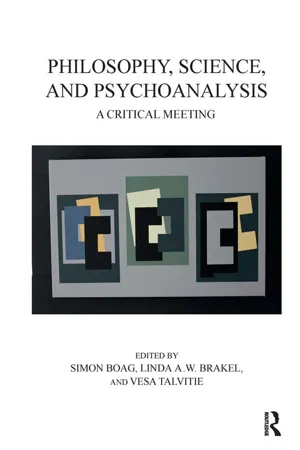
eBook - ePub
Philosophy, Science, and Psychoanalysis
A Critical Meeting
- 352 pages
- English
- ePUB (mobile friendly)
- Available on iOS & Android
eBook - ePub
Philosophy, Science, and Psychoanalysis
A Critical Meeting
About this book
The perennial interest in psychoanalysis shows no signs of abating and the longevity of psychoanalytic theory is seen in the varied extensions and elaborations of Freudian thinking in the fields of neuroscience and cognitive theory. Nevertheless, the scientific standing of psychoanalysis has long been questioned and developments in the fields of the philosophy of science and psychology require a fresh assessment of the scientific standing of psychoanalysis. While there are a range of views on the topic of whether psychoanalysis is in fact scientific, any satisfactory approach to understanding mind and behaviour requires an approach that is at once both philosophic and scientific. Accordingly, to even approach the question regarding the scientific nature of psychoanalysis, a foundation comprising a sophisticated conceptual and philosophical framework is required. This volume represents the junction where philosophy, science, and psychoanalysis meet and presents arguments critical and supportive of the scientific standing of psychoanalysis.
Information
Table of contents
- Cover Page
- Half Title
- Title Page
- Copyright Page
- Contents
- ABOUT THE EDITORS AND CONTRIBUTORS
- INTRODUCTION — Vesa Talvitie, Linda A. W. Brakel, and Simon Boag
- CHAPTER ONE ritique of Psychoanalysis — Adolf Grünbaum
- CHAPTER TWO Psychoanalysis and philosophy of science: basic evidence — Edward Erwin
- CHAPTER THREE Critique of Grünbaum’s “Critique of psychoanalysis” — Linda A. W. Brakel
- CHAPTER FOUR From scientific explanations to micropsychology: what should psychoanalytic theories be like? — Vesa Talvitie
- CHAPTER FIVE Psychoanalysis and philosophy of science: reply to Brakel and Talvitie — Edward Erwin
- CHAPTER SIX Two fundamental problems for philosophical psychoanalysis — Linda A. W. Brakel
- CHAPTER SEVEN The scientific status of psychoanalysis revisited — Agnes Petocz
- CHAPTER EIGHT Freud and Wittgenstein in the cuckoo’s nest — Thomas Wallgren
- CHAPTER NINE Psychoanalytic research with or without the psyche? Some remarks on the intricacies of clinical research — Anna Ursula Dreher
- CHAPTER TEN Repression, defence, and the psychology of science — Simon Boag
- NOTES
- REFERENCES
- INDEX
Trusted by 375,005 students
Access to over 1.5 million titles for a fair monthly price.
Study more efficiently using our study tools.
Frequently asked questions
Yes, you can cancel anytime from the Subscription tab in your account settings on the Perlego website. Your subscription will stay active until the end of your current billing period. Learn how to cancel your subscription
No, books cannot be downloaded as external files, such as PDFs, for use outside of Perlego. However, you can download books within the Perlego app for offline reading on mobile or tablet. Learn how to download books offline
Perlego offers two plans: Essential and Complete
- Essential is ideal for learners and professionals who enjoy exploring a wide range of subjects. Access the Essential Library with 800,000+ trusted titles and best-sellers across business, personal growth, and the humanities. Includes unlimited reading time and Standard Read Aloud voice.
- Complete: Perfect for advanced learners and researchers needing full, unrestricted access. Unlock 1.5M+ books across hundreds of subjects, including academic and specialized titles. The Complete Plan also includes advanced features like Premium Read Aloud and Research Assistant.
We are an online textbook subscription service, where you can get access to an entire online library for less than the price of a single book per month. With over 1.5 million books across 990+ topics, we’ve got you covered! Learn about our mission
Look out for the read-aloud symbol on your next book to see if you can listen to it. The read-aloud tool reads text aloud for you, highlighting the text as it is being read. You can pause it, speed it up and slow it down. Learn more about Read Aloud
Yes! You can use the Perlego app on both iOS and Android devices to read anytime, anywhere — even offline. Perfect for commutes or when you’re on the go.
Please note we cannot support devices running on iOS 13 and Android 7 or earlier. Learn more about using the app
Please note we cannot support devices running on iOS 13 and Android 7 or earlier. Learn more about using the app
Yes, you can access Philosophy, Science, and Psychoanalysis by Simon Boag, Linda A. W. Brakel, Vesa Talvitie, Simon Boag,Linda A. W. Brakel,Vesa Talvitie in PDF and/or ePUB format, as well as other popular books in Psicologia & Storia e teoria della filosofia. We have over 1.5 million books available in our catalogue for you to explore.