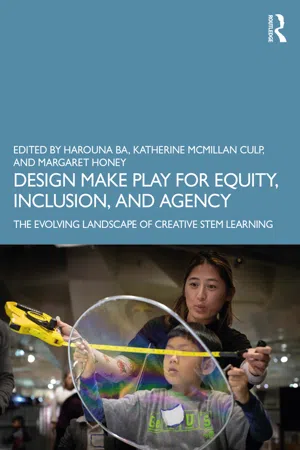
Design Make Play for Equity, Inclusion, and Agency
eBook - ePub

Design Make Play for Equity, Inclusion, and Agency

The Evolving Landscape of Creative STEM Learning

  1. 224 pages
  2. English
  3. ePUB (mobile friendly)
  4. Available on iOS & Android
eBook - ePub

Design Make Play for Equity, Inclusion, and Agency

The Evolving Landscape of Creative STEM Learning

About this book

This pioneering book offers a resource for educators, policymakers, researchers, exhibit designers, and program developers that illuminates creative, cutting-edge ways to inspire, engage, and motivate young people about STEM learning in both informal and formal education settings.

A follow-up to the popular book Design, Make, Play (2013), this volume combines new research, innovative case studies, and practical advice from the New York Hall of Science (NYSCI) to define and illustrate a vision for creative and immersive learning, focusing on STEM learning experiences that are truly equitable and inclusive, and that foster learners' agency.

Featuring contributions from program developers, facilitators, educators, exhibit designers, and researchers, the book provides real-world examples from informal and formal settings that fill the need for high-quality STEM learning opportunities that are accessible to all learners, including groups underrepresented in STEM education and careers. Chapters of the book describe strategies such as using narratives to make engineering learning more inclusive, engaging English language learners in digital design, focusing on whole-family learning, and introducing underserved students to computational thinking through an immersive computer game.

This book offers both a challenge and a guide to all STEM educators in museums, science centers, and other informal and formal education settings who are seeking out ambitious and more equitable forms of engagement. With leading-edge research and practical advice, the book provides appealing and accessible forms of engagement that will support a diverse range of audiences and deepen their approach to creative STEM learning.

Trusted byĀ 375,005 students

Access to over 1.5 million titles for a fair monthly price.

Study more efficiently using our study tools.

Information

Publisher
Routledge
Year
2021
Print ISBN
9781138572119
eBook ISBN
9781351333146

Part I

Designing for Visitors’ Agency

chapter 1

Designing for Agency in Informal STEM Learning Environments

Susan M. Letourneau
Motivation to learn is fostered for learners of all ages when they perceive the school or learning environment is a place where they ā€œbelongā€ and when the environment promotes their sense of agency and purpose.
National Academies of Sciences, Engineering, and Medicine, 2018, p. 133
Decades of research in the learning sciences have demonstrated that the most powerful learning experiences happen when individuals are able to actively construct knowledge, build on their everyday experiences, and investigate personally meaningful problems (The National Academies, 2018). In informal learning environments, educational practices are based on the understanding that learning is embedded in personal, social, and cultural experiences that accumulate and evolve over time (Falk & Dierking, 2016; Rogoff et al., 2016). Designers and educators in these settings pride themselves on offering active and engaging learning experiences that are relevant to people’s lives. But do these experiences specifically support visitors’ sense of agency? And how might our practices shift if we focus our attention on agency as a distinct and important construct?
On a typical day in a science center, one might observe any or all of the following taking place:
  • In an interactive exhibit, a visitor pushes a button to see a video or lifts flaps to read labels.
  • A facilitator starts a conversation with a group of visitors by asking what they notice about a display.
  • Caregivers and children build something in an engineering design space, discussing and elaborating on their plans over a sustained period of time.
  • A student looks at specimens through a microscope in a biology exhibit.
  • Children play a digital game together while their caregivers sit on a bench nearby to recharge.
  • Visitors quietly listen to a science film in a theater.
  • Teachers and chaperones guide groups of students through an exhibit.
  • A student carefully observes a demonstration and raises her hand to ask a question.
Although most of these activities involve visitor participation, they may not necessarily promote visitors’ agency in the learning process – if, for example, they constrain how visitors can make discoveries, limit the questions they can ask, or fail to tap visitors’ own knowledge and perspectives. Educators in informal learning environments might ask themselves questions like these: Which aspects of the experiences they offer allow learners to exercise their agency? What does ā€œagencyā€ mean and look like in informal learning environments, and why is it uniquely important for the kinds of learning that science centers hope to cultivate?
Researchers and educators have explored the role of agency in science, technology, engineering, and mathematics (STEM) learning from many angles and at various levels, from the individual to the systemic. This work leads us to recognize the complexity of designing learning environments that center on learners’ ideas while also guiding them toward specific learning goals. This chapter briefly introduces multiple lines of research that relate to agency in informal STEM learning and link agency with the creation of equitable and inclusive learning experiences. These studies provide a helpful lens for critically examining and questioning practices used in informal learning environments. As explained in this chapter, examining our practices through the lens of agency can change how we conceptualize the relationships between scientific knowledge, designed learning environments, and the learners themselves. Each line of work raises questions for practice that can inform the design of informal experiences and environments.

Who Decides? Interactivity, Agency, and Authority

Research in science education has examined agency in the context of the negotiations that take place as educators and learners define what questions to ask, how to find answers, and how knowledge is constructed and applied (Arnold & Clarke, 2014; Damsa et al., 2010; Miller et al., 2018). These studies demonstrate that providing opportunities for learners to shape the direction and outcome of their scientific investigations allows them to develop STEM practices in the context of their prior knowledge, perspectives, and skills (Barton & Tan, 2010; Stroupe, 2014). However, supporting agency in this way requires transforming pedagogical practices to give learners greater authority to decide what is worth knowing and how knowledge is produced (Stroupe et al., 2018). Learners’ own knowledge and perspectives are seen as relevant and necessary to the learning process (see Figure 1.1). This view aligns with research conducted in informal learning environments that describes learning as an active, personal, and experiential process, mediated by people’s social interactions and cultural contexts (Hein, 1998, 2006; Falk & Dierking, 2016; Rogoff et al., 2016).
Figure 1.1Children collectively write down their individual measurements on a shared poster-size image of the exhibit Celestial Mechanics.

Limitations on Visitors’ Agency

On the surface, many informal learning experiences provide opportunities for learners to be active participants. Science centers are designed to invite free choice exploration. Visitors navigate museums based on their existing interests and agendas, making sense of scientific content presented by museum exhibits and actively seeking out connections to their lives (Ash, 2004; Ellenbogen et al., 2004; Falk & Dierking, 2016; Zimmerman et al., 2010). As illustrated in the examples at the start of this chapter, experiences in museums and science centers invite and encourage participation in many learning experiences. However, the desire to teach science in an active and individualized way is sometimes at odds with the desire to communicate established scientific knowledge. This latter approach of conveying knowledge is often what visitors have come to expect from science and what educators and designers are used to providing. For example, exhibits often include physical and multimedia interactives (buttons to press, flaps to lift, levers to pull) that prompt visitors to seek out information, but these elements may be used to communicate ā€œcorrectā€ answers in one direction, from ā€œexpertsā€ to learners (Whitcomb, 2006). Although the implicit messages conveyed by these modes of interaction conflict with what research has shown about the kinds of contextualized and personal experiences that support deeper learning, they may align with visitors’ (and perhaps educators’) expectations that science can offer the certainty of undisputed factual knowledge.
Other exhibits in informal settings focus on discovery. They provide opportunities for visitors to ask questions and build on their own experiences while exploring a scientific concept (Hein, 2006). Pioneering work at the Exploratorium, for instance, showed that designing exhibits to provide accessible entry points and multiple pathways through an experience can support active, prolonged engagement and extend visitors’ exploration of scientific phenomena (Allen, 2004; Humphrey & Gutwill, 2005). With these exhibits, the goal is for visitors to explore in ways that support their understanding of accepted scientific knowledge, while giving them some control over the path they take to get there. Although these strategies are effective in deepening exploration, scientific knowledge is still framed as something external that the visitor can acquire or discover. These exhibits are often designed to ensure that visitors make discoveries in predictable ways that reinforce established knowledge (Whitcomb, 2006).
By limiting the ways in which visitors can make discoveries and by offering predetermined, authoritative explanations as the end point of the experience, museums often retain control over the questions being asked and the pathways that visitors can take to answer them. These practices can put visitors in the position of being passive receivers of information. And while this is a risk for all visitors, there is evidence that these practices disproportionately affect learners from non-dominant communities by centering on white, masculine, middle-class views of STEM and excluding the perspectives and knowledge that visitors bring (Buechley, 2013; Dawson, 2017, 2019; Gaskins, 2008). As a result, learners with many other backgrounds have to do extra work to figure out how to use exhibits and relate the information presented to their own experiences and prior knowledge (Ash & Lombana, 2011; Aikenhead, 2006; Dawson, 2014; Medin & Bang, 2014).

More Equitable Approaches

Research suggests that more equitable approaches do not limit learners’ involvement to constructing previously accepted knowledge. Instead, these approaches involve learners in deciding what to learn and how the learning process should unfold (Russ & Berland, 2019; Stroupe, 2014). This point of view aligns with the constructivist and participatory educational approaches used in many museums, which remove the authoritative voice entirely in order to allow for a dialogue in which visitors see their own experiences and ideas represented (McLean & Pollock, 2007; Whitcomb, 2006). For example, maker spaces place the artifacts that visitors create at the center of the experience (Sheridan et al., 2014), and participatory practices used in a variety of cultural institutions invite visitors to interact with one another and contribute to exhibit installations that evolve over time (Simon, 2010). In these environments, learning is viewed as a process of making meaning that cannot exist separately from the larger context of learners’ everyday lives, cultures, and prior experiences (Hein, 2006).
For example, in the programs described in Chapter 7 of this volume, staff in the New York Hall of Science’s (NYSCI) Maker Space created opportunities for families who visited NYSCI regularly to learn how to use a variety of new tools. Facilitators showed children how to use the tools but left the substance of their design projects entirely up to them. As families returned over time, children were able to build skills and pursue projects that interested them. Rather than simply receiving information from others or following instructions, children went on to share what they had learned with other children and their caregivers and even suggested new project ideas to museum staff. These kinds of experiences with making and design can all...

Table of contents

  1. Cover
  2. Half Title
  3. Title Page
  4. Copyright Page
  5. Contents
  6. List of Figures
  7. List of Tables
  8. List of Contributors
  9. Acknowledgments
  10. Introduction: Design Make Play for Equity, Inclusion, and Agency
  11. Part I Designing for Visitors’ Agency
  12. Part II Relinquishing Power and Authority in Informal Settings
  13. Part III Playing and Learning Across Settings
  14. Index

Frequently asked questions

Yes, you can cancel anytime from the Subscription tab in your account settings on the Perlego website. Your subscription will stay active until the end of your current billing period. Learn how to cancel your subscription
No, books cannot be downloaded as external files, such as PDFs, for use outside of Perlego. However, you can download books within the Perlego app for offline reading on mobile or tablet. Learn how to download books offline
We are an online textbook subscription service, where you can get access to an entire online library for less than the price of a single book per month. With over 1.5 million books across 990+ topics, we’ve got you covered! Learn about our mission
Look out for the read-aloud symbol on your next book to see if you can listen to it. The read-aloud tool reads text aloud for you, highlighting the text as it is being read. You can pause it, speed it up and slow it down. Learn more about Read Aloud
Yes! You can use the Perlego app on both iOS and Android devices to read anytime, anywhere — even offline. Perfect for commutes or when you’re on the go.
Please note we cannot support devices running on iOS 13 and Android 7 or earlier. Learn more about using the app
Yes, you can access Design Make Play for Equity, Inclusion, and Agency by Harouna Ba, Katherine McMillan Culp, Margaret Honey, Harouna Ba,Katherine McMillan Culp,Margaret Honey in PDF and/or ePUB format, as well as other popular books in Education & Education General. We have over 1.5 million books available in our catalogue for you to explore.