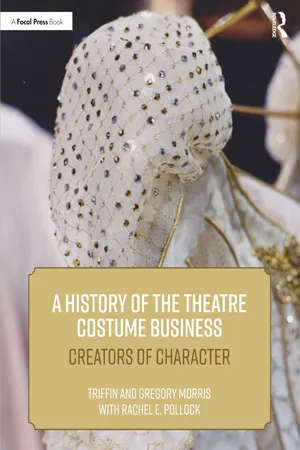
A History of the Theatre Costume Business is the first-ever comprehensive book on the subject, as related by award-winning actors and designers, and first hand by the drapers, tailors, and craftspeople who make the clothes that dazzle on stage.
Readers will learn why stage clothes are made today, by whom, and how. They will also learn how today's shops and ateliers arose from the shops and makers who founded the business. This never-before-told story shows that there is as much drama behind the scenes as there is in the performance: famous actors relate their intimate experiences in the fitting room, the glories of gorgeous costumes, and the mortification when things go wrong, while the costume makers explain how famous shows were created with toil, tears, and sweat, and sometimes even a little blood. This is history told by the people who were present at the creation – some of whom are no longer around to tell their own story.
Based on original research and first-hand reporting, A History of the Theatre Costume Business is written for theatre professionals: actors, directors, producers, costume makers, and designers. It is also an excellent resource for all theatregoers who have marveled at the gorgeous dresses and fanciful costumes that create the magic on stage, as well as for the next generation of drapers and designers.
Trusted by 375,005 students
Access to over 1.5 million titles for a fair monthly price.
“I flew through the air with that [lion] coat billowing out like Batman! They came over to me and said, ‘Yeah, that was great. And never ever do that again.’”
James Iglehart
James Monroe Inglehart with his Tony Award in New York 2014 (Debby Wong/Shutterstock.com)
James Monroe Iglehart had played the lion in The Wizard of Oz at American Musical Theatre in San Jose, and then got to complete the exacta by reprising the role in The Wiz off Broadway (2009, City Center). The director was Thomas Kail and the choreographer was Andy Blankenbuehler. “I had always wanted to play the lion,” he said. “Most kids would play basketball at recess, but I would con my friends into playing Wizard of Oz, or The Wiz, I could do Bert Lahr or Ted Ross.”
The lion costume Paul Tazewell designed had overalls with Timberlands. “I always seem to be wearing Timberlands on stage,” Iglehart noted. “And there was a cool leather jacket with fur in the rips. In the first fitting I put the overalls on and they started ripping them! Now I like wearing overalls anyway, and I was surprised at what they were doing, but it was so interesting to watch the conversion. So I just stood there and watched them work around me and on me. It was fascinating. And for such a big costume that looked so bulky, I remember how much fun and how easy it was to move in it.”
It was so easy to move, in fact, that it prompted Iglehart’s cowardly lion to get a little frisky. “On the stage at City Center there were all these ropes to represent vines in the forest,” he explained. “Some of them crossed to make a diamond. So I’m feeling my costume, and there is Alex Lacamoire on the keyboards, and I am supposed to hand-slap him and walk down between the vines.”
“All they saw was vines, but all I saw was free air, and I jumped through that diamond between the vines,” Iglehart said laughing. “I flew through the air with that coat billowing out like Batman! They came over to me and said, ‘Yeah, that was great. And never ever do that again.’ All they saw was the coat or my tail getting caught on the vines. So they were like, ‘never, ever!’” Iglehart said laughing harder.
The marquee of the New Amsterdam Theatre with Iglehart as the Genie (Helen89/Shutterstock.com)
As big and bold as the lion costumes were, the Genie costumes in Aladdin (2014–present, Gregg Barnes, New Amsterdam Theater) were even more so. “My first question was, ‘Will I be blue?’ When the answer was no I was so relieved! Mostly because I have too many friends who played Elphaba [in Wicked] and that green just tears their face off. But also because most African Americans don’t look good in blue makeup.
“I remember going to the shop for the first fitting,” Iglehart continued, “I don’t remember where it was, but the building looked like a place you could get killed. I went inside and immediately saw Courtney [Reed] and thought, wow, they found a real-life Jasmine! And then I saw the drawing of the Genie—not a full sketch, just the drawing, and I almost cried. It was so beautiful. Gregg’s sketches are artwork all by themselves, and everything he drew came to life in the costume.”
Jane Greenwood in her home office, 2010. Greenwood was nominated for 21 Tony Awards, winning in 2017 for Lillian Hellman’s The Little Foxes. That was after earning the Lifetime Achievement Tony in 2014. She also won two Lucille Lortel Awards for off Broadway, in 1996 for Sylvia and in 2001 for Old Money. Greenwood was inducted into the American Theater Hall of Fame in 2003. She earned the Ming Cho Lee Lifetime Achievement Award for regional theater in 2019 (Photo by author)
From Antiquity to Equity
“No actor goes on stage wearing a sketch,” said costume designer Jane Greenwood. That has been true for more than a century, and what may be the world’s only global cottage industry has grown over the decades to meet that need. It is very obviously high art and also very much a business.
Theater is as old as civilization. For most of history, actors would perform in clothes they owned or could gather for the production. There were plenty of exceptions, of course, such as the highly stylized masks and robes of kabuki.
Napoleon’s conquest of Egypt in 1801 is known to have ushered in an era of “Orientalism” in Paris and the rest of Europe. It began to matter to patrons and audiences whether Greek tragedies and Roman epics were performed in costumes that at least had the appearance of authenticity.
As many actors have said, costumes are instrumental in helping them create and inhabit the role. Costumes are also essential in helping the audience to remember which character is which to follow the action, especially in small companies where each actor may play multiple roles.
The benefits of performing also brought a burden. In most cases actors had to provide their own costumes. The Actors’ Equity Association was formed in 1913, but it was not until 1919 that actors’ contracts specified that costumes would be provided by the producers.
Notably, the oldest commercial costume shop in New York, Dazian’s, closed that same year. That cannot be considered a direct cause and effect, but as soon as producers took on the cost and authority over stage clothes, they sought ways to industrialize and economize.
Dazian’s was established in 1842 by Wolf Dazian, who was born in Bavaria. He opened a fabric and dry goods store on Lafayette Street in New York. That venture was incorporated as Dazian’s Theatrical Emporium in 1902 and did business at 142–144 West 44th Street. It closed in 1919, with the costumes and ephemera sent to the Museum of the City of New York. Remarkably, the fabric-selling of the business remains to this day.
In the early 1900s, several talented costume makers came from Europe and opened artisanal shops serving Broadway and the fashion industry, as detailed in Chapter 2. There were ateliers dedicated to ballet and opera, as discussed in Chapter 4. The major economic force in the business at the time were three large integrated operations that were primarily costume rental houses: Eaves, Brooks, and Van Horn.
These businesses dominated for several decades from the Depression through the 1960s, as detailed in Chapter 3, until the arrival of English costume pioneer Ray Diffen. Diffen opened a shop in New York in 1956 after working for several years at the Shakespeare Festival in Stratford, Ontario. He precipitated a wave of British immigration to the U.S. including designers and drapers. Ray Diffen Stage Clothes closed in 1979, but several of the major shops serving Broadway today trace their lineage to Diffen.
The Costume Just Clicked
The pilot project for Aladdin opened in Seattle, and the costumes were more simple than they would end up being on Broadway. “I had blue pants, gold boots, and a vest with stuff on it,” said Iglehart. “I told the costume people that I tend to sweat a lot, and so I wear Under Armor shirts under my costume, instead of a cotton tee shirt.
“Gregg came up with the idea of attaching the mesh sleeves to the Under Armor with snaps and then have the vest zip over all that. That way I was free to do stuff. It was very cool. When the show was transferred to Broadway, I got the full costume with all the crystals and decorations. The shoes were also much more flexible. It was all just so well thought-out.”
There were actually two costumes, one blue and one white for the Prince Ali scene. “The white one was made to look pretty,” Iglehart stated. “The blue costume was made to move. The sleeves were mesh and the pants were very light.
“In Seattle I had only one costume,” Iglehart noted. “When the show shifted to Toronto, we did not have the Prince Ali white costume, so they made for me this zoot suit that was a Cab Calloway homage. It was Velcro and designed to rip away, but at first it didn’t. Some [parts of the costume] would get pulled one way, and some would get pulled the other way, and some would stay on me. It was like being pulled apart in a shark movie.”
Gregg Barnes (2013) won the Tony Award for best costume design in 2006 for Drowsy Chaperone, and again in 2011 for Follies. Originally from San Diego, he earned his undergraduate degree from San Diego University and a Master of Fine Arts in design from New York University, where he subsequently taught for 20 years. He is the resident costume designer for the Paper Mill Playhouse in Millburn, NJ (Everett Collection Inc/Alamy Stock Photo)
“Gregg had the idea to try magnets, and it worked the first time,” Iglehart explained. “They were powerful magnets, and none of us thought about the lockers in the hallway. I was in the hall leaning against the wall, and suddenly I hear: click, click, click-click-click.”
In relating the story Iglehart was able to laugh, but in the moment it was an alarming situation. “There were so many magnets,” he said, “and they had to pull me off the lockers without pulling the costume off me.”
For exactly that reason, magnets are a bane for drapers. They seem like the obvious solution for a quick change, but they relentlessly stick to anything steel—not just lockers backstage, but sets and props on stage, or mic packs. Even when they stick to each other it is not necessarily in the order intended.
In this case, they did mostly work well on stage through both runs. “In Canada and on Broadway the magnets worked about 98% of the time,” said Iglehart. “The few times the quick change did not quite work was because a swing did not know to pull hard enough and part of the costume would stay on me. So I would have to think of some cool Genie way of getting it off.”
There was another quirk between the blue and white Genie costumes, which were made at two different shops. “In the blue costume, all the zips and clips were on the right side,” said Iglehart. “Even the giant necklace clasp was on the right. The white costume was identical, except all the closures were on the left. I thought, who would do that? The whole time in Toronto and on Broadway it never changed. And all the other actors who have played Genie say the same.”
John Baird in the Aladdin Genie costume, made at Carelli’s by Hugh Hanson, at ship out. Usually these photos are taken on a dress form but sometimes they need a model (Photo by Hugh Hanson)
True Colors
If anything, the quirks became endearing because Iglehart stated without reserve, “to this day the Genie costume is my favorite ever in life. The most comfortable, the most fun, the most flashy. And Gregg is one of the nicest, sweetest people in the world. When he comes into the room he likes to sit down and chat with the costume people just like he was one of the girls.”
Iglehart’s tone turned serious. “I was really pissed off—I probably should say upset, or angry, but pissed off is the way I felt—that Gregg was not even nominated for best costumes for Aladdin. Sure I won a Tony, but I was so upset for Gregg. That show was amazing.”
Ever gracious, Barnes had a Hawaiian-style shirt hand-painted by Jeff Fender Studios for Iglehart reprising the Genie costume.
Iglehart also lauds Barnes for his attention to detail and color palette, not just for the show, but for the actors. “Gregg really put the show together to make a perfect picture. Usually an actor will look at sketches and think, ‘Oh, I hope I look good.’ In Aladdin I saw the whole picture, how Gregg worked with the lighting designer Natasha Katz and with the colors of the actors.
“We had darker guys in colors that complimented,” Iglehart added, “and lighter girls in colors that popped. No one looked out of place. That is not always the case with people of color. The costume for the opening number in Aladdin was the biggest thing I have ever worn.
“At that moment I’m just the narrator telling the story, everyone knows I’m also going to be Genie, but to make my look different, I had a huge cape. It was the biggest thing I have ever worn, and we had to figu...
Table of contents
Cover
Half Title
Title Page
Copyright Page
Dedication
Contents
Acknowledgments
An Invitation
Notes on Terminology
Introduction: How Costumes Have Saved Choreography and Created Characters
Chapter 1 Orientation: How Costumes Became a Business, and How it Works
Chapter 2 A Stitch in Time: The Early Designer-Drapers
Chapter 3 Thread and Circuses: The Rise and Fall of the Big Rental Shops
Chapter 4 The Coming of the Continentals: Lighter Hands for Ballet and Opera
Chapter 5 Broadway as a Business: The Syndicate, the Shuberts, and the Unions
Chapter 6 The British Invasion: The Legacy of Ray Diffen
Chapter 7 A Leading Lady Herself: Barbara Matera
Chapter 8 Nights (and Weekends) on Broadway: The Current Commercial Shops
Chapter 9 Thoroughly Modern Milliners and Makers: The Modern Atelier System
Chapter 10 Angel Wings and Dancing Candlesticks: Craft and Specialty Shops
Chapter 11 Tinkers and Tailors: Old Machines Soldier On and Can be Spied in New Shops
Chapter 12 West of 12th Avenue: Commercial Shops Across North America
Appendix A: Timeline of Broadway Shops with Landmark Shows
Appendix B: Award-Winning Broadway Shows and Shops
Bibliography
Index
Frequently asked questions
Yes, you can cancel anytime from the Subscription tab in your account settings on the Perlego website. Your subscription will stay active until the end of your current billing period. Learn how to cancel your subscription
No, books cannot be downloaded as external files, such as PDFs, for use outside of Perlego. However, you can download books within the Perlego app for offline reading on mobile or tablet. Learn how to download books offline
We are an online textbook subscription service, where you can get access to an entire online library for less than the price of a single book per month. With over 1.5 million books across 990+ topics, we’ve got you covered! Learn about our mission
Look out for the read-aloud symbol on your next book to see if you can listen to it. The read-aloud tool reads text aloud for you, highlighting the text as it is being read. You can pause it, speed it up and slow it down. Learn more about Read Aloud
Yes! You can use the Perlego app on both iOS and Android devices to read anytime, anywhere — even offline. Perfect for commutes or when you’re on the go. Please note we cannot support devices running on iOS 13 and Android 7 or earlier. Learn more about using the app
Yes, you can access A History of the Theatre Costume Business by Triffin I. Morris,Gregory DL Morris,Rachel E. Pollock in PDF and/or ePUB format, as well as other popular books in Media & Performing Arts & Performing Arts & Business. We have over 1.5 million books available in our catalogue for you to explore.