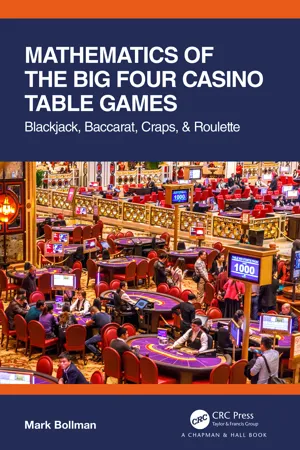
Mathematics of The Big Four Casino Table Games
eBook - ePub

Mathematics of The Big Four Casino Table Games

Blackjack, Baccarat, Craps, & Roulette

  1. 360 pages
  2. English
  3. ePUB (mobile friendly)
  4. Available on iOS & Android
eBook - ePub

Mathematics of The Big Four Casino Table Games

Blackjack, Baccarat, Craps, & Roulette

About this book

Mathematics is the basis of casino games, which are the bedrock of a $100 billion/year industry. Mathematics of the Big Four Casino Table Games: Blackjack, Baccarat, Craps, & Roulette takes an in-depth look at the four biggest table games in casinos: blackjack, baccarat, craps, and roulette. It guides readers through the mathematical principles that underpin these games and their different variations, providing insights that will be of huge interest to gamblers, casino managers, researchers, and students of mathematics.

Features


  • A valuable teaching resource, replete with exercises, for any course on gambling mathematics


  • Suitable for a wide audience of professionals, researchers, and students


  • Many practical applications for the gambling industry

Mark Bollman is Professor of Mathematics and chair of the Department of Mathematics & Computer Science at Albion College in Albion, Michigan, and has taught 116 different courses in his career. Among these courses is "Mathematics of the Gaming Industry, " where mathematics majors carefully study the math behind games of chance and travel to Las Vegas, Nevada, in order to compare theory and practice. He has also taken those ideas into Albion's Honors Program in "Great Issues in Humanities: Perspectives on Gambling, " which considers gambling from literary, philosophical, and historical points of view as well as mathematically. Mark has also authored Basic Gambling Mathematics: The Numbers Behind the Neon, Mathematics of Keno and Lotteries, and Mathematics of Casino Carnival Games.

Frequently asked questions

Yes, you can cancel anytime from the Subscription tab in your account settings on the Perlego website. Your subscription will stay active until the end of your current billing period. Learn how to cancel your subscription.
At the moment all of our mobile-responsive ePub books are available to download via the app. Most of our PDFs are also available to download and we're working on making the final remaining ones downloadable now. Learn more here.
Perlego offers two plans: Essential and Complete
  • Essential is ideal for learners and professionals who enjoy exploring a wide range of subjects. Access the Essential Library with 800,000+ trusted titles and best-sellers across business, personal growth, and the humanities. Includes unlimited reading time and Standard Read Aloud voice.
  • Complete: Perfect for advanced learners and researchers needing full, unrestricted access. Unlock 1.4M+ books across hundreds of subjects, including academic and specialized titles. The Complete Plan also includes advanced features like Premium Read Aloud and Research Assistant.
Both plans are available with monthly, semester, or annual billing cycles.
We are an online textbook subscription service, where you can get access to an entire online library for less than the price of a single book per month. With over 1 million books across 1000+ topics, we’ve got you covered! Learn more here.
Look out for the read-aloud symbol on your next book to see if you can listen to it. The read-aloud tool reads text aloud for you, highlighting the text as it is being read. You can pause it, speed it up and slow it down. Learn more here.
Yes! You can use the Perlego app on both iOS or Android devices to read anytime, anywhere — even offline. Perfect for commutes or when you’re on the go.
Please note we cannot support devices running on iOS 13 and Android 7 or earlier. Learn more about using the app.
Yes, you can access Mathematics of The Big Four Casino Table Games by Mark Bollman in PDF and/or ePUB format, as well as other popular books in Mathematics & Game Theory. We have over one million books available in our catalogue for you to explore.

Information

Publisher
CRC Press
Year
2021
Print ISBN
9780367740900
eBook ISBN
9781000423891
Edition
1
Subtopic
Game Theory

Chapter 1

Essential Probability

DOI: 10.1201/9781003156680-1
The mathematics behind roulette, craps, baccarat, and blackjack is drawn from probability theory at various levels of complexity. This is appropriate, because the origins of this branch of mathematics lie with the analysis of simple games of chance. This began with a series of letters between Blaise Pascal and Pierre de Fermat in 1654 that raised and answered several questions at the foundation of probability theory while addressing questions that arose in resolving gambling games [35]. Later mathematicians have developed and expanded this topic into a rigorous field of mathematics with many important applications unrelated to gambling. In this chapter, we shall outline the fundamental ideas of probability that are essential for analyzing casino games.

1.1 Elementary Ideas

We begin our study of probability with the careful definition of some important terms.
Definition 1.1. An experiment is a process whose outcome is determined by chance.
This may not seem like a useful definition. We illustrate the concept with several examples.
Example 1.1. Roll a standard six-sided die and record the number that results.
Example 1.2. Roll two standard six-sided dice (abbreviated as 2d6) and record the sum.
Example 1.3. Roll 2d6 and record the larger of the two numbers rolled (or the number rolled, if both dice show the same number).
Example 1.4. Deal a five-card video poker hand and record the number of aces it contains.
One trait of an experiment is that it results in a single definite outcome. While we will eventually concern ourselves with individual outcomes, we begin by looking at all of the possible results of an experiment.
Definition 1.2. The sample spaceS of an experiment is the set of all possible outcomes of the experiment.
Example 1.5. In Example 1.1, the sample space is S={1,2,3,4,5,6}. The same sample space applies to the experiment described in Example 1.3.
Example 1.6. In Example 1.2, the sample space is S={2,3,4,,12}.
It is important to note that the 11 elements of S are not equally likely, as this will play an important part in our explorations of probability. Rolling a 7 is more likely than rolling any other sum on two dice; 2 and 12 are the least likely sums.
When we're only interested in some of the possible outcomes of an experiment, we are looking at subsets of S. These are called events.
Definition 1.3. An eventA is any subset of the sample space S. An event is called simple if it contains only one element.
Example 1.7. In Example 1.2, we rolled 2d6 and considered the sum as the outcome. The event “the roll is an even number” is the subset {2,4,6,8,10,12}.
The event “The roll is a 7” is a simple event. Although there are 6 different ways to roll a sum of 7 on 2d6, we are ...

Table of contents

  1. Cover
  2. Half Title
  3. Series
  4. Title Page
  5. Copyright Page
  6. Dedication
  7. Contents
  8. Preface
  9. Acknowledgments
  10. 1 Essential Probability
  11. 2 Roulette
  12. 3 Craps
  13. 4 Baccarat
  14. 5 Blackjack
  15. Answers to Selected Exercises
  16. References
  17. Index