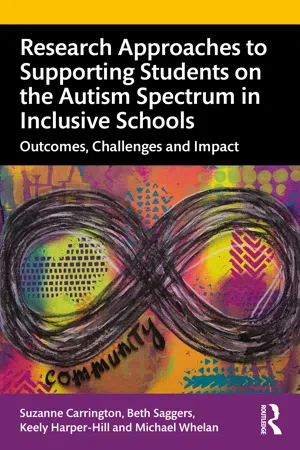
Research Approaches to Supporting Students on the Autism Spectrum in Inclusive Schools
eBook - ePub

Research Approaches to Supporting Students on the Autism Spectrum in Inclusive Schools

Outcomes, Challenges and Impact

  1. 134 pages
  2. English
  3. ePUB (mobile friendly)
  4. Available on iOS & Android
eBook - ePub

Research Approaches to Supporting Students on the Autism Spectrum in Inclusive Schools

Outcomes, Challenges and Impact

About this book

This book will support researchers in the field of education disability by outlining inclusive research approaches and their challenges, outcomes, and impact. Each chapter reports on school/university-based research supporting inclusion for young people on the autism spectrum. This research has been developed in Australian schools with students, families, teachers, and specialists. The intent of this approach is to mobilise new knowledge to the benefit of all students, including students on the autism spectrum, their families, teachers, and school communities. This book showcases how research can be more inclusive with a move to collaborative, participatory, and co-produced research that will impact on young people, families, and educators. The authors highlight the complex challenges and the positive outcomes of conducting research in inclusive ways and provide detailed practical strategies for researchers.

Inclusive education is socially, emotionally, and academically beneficial for all students and positively impacts on respectful attitudes to difference. This book provides a groundbreaking approach to research that by design is inclusive and therefore provides an invaluable opportunity for building the foundations of an inclusive society for all. This book will be invaluable to researchers, educators, and professional learning in schools.

Frequently asked questions

Yes, you can cancel anytime from the Subscription tab in your account settings on the Perlego website. Your subscription will stay active until the end of your current billing period. Learn how to cancel your subscription.
At the moment all of our mobile-responsive ePub books are available to download via the app. Most of our PDFs are also available to download and we're working on making the final remaining ones downloadable now. Learn more here.
Perlego offers two plans: Essential and Complete
  • Essential is ideal for learners and professionals who enjoy exploring a wide range of subjects. Access the Essential Library with 800,000+ trusted titles and best-sellers across business, personal growth, and the humanities. Includes unlimited reading time and Standard Read Aloud voice.
  • Complete: Perfect for advanced learners and researchers needing full, unrestricted access. Unlock 1.4M+ books across hundreds of subjects, including academic and specialized titles. The Complete Plan also includes advanced features like Premium Read Aloud and Research Assistant.
Both plans are available with monthly, semester, or annual billing cycles.
We are an online textbook subscription service, where you can get access to an entire online library for less than the price of a single book per month. With over 1 million books across 1000+ topics, we’ve got you covered! Learn more here.
Look out for the read-aloud symbol on your next book to see if you can listen to it. The read-aloud tool reads text aloud for you, highlighting the text as it is being read. You can pause it, speed it up and slow it down. Learn more here.
Yes! You can use the Perlego app on both iOS or Android devices to read anytime, anywhere — even offline. Perfect for commutes or when you’re on the go.
Please note we cannot support devices running on iOS 13 and Android 7 or earlier. Learn more about using the app.
Yes, you can access Research Approaches to Supporting Students on the Autism Spectrum in Inclusive Schools by Suzanne Carrington,Beth Saggers,Keely Harper-Hill,Michael Whelan in PDF and/or ePUB format, as well as other popular books in Education & Education General. We have over one million books available in our catalogue for you to explore.

Information

Publisher
Routledge
Year
2021
Print ISBN
9780367501877

Part 1
Introduction


image
My Helping Hands (by Sarah Harding, aged nine years)


‘This shows how I think a lot about my friends and how I can help them and others.’

1
An introduction to research in inclusive education

Empirical evidence for supporting an inclusive approach for students on the autism spectrum

Suzanne Carrington and Beth Saggers
This chapter sets the agenda for this book by introducing the research supporting inclusive education. Inclusive education leads to positive academic and social emotional outcomes for all students, with and without disabilities. An inclusive approach was a focus of the research in the Cooperative Research Centre for Living with Autism (Autism CRC) and our researchers worked with educators, families, and students in classrooms and schools to establish evidence to inform inclusive practice. The research reported in this chapter is an important starting point for this book and will influence how education systems, schools, and teachers commit to inclusive education in the future. This chapter defines inclusive education and describes the difference between inclusive education and special education. We suggest that it is important to understand the difference before we consider how we can support advocacy and promote change in policy and practice. The chapter presents research to support short-term and long-term benefits of an inclusive approach. Further to this discussion, the chapter will specifically present an overview of the evidence drawn from international research that focuses on inclusive education for students on the autism spectrum. This chapter provides evidence to support future policy and planning for improved inclusive education programs and builds a shared understanding that inclusive education is a global movement to support equitable and quality education. The research reported in this book highlights how the social and cultural context of education communities is important and that educators, families, and students need to work together in respectful ways to support inclusion and a sense of belonging for all.
Inclusive education is now viewed as a human right where all students, whether they have a disability or not, have the right to access, be successful, and participate at their local school (United Nations, 2006). The UN Convention on the Rights of Persons with Disabilities (CRPD) was published in 2006 and ratified by more than 180 countries, making inclusive education a legally binding obligation for countries such as Australia under Article 24. This is reinforced through the companion document, General Comment 4, released in 2016, which now provides a clear definition of inclusion:
Inclusion involves a process of systemic reform embodying changes and modifications in content, teaching methods, approaches, structures and strategies in education to overcome barriers with a vision serving to provide all students of the relevant age range with an equitable and participatory learning experience and environment that best corresponds to their requirements and preferences.
(United Nations, 2016, p. 4)
Inclusive education is also a goal in the 2030 Agenda for Sustainable Development and the Sustainable Development Goals (SDGs).1 The signing of international declarations such as the CRPD by countries around the world means that inclusive education at local mainstream schools is the expected approach for students with disabilities and that special education should be phased out over time (UNESCO, 2017; United Nations, 2006). The research reported in this book aims to support educators to include autistic students in their local schools, transition to life after school, and to participate meaningfully in their community. The authors share their research approaches and outcomes of working in respectful and inclusive ways to support the development of culture, policy, and practice for inclusion.
…all students, whether they have a disability or not, have the right to access, be successful, and participate at their local school

What is the difference between inclusive education and special education?

It is important to understand the difference between inclusive education and special education before we consider how we can support advocacy and promote change in policy and practice. Special education is often considered as an approach to inclusive education in countries such as Australia where there is an array of special educatio...

Table of contents

  1. Cover
  2. Half Title
  3. Cover Art
  4. Title Page
  5. Copyright Page
  6. Dedication
  7. Table of Contents
  8. Figures and tables
  9. Foreword
  10. Acknowledgements
  11. Contributors
  12. Part 1: Introduction
  13. Part 2: Outcomes of an inclusive research approach
  14. Part 3: Knowledge translation and research impact
  15. Part 4: Conclusion
  16. Index