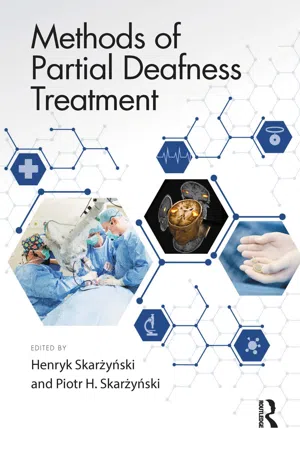
Methods of Partial Deafness Treatment
- 420 pages
- English
- ePUB (mobile friendly)
- Available on iOS & Android
Methods of Partial Deafness Treatment
About this book
This book presents the revolutionary approach to the treatment of hearing loss proposed by Professor Henryk Skar?y?ski and developed in collaboration with the group of internationally recognized experts on clinical and experimental otolaryngology, otosurgery, and audiology. The authors present an in-depth look at different aspects of this comprehensive concept of treatment of partial and total deafness with hearing implants, and discuss the approaches to diagnostics and patient selection, results in different groups of patients, the surgical technique, and procedures. This book also covers audiological aspects, auditory training, patient's performance, and psychology.
This book is a comprehensive review of the method of partial and total deafness treatment developed and introduced into clinical practice by Professor Henryk Skar?y?ski. The publication is noteworthy for presenting a multifaceted approach to the subject from related science experts' and clinicians' point of view.
Tools to learn more effectively

Saving Books

Keyword Search

Annotating Text

Listen to it instead
Information
Chapter 1 The strategy of preservation of preoperative hearing and inner ear structures in hearing implant surgery
CONTENTS
- Introduction
- Otosurgical method used in the strategy of preserving the preoperative hearing and inner ear structures
- Conclusions
INTRODUCTION
| No. | Groups of patients with partial deafness |
|---|---|
| 1. | Acoustic amplification of hearing with a hearing aid, bone conduction device, or middle ear implant [PDT – acoustic stimulation (PDT-AS)]. |
| 2. | Combined natural-electric stimulation: amplification of the preserved efficient hearing up to 1.5 kHz through electric stimulation [PDT – electro-natural stimulation (PDT-ENS)]. |
| 3. | Electric complementation of existing good hearing in low frequencies up to 0.5 kHz [PDT – electric complementation (PDT-EC)]. |
| 4. | Combined acoustic-electric stimulation with acoustic amplification of the preserved residual hearing in low and mid-frequencies with a hearing aid or a duet/hybrid system, and electric stimulation of the remaining part of the same ear [PDT – electric-acoustic stimulation (PDT-EAS)]. |
| 5. | Only electric stimulation in the case of an existing but nonfunctional residual hearing on different frequencies with preservation of inner ear structures [PDT – electric stimulation (PDT-ES)]. |

Table of contents
- Cover
- Half Title
- Title Page
- Copyright Page
- Table of Contents
- Preface
- Editors
- Contributors
- 1 The strategy of preservation of preoperative hearing and inner ear structures in hearing implant surgery
- 2 Audiological aspects of the partial deafness cochlear implantation with hearing preservation
- 3 Intraoperative monitoring of hearing preservation with ECochG in treatment of partial deafness
- 4 Genetic biomarkers of neuroplasticity in the treatment of children with prelingual deafness with cochlear implantation
- 5 Otosurgical techniques in the application of various auditory implants
- 6 Hearing preservation classification according to Skarżyński et al. (2013)
- 7 Review of clinical material presented during demonstration surgeries
- 8 Role of the pharmacology (glucocorticoids) in hearing preservation in the partial deafness treatment (PDT)
- 9 Otoneurological aspects of cochlear implantation in partial and total deafness
- 10 The utility of the functional magnetic resonance imaging for assessment of brain functions in patients with partial deafness
- 11 Audiological rehabilitation in the partial deafness treatment program strategy – eliminating participation limitations
- 12 Auditory development and speech perception in children after partial deafness cochlear implantation
- 13 Understanding the partial deafness – different perspectives: subjective, auditory perception and communication, psychological, and social
- 14 Evaluation of partial deafness patients by means of auditory evoked potentials, otoacoustic emissions, and wideband tympanometry
- 15 Auditory cortex, partial hearing loss, and cochlear implants: selected observations and comments
- Bibliography
- Index
Frequently asked questions
- Essential is ideal for learners and professionals who enjoy exploring a wide range of subjects. Access the Essential Library with 800,000+ trusted titles and best-sellers across business, personal growth, and the humanities. Includes unlimited reading time and Standard Read Aloud voice.
- Complete: Perfect for advanced learners and researchers needing full, unrestricted access. Unlock 1.4M+ books across hundreds of subjects, including academic and specialized titles. The Complete Plan also includes advanced features like Premium Read Aloud and Research Assistant.
Please note we cannot support devices running on iOS 13 and Android 7 or earlier. Learn more about using the app