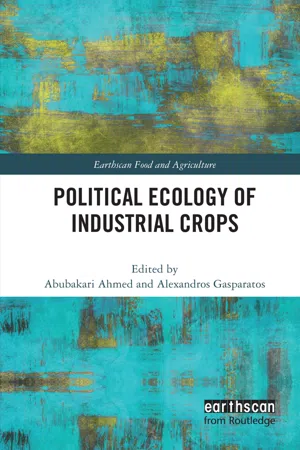
This book employs a political ecology lens to unravel how industrial crops catalyse ecological, agrarian, socioeconomic, and institutional transformation.
Using the conceptual tools and perspectives of political ecology, namely multi-scalar analysis and attention to marginalisation, social difference, and discourses and narratives, this volume provides a critical and comprehensive assessment of the transformative power of industrial cropping systems. It presents a truly international overview by drawing on a range of case studies from the global South, including soybeans in South America, cashew nuts in Guinea Bissau, cotton in India, maize in China, jatropha in Ghana, sugarcane in Peru and Eswatini, and oil palm in Ghana and Peru. The unique case studies are put into perspective with chapters introducing the key concepts of political ecology and critical dimensions of industrial cropping systems related to large-scale land acquisitions, land grabbing, and marginal land. The individual chapters employ different approaches all rooted in political ecology, thus offering a rich overview of how the field engages with such cropping systems. Overall, this volume contains valuable propositions for improving current policies and practices in industrial crop settings in both developed and developing countries.
Through its comprehensive and interdisciplinary outlook, this volume will be of great interest to students and scholars of political ecology, agrarian studies, development studies, and ecological economics.
Trusted by 375,005 students
Access to over 1.5 million titles for a fair monthly price.
Abubakari Ahmed, Marcin Pawel Jarzebski and Alexandros Gasparatos
Industrial crops: Definition, uses, and modes of production
Industrial crops are crops whose products have important non-food uses such as fibre, bioenergy, and biomaterials (Singh, 2010) (Table 1.1). Some industrial crops such as cotton, tobacco, or jatropha have products with strictly non-food uses, as they cannot be used for direct food consumption or as an input to the food industry. Other industrial crops such as oil palm, sugarcane, and soybean have both products with non-food uses and products that are integral components of the food industry, without being staple food crops (Singh, 2010) (Table 1.1). Finally, a few staple food crops such as maize, wheat, and potatoes have products with important industrial uses (Table 1.1) (Chapter 10).
Some industrial crops are practically mono-functional, as their products are used solely or overwhelmingly for a single end-use such as fibre (e.g. cotton), recreation (e.g. tobacco), energy (e.g. jatropha), or biomaterials (e.g. rubber). Other industrial crops, such as sugarcane, are multi-functional, as their products have multiple uses in the food (i.e. sugar), energy (i.e. ethanol, electricity), and chemical (i.e. bioplastics) industries (Singh, 2010).
In this respect, industrial crops are defined by their functionality and end use (Table 1.1) rather than the mode of their production. In fact, as discussed below, industrial crops are produced in very diverse systems across the world ranging from large-scale intensified plantations to extensive smallholder farms (Singh, 2010).
For this edited volume, we adopt a rather broad definition of industrial crops that encompasses crops whose products have clear industrial uses such as bioenergy and biomaterials and non-food crops whose products are important inputs in the food industry (e.g. cocoa, coffee). It is worth noting that some crops can be considered as industrial in some geographical contexts, and non-industrial in others. For example, maize is clearly an industrial crop in the US, as it is a major feedstock for bioenergy and biomaterials. However, in other geographical contexts, maize has a few industrial uses (e.g. China) (Chapter 10) or practically no such uses (e.g. in sub-Sahara Africa) (Jarzebski et al., 2020).
Table 1.1 Major industrial crops, uses, and production patterns in 2019
Crop
Uses
Production (Mt)
Main producing countries
Food industry
Bioenergy
Fibre
Biomaterial/biochemicals
Recreation
Cashew nuts
✓
4
Ivory Coast, India, Burundi, Vietnam, Philippines
Cocoa
✓
5.6
Ivory Coast, Ghana, Indonesia, Nigeria, Ecuador
Coffee
✓
10
Brazil, Vietnam, Colombia, Indonesia, Ethiopia
Cotton
✓
✓
82.6
China, India, USA, Brazil, Pakistan
Jatropha
✓
NA
China, Indonesia, Ghana, Tanzania, Mozambique
Jute
✓
✓
3.4
India, Bangladesh, China, Uzbekistan, Nepal
Linseed
✓
✓
3.1
Kazakhstan, Russia, Canada, China, USA
Maize
✓
✓
✓
1148.5
USA, China, Brazil, Argentina, Ukraine
Miscanthus
✓
✓
NA
USA
Mustard seed
✓
✓
0.7
Nepal, Russia, Canada, Myanmar, Ukraine
Oil palm
✓
✓
410.7
Indonesia, Malaysia, Thailand, Nigeria, Colombia
Potatoes
✓
✓
✓
370.4
China, India, Russia, Ukraine, USA
Rapeseed
✓
✓
✓
70.5
Canada, China, India, France, Ukraine
Rubber
✓
14.6
Thailand, Indonesia, Vietnam, India, China
Sisal
✓
✓
0.2
Brazil, Tanzania, Kenya, Madagascar, Haiti
Soybean
✓
✓
333.7
Brazil, USA, Argentina, China, India
Sugar beet
✓
✓
278.5
Russia, France, Germany, USA, Turkey
Sugarcane
✓
✓
✓
1949.3
Brazil, India, Thailand, China, Pakistan
Sunflower seed
✓
✓
56.1
Russia, Ukraine, Argentina, Romania, China
Switchgrass
✓
✓
NA
USA
Tea
✓
6.5
China, India, Kenya, Sri Lanka, Vietnam
Tobacco
✓
✓
6.7
China, India Brazil, Zimbabwe, USA
Wheat
✓
✓
765.8
China, India, Russia, USA, France
Note: There are no reliable global statistics about the production and major producing countries for jatropha, miscanthus, and switchgrass. The major producing countries for these three crops were identified through a literature review.
Source: (FAOSTAT, 2021).
There is a large variability in industrial crop production systems depending on the crop, intended market, production location, and various other contextual environmental, socioeconomic, and institutional factors (Figure 1.1). Mindful of the large diversity of industrial crop systems globally, the most common production modes include: (a) large-scale systems (e.g. plantations); (b) smallholder-based schemes; and (c) hybrid systems (Figure 1.2). Such systems are integrated in very diverse landscapes containing different configurations of agricultural land and natural vegetation (Gasparatos et al., 2018).
Figure 1.1Main modes of industrial crop production.
Adapted from (Gasparatos et al., 2015).
Figure 1.2Direct land use change from the main modes of industrial crop production.
Adapted from (Gasparatos et al., 2018)
Large-scale production systems can be sub-divided into large-scale farming and plantation farming depending on ownership and labour practices (Gibbon, 2011). A common characteristic of all these systems is their much larger size compared to family farms (see below), which can extend from a few tens of hectares to several thousands of hectares depending on the crop and the region (Saravia Matus et al., 2013; Smalley, 2013) (Chapter 3). Thus, large-scale production systems tend to convert rather extensive areas, adopt monocultural practices, entail land consolidation processes, and rely on hired labour (Gibbon, 2011; Smalley, 2013). The owners and investors of large-scale production systems are equally diverse, usually including national or multi-national private companies, state agencies, parastatal bodies, or joint partnerships (Chapters 3, 5, 8, 9, and 11).
Smallholder-based production is mainly undertaken at the level of individual family farms and can take many forms depending on, among others, land allocation, land consolidation, agricultural practices, and integration in industrial crop value chains (Jelsma et al., 2017; Jezeer et al., 2018; Kuivanen et al., 2016; von Maltitz et al., 2019). For example, some smallholders tend to allocate part of their land for industrial crop production, setting aside the remainder for food crop production, while others specialise entirely in industrial crop production, essentially converting all their land into small industrial crop plantations. Some crops such as sugarcane or oil palm require the almost-complete farm conversion, especially if produced under irrigated conditions or outgrower arrangements (von Maltitz et al., 2019; Jelsma et al., 2017). In terms of market integration, industrial crop smallholders can enter in dedicated contractual arrangements with plantations (i.e. sell all their output) receiving in return agricultural inputs and extension services (e.g. outgrower schemes), while others can remain independent selling to different buyers depending on market signals (Ahmed et al., 2019c; von Maltitz et al., 2019) (Chapters 8 and 11).
Hybrid production systems combine large-scale production areas (e.g. core plantations) and smallholder-based schemes (Brüntrup et al., 2018) (Chapter 8). As mentioned above, these smallholders can be contractually linked to single buyers through outgrower schemes, or sell to multiple buyers depending on market signals. Hybrid systems are more common for crops such as sugarcane and oil palm that are perishable and whose production benefits from achieving economies of scale (Ahmed et al., 2019c; von Maltitz et al., 2019) (Chapters 8 and 11).
History and drivers of industrial crop production
In many parts of the world, industrial crop production has traditionally been a major agricultural activity with a long legacy. For example, industrial crops such as cotton, flax, and sugarcane have had multiple centres of domestication across the globe, with their production spanning many thousands of years. Other industrial crops such as coc...
Table of contents
Cover
Half Title
Series Information
Title Page
Copyright Page
Contents
Acknowledgements
List of figures
List of tables
About the authors
Part I Introductory
Part II Ecological transformation
Part III Agrarian transformation
Part IV Socioeconomic and institutional transformation
Part V Synthesis
Index
Frequently asked questions
Yes, you can cancel anytime from the Subscription tab in your account settings on the Perlego website. Your subscription will stay active until the end of your current billing period. Learn how to cancel your subscription
No, books cannot be downloaded as external files, such as PDFs, for use outside of Perlego. However, you can download books within the Perlego app for offline reading on mobile or tablet. Learn how to download books offline
Perlego offers two plans: Essential and Complete
Essential is ideal for learners and professionals who enjoy exploring a wide range of subjects. Access the Essential Library with 800,000+ trusted titles and best-sellers across business, personal growth, and the humanities. Includes unlimited reading time and Standard Read Aloud voice.
Complete: Perfect for advanced learners and researchers needing full, unrestricted access. Unlock 1.5M+ books across hundreds of subjects, including academic and specialized titles. The Complete Plan also includes advanced features like Premium Read Aloud and Research Assistant.
Both plans are available with monthly, semester, or annual billing cycles.
We are an online textbook subscription service, where you can get access to an entire online library for less than the price of a single book per month. With over 1.5 million books across 990+ topics, we’ve got you covered! Learn about our mission
Look out for the read-aloud symbol on your next book to see if you can listen to it. The read-aloud tool reads text aloud for you, highlighting the text as it is being read. You can pause it, speed it up and slow it down. Learn more about Read Aloud
Yes! You can use the Perlego app on both iOS and Android devices to read anytime, anywhere — even offline. Perfect for commutes or when you’re on the go. Please note we cannot support devices running on iOS 13 and Android 7 or earlier. Learn more about using the app
Yes, you can access Political Ecology of Industrial Crops by Abubakari Ahmed, Alexandros Gasparatos, Abubakari Ahmed,Alexandros Gasparatos in PDF and/or ePUB format, as well as other popular books in Biological Sciences & Environmental Science. We have over 1.5 million books available in our catalogue for you to explore.