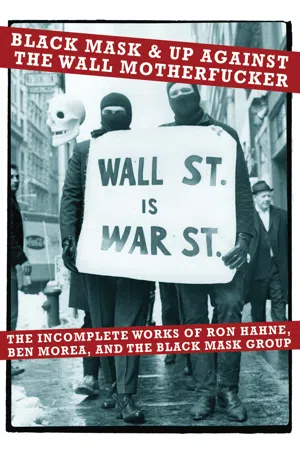
![]()
SECTION ONE
BLACK MASK
ISSUES 1-10
![]()
A new spirit is rising. Like the streets of Watts we burn with revolution. We assault your Gods - - We sing of your death. DESTROY THE MUSEUMS - - our struggle cannot be hung on walls. Let the past fall under the blows of revolt. The guerilla, the blacks, the men of the future, we are all at your heels. Goddamn your culture, your science, your art. What purpose do they serve? Your mass-murder cannot be concealed. The industrialist, the banker, the bourgeoisie, with their unlimited pretense and vulgarity, continue to stockpile art while they slaughter humanity. Your lie has failed. The world is rising against your oppression. There are men at the gates seeking a new world. The machine, the rocket, the conquering of space and time, these are the seeds of the future which, freed from your barbarism, will carry us forward. We are ready - -
LET THE STRUGGLE BEGIN.
![]()
BLACK MASK No. 1 - November 1966
A new spirit is rising. Like the streets of Watts we burn with revolution. We assault your Gods… We sing of your death. DESTROY THE MUSEUMS… our struggle cannot be hung on walls. Let the past fall under the blows of revolt. The guerrilla, the blacks, the men of the future, we are all at your heels. Goddamn your culture, your science, your art. What purpose do they serve? Your mass-murder cannot be concealed. The industrialist, the banker, the bourgeoisie, with their unlimited pretence and vulgarity, continue to stockpile art while they slaughter humanity. Your lie has failed. The world is rising against your oppression. There are men at the gates seeking a new world. The machine, the rocket, the conquering of space and time, these are the seeds of the future which, freed from your barbarism, will carry us forward. We are ready…
LET THE STRUGGLE BEGIN.
The statement on the first page was issued as part of an action taken against the Museum of Modern Art. The accompanying press release was meant as a partial explanation.
On Monday, October 10 at 12.30pm we will close the Museum of Modern Art. This symbolic action is taken at a time when America is on a path of total destruction, and signals the opening of another front in the world-wide struggle against suppression. We seek a total revolution, cultural, as well as social and political - LET THE STRUGGLE BEGIN.
A number of copies were also sent via the mail, in response to which we received the following letter. For further clarification of our ideas and actions we publish both the letter and our response.
The scribbling on your leaflet enclosed was my immediate reaction (“why mess with this - close the War Plants, or the Pentagon or City Hall, or the Precinct Station”) but George thinks it’s too blunt and tactless. I don’t agree really: I expect revolutionaries to be thick-skinned enough to stand rough treatment without confusing their friends with their enemies. But he’s too busy right now to write to you himself.
Thanks for sending the stuff - tho I couldn’t disagree more, I hope you’ll keep us on your mailing list, and we’ll add you to ours.
But why oh why start with the museums??? If you want to assault the gods, attack religion; if you want to end the slaughter, attack the war machine; if you oppose oppression, attack the state. Or is it really only the pretence and vulgarity - not the power - of the bourgeoisie that bugs you? If so, it’s not enough to build a revolution on. The man-power it takes to overthrow a system won’t come from the small minority of us that are concerned with culture; it’ll come from the mass oppressed by power. And most of them don’t give a damn whether the Museum of Modern Art is open or closed, or whether it exists at all; their problems are much more vital, like whether they’re going to die in Vietnam or from a cop’s bullet in the back. Like the waste of their passionate youth in the stultifying routine of classrooms decades behind the world they’re growing into. Like having to sell their humanity in eight-hour slices to pay rent and the groceries - and not even because production any longer needs it, but just because it’s what the wielders of power decree.
Sure: LET THE STRUGGLE BEGIN. But let’s not just nip at their heels, let’s strike where it really hurts!
Love
Louise Crowley
It is possible that the red-ink of your “immediate reaction’ prevented you from reading our statement (if so, another is enclosed) but assuming you did read it, I hope a few comments will help clear up some of your misunderstandings.
Your first question is “why start with the museums.” I assume you mean why do we start with museums, since no where do we say that others should start here, or for that matter that they should abandon their present course to join us, in fact quite to the contrary we state that we are going to join them, by “opening another front.” We fully realize the manpower it takes to overthrow a system won’t come from a small minority but we are not a small minority since we are joining a world-wide struggle, which has many fronts.
As creative men, we say “destroy the museums” yet we are no more interested in closing the Modern Art than you are, it is instead symbolic to us of the total suppression of man. Why does the ghetto dweller attack the slumlord instead of the more powerful bankers behind them or the capitalist system itself? Because a man strikes at that which directly confronts him. We don’t question this action, yet as revolutionaries we hope it is taken with knowledge of the total picture or that it will at least lead to a deeper understanding. Yet you question us, as creative men, for attacking the museums. You must have realized that we saw this as part of a wider struggle since we linked ourselves to the “guerrilla” and the “blacks” and quite literally stated “we seek a total revolution, cultural as well as social and political.”
I assume then that you question the relevance of a cultural revolution as part of wider revolution. The fact that you think only a small minority is concerned with culture is part of a basic misconception, which equates culture with western-bourgeois culture. The Vietnamese are fighting against the destruction of their culture as well as their land. The African revolutionaries have always been concerned with the preservation of their culture in the face of colonialism. And in this country the black man is becoming more aware of his culture, among others, the birth of jazz being no mean achievement. As well as the Mexican, Puerto Rican and Indian seeking to preserve theirs.
Obviously, none of these people are concerned with museums, but neither are we (other than seeing them destroyed). They are involved with a living culture which is what we hope to see rise throughout America, a living culture which comes from the creative spirit of man. With this we can change the stultifying classrooms, the inhuman city, the concept of work when it is unnecessary and everything else which is crushing life instead of allowing it to grow fully. This cannot be achieved without revolution, but neither can it be achieved without the creative force. Sure: Close the warplants or the pentagon or city hall or the precinct station - but don’t stop there, let their culture fall too. FF
Albert Camus: Interview in Demain; Issue 24, — 30 Oct. 1957
The notion of art for art’s sake is obviously alien to your thinking. That of “Commitment” as it has been made fashionable of late is equally so. Taken in its present meaning, commitment consists in making one’s own art subservient to a policy. It seems to me that there is something more important, which is characteristic of your work, that might be called inserting that work into its time. Is this correct? And if it is, how would you describe that insertion?
I can accept your expression: inserting a work into its time. But, after all, this describes all literary art. Every writer tries to give a form to the passions of his time. Yesterday it was love. Today the great passions of unity and liberty disrupt the world. Yesterday love led to individual death. Today collective passions make us run the risk of universal destruction. Today just as yesterday, art wants to save from death a living image of our passions and our suffering.
Perhaps it is harder today. It is possible to fall in love every once in a while. Once is enough, after all. But it is not possible to be a militant in one’s spare time. And so the artist of today becomes unreal if he remains in his ivory tower or sterilized if he spends his time galloping around the political arena. Yet between the two lies the arduous way of true art. It seems to me that the writer must be fully aware of the dramas of his time and that he must take sides every time he can or knows how to do so. He must also maintain, or resume from time to time a certain distance in relation to our history. Every work presupposes a content of reality and a creator who shapes the container. Consequently, the artist, if he must share the misfortune of his time, must also tear himself away in order to consider that misfortune and give it form. This continual shuttling, this tension that gradually becomes increasingly dangerous, is the task of the artist today. Perhaps this means that in a short time there will be no more artists. And perhaps not. It is a question of time, of strength of mastery and also of chance.
In any case, this is what ought to be. There remains what is; there remains the truth of our days which is less magnificent. And the truth, as I see it at least, is that the artist is groping his way in the dark, just like the man in the street — incapable of separating himself from the world’s misfortune and passionately longing for solitude and silence; dreaming of justice, yet being himself a source of injustice; dragged — even though he thinks he is driving it — behind a chariot that is bigger than he. In this exhausting adventure the artist can only draw help from others, and, like anyone else, he will get help from pleasure, from forgetting, and also from friendship and admiration. And like anyone else, he will get help from hope. In my case, I have always drawn my hope from the idea of fecundity. Like many men Today, I am tired of criticism, of disparagement, of spitefulness — and of nihilism in short. It is essential to condemn what must be condemned, but swiftly and firmly. On the other hand, one should praise at length what deserves to be praised. After all, that is why I am an artist, because even the work that negates still affirms something and does homage to the wretched and magnificent life that is ours.
When a man speaks as you do, he is not solely speaking for himself. He is inevitably speaking for others. And he is speaking for something. In other words, he is speaking in the name of and in the favour of men for whom those values count. Who are those men and what are those values.
To begin with, I feel a solidarity with the common man. Tomorrow the world may burst into fragments. In that threat hanging over our heads there is a lesson of truth. As we face such a future, heirarchies, titles, honors are reduced to what they are in reality; a passing puff of smoke. And the only certainty left to us is that of naked suffering, common to all, intermingling its roots with those of stubborn hope.
In all your work there co-exist philosophical pessimism and, nonetheless, not optimism but a sort of confidence. Confidence in the spirit rather than in man, in nature rather than in the universe, in action rather than in its results. Do you think this attitude — which is that of the rebel, for the value of the revolt makes up for the world’s absurdity — can be adopted by the majority or is it condemned to remain the privilege of a few wise men?
Is that position really so special? And do not the men of today, threatened and yet resisting, live in this manner? We stifle and yet survive, we think we are dying of grief and yet life wins out. The men of our time, whom we encounter in the streets, show in their faces that they know. The only difference is that some of them show more courage. Besides, we have no choice. It is either that or nihilism, whether totalitarian or bourgeois, then those individuals who refuse to give in will stand apart, and they must accept this. But in their place and within their means, they must do what is necessary so that all can live together.
Personally, I have never wanted to stand apart. For the man of today there is a sort of solitude, which is certainly the harshest thing our era forces upon us. I feel its weight, believe me. But, nevertheless, I should not want to change eras, for I also know and respect the greatness of this one. Moreover, I have always thought that the maximum danger implied the maximum hope.
![]()
Power Concedes Nothing Without A Demand
‘Find out just what any people will quietly submit to and you have found out the exact measure of injustice and wrong which will be imposed upon them, and these will continue till they are resisted with either words or blows or both.’
For many years black people in the black belt of Alabama have been the victims of a vicious system of political, economic and social exclusion. Political exclusion is maintained in many ways — the denial of the right to vote, service on juries, access to political offices and by naked brutality acting under color of law or just a plain white sheet.
Although black people are a numerical majority of Lowndes County, Alabama the Democratic Party only provides them with white candidates who will adhere to a policy of white supremacy. The Lowndes County Freedom Organization wants a politics that is responsive to the needs of the poor — responsive to the need for education, decent law enforcement, paved roads, decent housing, good medical facilities, and all the things they hope for themselves and their children.
On November 8th, black people in Lowndes County will have a chance to cast ballots for candidates representing these interests. These candidates running under the symbol of the Black Panther, if elected, will be in positions of control. These will be black people in control, seeking to use the county governing mechanism for the benefit of all persons in Lowndes County. THIS POLITICAL EFFORT IS SIGNIFICANT FOR BLACK PEOPLE AROUND THE COUNTRY, NOT JUST IN LOWNDES COUNTY. THIS EFFORT NEEDS THE SUPPORT OF ALL BLACK PEOPLE.
WHAT YOU CAN DO TO HELP
The Lowndes County Freedom Organization will need money for gasoline to make sure that everyone gets out to vote on November 8th. Candidates need money to help in the canvassing of the county between now and November 8th.
The word needs to be spread about what is happening in Lowndes County.
On election day support rallies should be held for the people of Lowndes County.
Vote fraud or violent assault against the Lowndes County Freedom Organization on election day is a real possibility. Some form of action may be necessary. You may be called on to help.
A VICTORY FOR THE LOWNDES COUNTY FREEDOM ORGANIZATION IS A VICTORY FOR US.
‘The whole history of the progress of human liberty shows that all concessions yet made to her ……. have been born of earnest struggle.
If there is no struggle there is no progress. Those who profess to favor freedom yet deprecate agitaion, are men who want crops without plowing up the ground, they want rain without thunder and lightning. They want the ocean without the roar of it’s many waters.
This struggle may be a moral one, or it may be a physical one, and it may be both moral and physical, but it must be a struggle.
| SNCC | LOWNDES COUNTY |
| 360 Nelson St. S.W. | FREEDOM ORGANIZATION |
| Atlanta, Georgia 30313 | Rte. 1, Box 191 |
| Phone —404 688-0331 | Hayneville, Alabama |
![]()
The Total Revolution
One continuing purpose of this newsletter will be to fuse factionalized struggles into a functional whole. Too long we have witnessed the weakening and eventual destruction of radical movements by their forced specialisation. Obviously one must function within an area of personal confrontation be it the factory the ghetto, or the university, but there must always be the inner direction of a totality. The labor unions concern only with wages and working conditions has all but emasculated their original radicalism. The negro movement for integration would have fallen into the same trap, but now the cry of “Black Power” will put an emphasis on community control, revitalizing their struggle, just as the goal of workers control of production, especially under the impending changes of automation and cybernation,
![]()
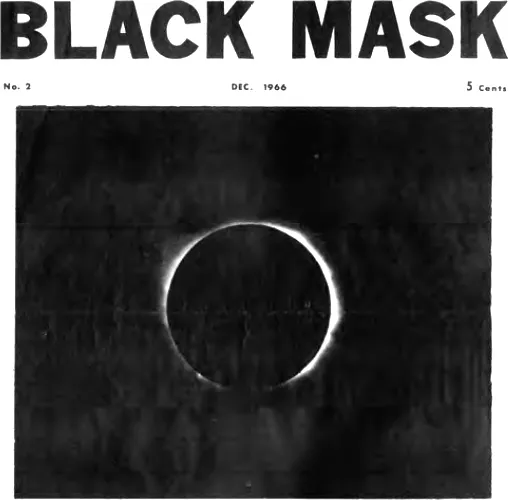
BLACK MASK No. 2 - December 1966