![]()
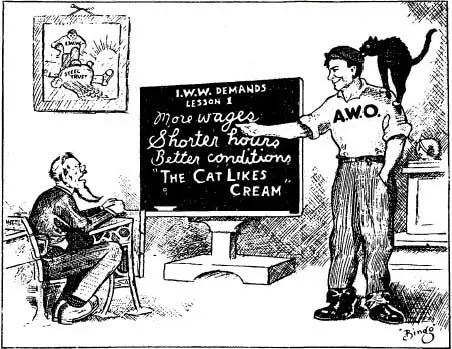
John Farmer’s First Lesson
Cartoon by Ralph Chaplin for the IWW’s Agricultural Workers’ Organization (1916)
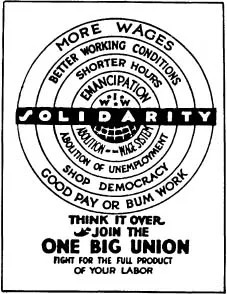
Silent Agitator Sticker by Ralph Chaplin (circa 1916)
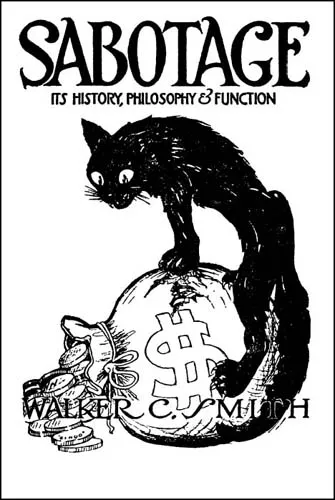
Sabotage
Its History, Philosophy & Function
Walker C. Smith
FOREWORD
This little work is the essence of all available material collected on the subject of Sabotage for a period of more than two years. Thanks are due to the many rebels who gave assistance, and especially to Albin Braida, who made for me what I think to be the first. English translation of Pouget’s work on Sabotage. From this last pamphlet extracts have been taken and adaptations made to suit American conditions.
The object of this work is to awaken the producers to a consciousness of their industrial power. It is dedicated, not to those who advocate but to those who use sabotage.
—Walker C. Smith.
I
NO THEORY, NO PHILOSOPHY, NO LINE OF ACTION IS SO GOOD as claimed by its advocates nor so bad as painted by its critics. Sabotage is no exception to this rule. Sabotage according to the capitalists and the political socialists, is synonymous with murder, rapine, arson, theft; is illogical, vile, unethical, reactionary, destructive of society itself. To many anarchist theorists it is the main weapon of industrial warfare, overshadowing mass solidarity, industrial formation and disciplined action. Some even go so far as to claim that sabotage can usher in the new social order. Somewhere between these two extreme views can be found the truth about sabotage.
Three versions are given of the source of the word. The one best known is that a striking French weaver cast his wooden shoe—called a sabot—into the delicate mechanism of the loom upon leaving the mill. The confusion that resulted, acting to the workers’ benefit, brought to the front a line of tactics that took the name of SABOTAGE. Slow work is also said to be at the basis of the word, the idea being that wooden shoes are clumsy and so prevent quick action on the part of the workers. The third idea is that Sabotage is coined from the slang term that means “putting the boots” to the employers by striking directly at their profits without leaving the job. The derivation, however, is unimportant. It is the thing itself that causes commotion among employers and politicians alike. What then is Sabotage?
Sabotage is the destruction of profits to gain a definite, revolutionary, economic end. It has many forms. It may mean the damaging of raw materials destined for a scab factory or shop. It may mean the spoiling of a finished product. It may mean the displacement of parts of machinery or the disarrangement of a whole machine where that machine is the one upon which the other machines are dependent for material. It may mean working slow. It may mean poor work. It may mean missending packages, giving overweight to customers, pointing out defects in goods, using the best of materials where the employer desires adulteration and also the telling of trade secrets. In fact, it has as many variations as there are different lines of work.
Note this important point, however. Sabotage does not seek nor desire to take human life. Neither is it directed against the consumer except where wide publicity has been given to the fact that the sabotaged product is under the ban. A boycotted product is at all times a fit subject for sabotage. The aim is to hit the employer in his vital spot, his heart and soul, in other words, his pocketbook. The consumer is struck only when he interposes himself’ between the two combatants.
On the other hand, sabotage is simply one of the many weapons in labor’s arsenal. It is by no means the greatest one. Solidaric action is mightier than the courageous acts of a few. Industrial class formation gives a strength not to be obtained by mere tactics. Self discipline and co-operative action are necessary if we are to build a new social order as well as destroy the old. Sabotage is merely a means to an end; a means that under certain conditions might be dispensed with and the end still be gained.
Sabotage will sometimes be misused, flagrantly so; the same is true of every one of the weapons of labor. The main concern to revolutionists is whether the use of sabotage will destroy the power of the masters in such a manner as to give the workers a greater measure of industrial control. On that point depends its usefulness to the working class.
II
Sabotage is not a form of action brought forth from French conditions. It dates back to the earliest days of human exploitation. It is born of class struggles—of man’s inhumanity to man. From serfdom to wage slavery the enslaved class has instinctively tried to render less to the master than was expected of it. This unconscious sabotage shows the irreconcilable antagonism between capitalist and laborer—master and slave.
Sabotage was not formally baptized as a word to describe a formula of social struggle until the Confederal Congress of Tolosa in 1897. Open advocacy of the idea and conscious sabotage in place of instinctive action began in France about this time. It had been preached in England and Scotland for many years before that under the name of “Ca’ Canny.” This phrase of Scotch origin meant “Go slow,” or to be more literal, “Don’t hurry up.” From a publication “The Social Museum” an instance is gained of the use of sabotage by the Scotch.
“In 1889 the organized dockers of Glasgow demanded a ten per cent increase of wages but met with the refusal of the employers. Strike breakers were brought in from among the agricultural laborers and the dockers had to acknowledge defeat and return to work on the old, wage scale. But before the men resumed their work, their secretary of the union delivered to them the following address:
“You are going back to work at the old wage. The employers have repeated time and time again that they were delighted with the work of the agricultural laborers who had taken our places for several weeks during the strike. But we have seen them at work; we have seen that they could not even walk a vessel, that they dropped half of the merchandise they carried, in short, that two of them could hardly do the work of one of us. Nevertheless, the employers have declared themselves enchanted by the work of these fellows; well, then, there is nothing left for us but do the same and to practice Ca’ Canny. Work as the agricultural laborers worked. Only they often fell into the water; it is useless for you to do the same.”
“This order was obeyed to the letter. After a few days the contractors sent for the general secretary of the dockers and begged him to tell the dockers to work as before and that they were ready to grant the ten per cent increase.”
Balzac, writing three-quarters of a century ago, gave a good illustration of sabotage in describing the bloody uprising of Lyons in 1831.
“There have been many things said about the uprising of Lyons, of the republic cannonaded in the streets, but no one has told the truth. The republic seized the movement as an insurgent seizes a rifle.
“The commerce of Lyons is a commerce without courage; as soon as an ounce of silk is manufactured it is asked for and payment made at once. When the demand stops, the workers are dying of starvation; when they are working they earn barely enough to live upon. The prisoners are more happy than they.
“After the July revolution misery reached the point where the workers were compelled to raise a standard: ‘Bread or Death!’—a standard which the government should have considered.
“The republicans had felt out the revolt and they organized the spinners who fought in double shifts. Lyons had its three days. Then everything became normal again and the poor went back to their dog kennels.
“The spinners who had, until then, transformed into useful goods the silk which was weighed to them in cocoons, laid aside probity. They began to grease their fingers with oil. With scrupulous ability they rendered the correct weight, but the silks were all specked with oil. The commerce of the silk manufacturies was infested with greasy goods which caused a loss to Lyons and to a portion of the French commerce.”
This action, as Balzac points out, was nothing more than the workers taking revenge for having been the victims of bayonets when they had asked for bread. But sabotage is something more than simply the equivalent of an oppression received; it has an economic foundation.
III
There exists today a labor market in which the wage workers sell their power to perform various task asked of them by the purchasers—the employing class. The labor power of the workers is a commodity. In selling their merchandise the workers must sell themselves along with it. Therefore they are slaves—wage slaves. In purchasing goods from a merchant one receives an inferior quality for a low price. For a low price—poor products. If this applies to hats and shoes, why not equally to the commodity sold by the laborer? It is from this reasoning that there arises the idea: For poor wages—bad work. This thought is a natural one even to those who agree with society as it is now constituted. To those who do not look upon the wage system as a finality and who have come to regard the employers in their true light—as thieves of the laborers’ product—the idea of sabotage commends itself still more strongly. It is a logical weapon for the revolutionist.
Economists have shown that the wages of the workers are not determined by their product. Wages are simply the market price of the commodity called labor power. Wages are not raised or lowered as the productivity of the worker ebbs and flows. They are conditioned upon the supply and demand, the standard of living where the wages are paid, and the relative strength of the organizations of workers and employers. Not many wage workers have studied the deeper economists, but the ditch digger knows that when he has finished the ditch upon which he is at work he must hunt another master. He instinctively slows up. Self-preservation is one of the first laws of nature. His action has value from a class standpoint, for either more ditch diggers must be employed to complete the work within a given time, or else there is less competition in the labor market for those extra days he labors.
Many who condemn sabotage will be found to be unconscious advocates of it. Think of the absurd position of the “craft union socialists” who decry sabotage and, in almost the same breath, condemn the various efficiency systems of the employers! By opposing “scientific management” they are doing to potential profits what the saboteurs are doing to actual profits. The one prevents efficiency, the other withdraws it. Incidentally it might be said that sabotage is the only effective method of warding off the deterioration of the worker that is sure to follow the performance of the same monotonous task minute after minute, day in and day out. Sabotage also offers the best method to combat the evil known as “speeding up.” None but the workers know how great this evil is. It is one of the methods by which employers coin wealth from death, consuming the very lives of the toilers. By payment of slightly higher wage to the stronger and more dexterous slave, the rest are forced to keep pace. Those who fall by the way are unceremoniously cast aside to beg, steal or starve. One method used by the saboteur to stop this form of scabbery is illustrated by the following occurrence:
Building laborers were wheeling barrows of material to an electric hoist, following the rate of speed set by their higher paid taskmaster. The pace became so swift that those who were weaker could no longer keep up. During the noon hour one of the men stepped to the wheel barrow of the speeder and tightened the burrs on the wheel. Upon resuming work the task master started at his usual pace but soon was obliged to slow down through sheer weariness. No class-conscious worker will join the moralists and vote catchers in condemning this action.
In the steel mills the speeding up process has become so distressing to the average worker that still greater steps are taken for self-protection. In fact, in speaking of these class traitors, it is often remarked that “Something dropped on their foot often affects their head.” There are many points of similarity between the speeder and the favored steer in the stock yards who is trained to lead the other steers into the killing pens.
England offers an example of a practical method of limiting the output. Due to effective, widespread, systematic sabotage the brick masons there lay as a day’s work, less than one-third the number of brick required from their brother craftsmen in America. Any reduction in pay is met with a counter reduction in the work. Sabotage means, therefore, that the workers directly fight the conditions imposed by the masters in accordance with the formula “Poor wages—bad work.”
IV
Actions which might be classed as “capitalist sabotage” are used by the different exploiting and professional classes. The truck farmer packs his largest fruits and vegetables on top. The merchant sells inferior articles as “something just as good.” The doctor gives “bread-pills” or other harmless concoctions in cases where the symptoms are puzzling. The builder uses poorer material than demanded in the specifications. The manufacturer adulterates foodstuffs and clothing. All these are for the purpose of gaining more profits. Carloads of potatoes were destroyed in Illinois recently; cotton was burned in the Southern states; coffee was destroyed by the Brazilian planters; barge loads of onions were dumped overboard in California; apples are left to rot on the trees of whole orchards in Washington; and hundreds of tons of foodstuffs are held in cold storage until rendered unfit for consumption. All to raise prices. Yet it is exploiters of this character who are loudest in condemnation of sabotage when it is used to benefit the workers.
Some forms of capitalist sabotage are legalized, others are not. But whether or not the various practices are sanctioned by law, it is evident that they are more harmful to society as a whole than is the sabotage of the workers. Capitalists cause imperfect dams to be constructed, and devastating floods sweep whole sections of the country. They have faulty bridges erected, and wrecks cause great loss of life. They sell steamer tickets, promising absolute security, and sabotage the life-saving equipment to the point where hundreds are murdered, as witness the Titanic. The General Slocum disaster in an example of capitalist sabotage on the life preservers, The Iroquois Theater fire is an example of sabotage by exploiters who assured the public that the fire curtain was made of asbestos. There are also the Primero, the Drakesboro, the Cherry mine disasters and the terrible Triangle Shirtwaist tragedy. The cases could be multiplied indefinitely. These capitalist murderers constitute themselves the mentors of the morals of those slaves who “have nothing to lose but their chains.” Only fools will take their ethics from such knaves. Capitalist opposition to sabotage is one of its highest recommendations.
Capitalist sabotage aims to benefit a small group of non-producers, while working-class sabotage seeks to help the whole body of producers at the expense of the parasites. The frank position of the class-conscious worker is that capitalist sabotage is wrong because it harms the workers; working-class ...