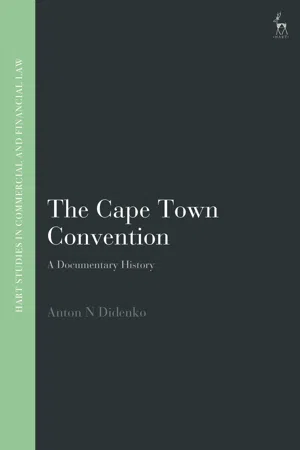
This book is the first detailed and comprehensive research of the history of the Cape Town Convention and its protocols. It critically engages with the challenges faced by the developers of this treaty, analyses thousands of pages of archived materials and derives important lessons for the development of transnational commercial law globally.
The book is an invaluable addition to the existing literature on the Cape Town Convention. It also informs the debate about harmonisation of secured transactions regimes generally, and as such will be of interest to academics, legal practitioners and the judiciary involved in secured transactions law around the world. Practising lawyers will better understand the rationale behind the key provisions of the Cape Town Convention, while the treaty-making lessons will assist governmental officials, representatives of international organisations and legal advisors engaged in harmonisation of commercial law.
The text covers all four protocols to the Cape Town Convention, including the MAC Protocol adopted on 22 November 2019 in Pretoria.
- 239 pages
- English
- PDF
- Available on iOS & Android
eBook - PDF
About this book
Information
Table of contents
- Preface
- Acknowledgements
- Contents
- List of Abbreviations
- Table of Reports and Working Papers
- Table of Conventions and Model Laws
- 1. Introduction
- 2. Defining the Scope of the Convention
- 3. Selecting the Asset Types Covered by the Convention
- 4. Choosing an Appropriate Structure for the Convention
- 5. Addressing Inter Partes Matters: Remedies and Party Autonomy
- 6. Addressing Matters Affecting Third Parties: Key Considerations
- 7. Measuring the Feasibility of the Convention: Commercial Concerns and State Sensitivities
- 8. Process-Management Challenges
- 9. Conclusions
- Appendix 1: Cape Town Convention Development Timeline: Key Milestones
- Appendix 2: Table of Concordance of Reports and Working Papers
- Bibliography
- Index
Trusted by 375,005 students
Access to over 1.5 million titles for a fair monthly price.
Study more efficiently using our study tools.
Frequently asked questions
Yes, you can cancel anytime from the Subscription tab in your account settings on the Perlego website. Your subscription will stay active until the end of your current billing period. Learn how to cancel your subscription
No, books cannot be downloaded as external files, such as PDFs, for use outside of Perlego. However, you can download books within the Perlego app for offline reading on mobile or tablet. Learn how to download books offline
Perlego offers two plans: Essential and Complete
- Essential is ideal for learners and professionals who enjoy exploring a wide range of subjects. Access the Essential Library with 800,000+ trusted titles and best-sellers across business, personal growth, and the humanities. Includes unlimited reading time and Standard Read Aloud voice.
- Complete: Perfect for advanced learners and researchers needing full, unrestricted access. Unlock 1.5M+ books across hundreds of subjects, including academic and specialized titles. The Complete Plan also includes advanced features like Premium Read Aloud and Research Assistant.
We are an online textbook subscription service, where you can get access to an entire online library for less than the price of a single book per month. With over 1.5 million books across 990+ topics, we’ve got you covered! Learn about our mission
Look out for the read-aloud symbol on your next book to see if you can listen to it. The read-aloud tool reads text aloud for you, highlighting the text as it is being read. You can pause it, speed it up and slow it down. Learn more about Read Aloud
Yes! You can use the Perlego app on both iOS and Android devices to read anytime, anywhere — even offline. Perfect for commutes or when you’re on the go.
Please note we cannot support devices running on iOS 13 and Android 7 or earlier. Learn more about using the app
Please note we cannot support devices running on iOS 13 and Android 7 or earlier. Learn more about using the app
Yes, you can access The Cape Town Convention by Anton Didenko in PDF and/or ePUB format, as well as other popular books in Law & Commercial Law. We have over 1.5 million books available in our catalogue for you to explore.