- 264 pages
- English
- ePUB (mobile friendly)
- Available on iOS & Android
eBook - ePub
Posterior Direct Restorations
About this book
This book achieves the ambitious aim of showing dentists how to create conservative and esthetic direct restorations of posterior teeth using composite resin. The book begins with a primer on occlusal anatomy, describing the specifics of each type of posterior tooth. This foundation supports the diagnosis and treatment of lesions, isolation, and cavity preparation for the buildup, as well as modeling, detailing, and finishing of restorations that closely mimic natural tooth anatomy for optimal esthetics and function. Numerous clinical tips and case examples are provided, and the procedural rationale is supported by scientific evidence, in addition to the authors' considerable clinical experience. Techniques for a wide range of clinical scenarios are presented to provide practitioners with the information they need to achieve optimal restorations.
Trusted by 375,005 students
Access to over 1 million titles for a fair monthly price.
Study more efficiently using our study tools.
Information
1
Shape and Visual Perception
To construct occlusal morphology, it is necessary to know exactly how to observe the form to be replicated and to have a good knowledge of dental anatomy. The human brain may be considered a nearly perfect machine, but it will try to make its work simpler by expending as little energy as possible for maximum results. These mental shortcuts lead to limitations in a person’s ability to accurately observe shape. This chapter explains how to overcome these limitations through visual decomposition.
The concept of shape, concerning an object’s outward appearance, is inseparably linked with the concept of function: Objects are shaped in accordance with the function for which they were designed. For example, the hand, a tactile sensory extension of the brain, can perform prehensile functions because its thumb opposes the other fingers: Many of the fine, precise movements that can be performed with the hand, particularly the fingers, would no longer be feasible if the thumb were aligned with the forefingers. A study of shape begins with a perceptual analysis of how things are done. Visual perception is the outcome of integrating and processing an image through a series of mental processes that are influenced by the observer’s cognitive resources (cognitive processing stage). Cognitive experience is influenced by previous experiences as the brain establishes similarities between things that are currently being observed and things that are already known. Full perception of an object (shape) and the ensuing emotional experience can only come about when the various information has been assimilated.
Perception of objects is made possible by two types of stimuli: distal and proximal.1 A distal stimulus allows us to perceive an object’s physical presence. A proximal stimulus leads the observer to the information needed to arrive at the distal stimulus. In other words, we recognize an apple (distal stimulus) because it is roundish and red in color and has two depressions (proximal stimulus). Based on the proximal stimulus (characteristics of the observed object), we can perceive an object’s presence (distal stimulus) through a process that allows us to create a perceptive representation of the object by reproducing the information embedded in the proximal stimulus.
The Gestalt philosophical movement, established in Germany by Max Wertheimer (1921), Wolfgang Kohler, and Kurt Koffka (1935), adopts an interesting approach to shape. According to this philosophy, “The whole is greater than the sum of its parts.”2 The overall shape is conditioned by the perceptive capacities, which include perception of:
- Outlines
- Space and ratios
- Light and shadow
Perception of Outlines
The perception of outlines defines an object’s visual perimeter, which essentially depends on the observation perspective: Different perspectives of observation will correspond to different visual perimeters.
Figure 1-1 shows the same tooth observed from two different perspectives. Marking the outlines of both teeth (in blue) establishes the differences between the visual perimeters. This demonstrates that when observing a tooth, we must observe it from all possible perspectives in order to appreciate its true morphologic variations. Each observation perspective will supply the brain with information that, when assimilated by the memory, can be processed to assemble a perceived overall form.
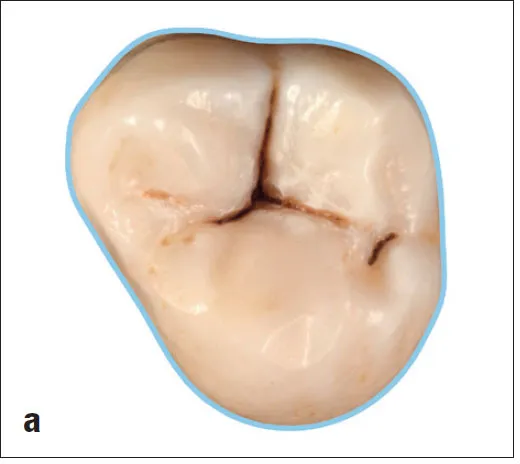
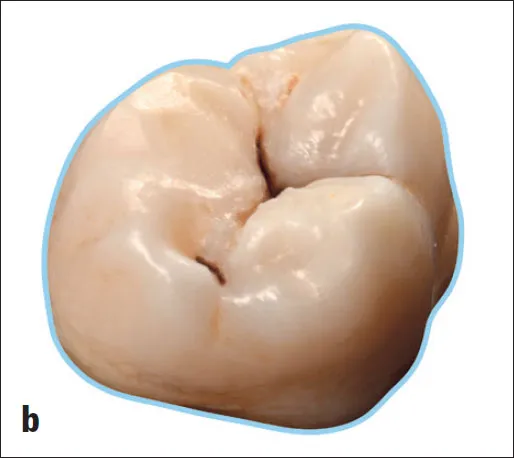
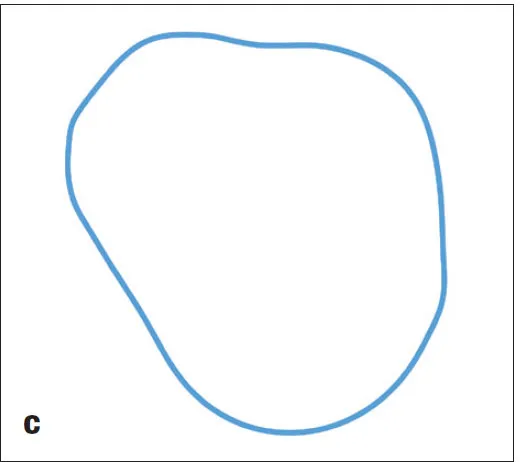
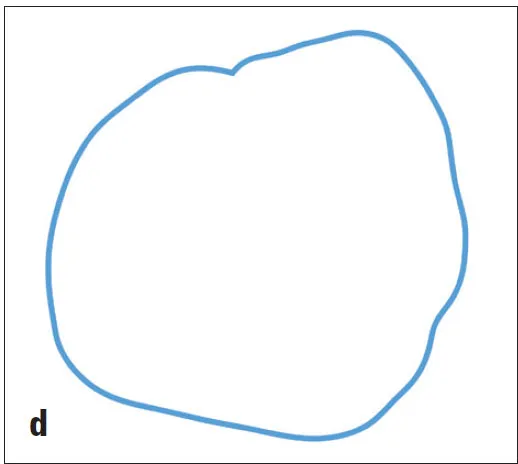
FIG 1-1 (a and b) Maxillary second molar from two perspectives, outlined in blue. (c and d) Viewing the outlines alone demonstrates how the visual perimeters change based on perspective.
For example, when performing a Class 2 restoration, the first step is to convert cavities to Class 1 in order to redefine the outline and make it easier to reconstruct the occlusal surface. The optical perception of a restored outline defines the peripheral limits and provides the morphologic information necessary to simplify the occlusal restoration procedure.
Perception of Space and Ratios
The perception of space and ratios defines the relationship that the object establishes with the surrounding space and other elements present in the field of observation as well as relationships established between the object’s constituent parts: everything must be in relative proportion (Fig 1-2).

FIG 1-2 Note the anatomical relationships between the constituent anatomical parts of each molar, between the two molars, and in the space surrounding and between the molars.
Perception of Light and Shadow
Perception of light and shadow plays a crucial role in perceiving an object’s 3D shape and surface details (Fig 1-3). If light is completely removed from the image of the molar shown in Fig 1-1a, only the outline of the figure can be perceived (Fig 1-4a), which is only possible due to the distinct contrast between the image and the white background. If the white background of the same image is replaced by a black background (Fig 1-4b), the shape is not perceptible. Similarly, if all the shading is removed from the molar in Fig 1-1a, only the outline can be perceived, and this is only due to the distinct contrast between the image and the black background (Fig 1-4c). If the black background of the same image is replaced by a white background, the shape is not perceptible (Fig 1-4d).

FIG 1-3 Relationship of light and shadow in an occlusal view of a maxillary molar.
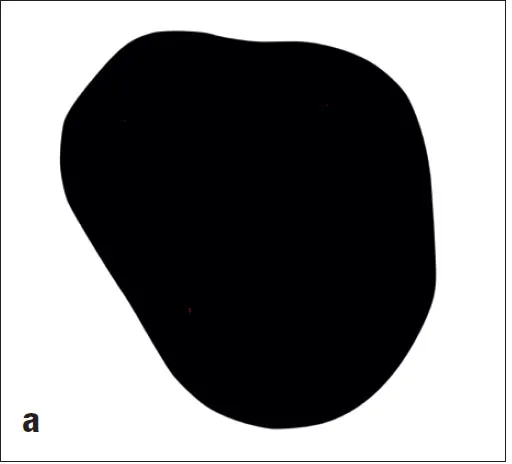

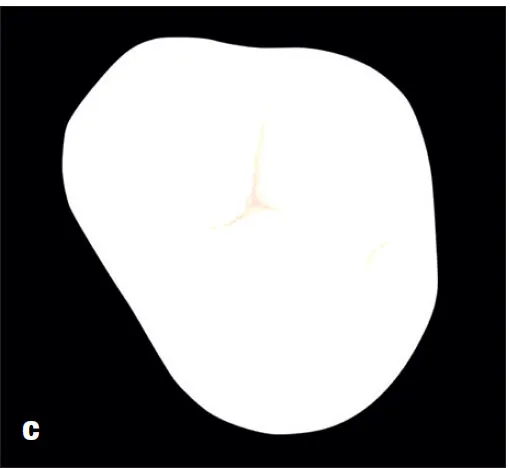
FIG 1-4 (a) Molar from Fig 1-1a with all light removed. (b) Without a contrasting background, the shape is imperceptible. (c) Molar without shading. The shape can be perceived against the contrasting background. (d) W...
Table of contents
- Cover
- Halftitle Page
- Copyright Page
- Title Page
- Dedication Page
- Contents
- Forewords
- Preface
- Contributors
- 1 Shape and Visual Perception
- 2 Anatomical Knowledge for Modeling
- 3 Diagnosis and Treatment of Early Caries Lesions
- 4 Isolation
- 5 Cavity Preparation
- 6 Restoring the Interproximal Wall
- 7 Occlusal Modeling
- 8 Detailing
- 9 Finishing, Polishing, and Finalizing the Occlusion
- 10 Clinical Cases
- Index
Frequently asked questions
Yes, you can cancel anytime from the Subscription tab in your account settings on the Perlego website. Your subscription will stay active until the end of your current billing period. Learn how to cancel your subscription
No, books cannot be downloaded as external files, such as PDFs, for use outside of Perlego. However, you can download books within the Perlego app for offline reading on mobile or tablet. Learn how to download books offline
Perlego offers two plans: Essential and Complete
- Essential is ideal for learners and professionals who enjoy exploring a wide range of subjects. Access the Essential Library with 800,000+ trusted titles and best-sellers across business, personal growth, and the humanities. Includes unlimited reading time and Standard Read Aloud voice.
- Complete: Perfect for advanced learners and researchers needing full, unrestricted access. Unlock 1.4M+ books across hundreds of subjects, including academic and specialized titles. The Complete Plan also includes advanced features like Premium Read Aloud and Research Assistant.
We are an online textbook subscription service, where you can get access to an entire online library for less than the price of a single book per month. With over 1 million books across 990+ topics, we’ve got you covered! Learn about our mission
Look out for the read-aloud symbol on your next book to see if you can listen to it. The read-aloud tool reads text aloud for you, highlighting the text as it is being read. You can pause it, speed it up and slow it down. Learn more about Read Aloud
Yes! You can use the Perlego app on both iOS and Android devices to read anytime, anywhere — even offline. Perfect for commutes or when you’re on the go.
Please note we cannot support devices running on iOS 13 and Android 7 or earlier. Learn more about using the app
Please note we cannot support devices running on iOS 13 and Android 7 or earlier. Learn more about using the app
Yes, you can access Posterior Direct Restorations by Salvatore Scolavino,Gaetano Paolone in PDF and/or ePUB format, as well as other popular books in Medicine & Dentistry. We have over one million books available in our catalogue for you to explore.