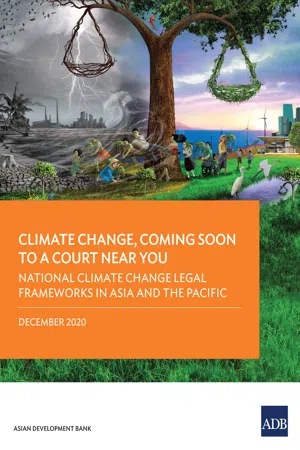
National legal and policy frameworks underpin international climate action because they are the backbone of domestic responses to the climate emergency. Unless they support global objectives, local climate action stalls. Concerned by sluggish national responses to climate change or injured by its impacts, citizens are filing lawsuits, making courts central to national climate governance. To adjudicate these lawsuits, courts require current information about their climate change legal and policy frameworks. This report provides holistic syntheses of the climate legal and policy frameworks of 32 countries in Asia and the Pacific and discusses key legislative trends and climate-relevant constitutional rights.
- 336 pages
- English
- ePUB (mobile friendly)
- Available on iOS & Android
eBook - ePub
About this book
Trusted by 375,005 students
Access to over 1 million titles for a fair monthly price.
Study more efficiently using our study tools.
Information

Managing flood and riverbank erosion on the banks of the Brahmaputra River in Assam. Flood and riverbank erosion measures help communities adapt to climate change impacts and boost economic and national interests (photo by Rakesh Sahai/ADB).
PART ONE
INTRODUCTION
I. Judiciaries Play a Role in Domestic Climate Action and Need Resources
The diplomats have done their job: the Paris Agreement points the world in the right direction, and with sophistication and clarity. It does not, however, ensure implementation, which necessarily remains the domain of politicians, businessmen, scientists, engineers, and civil society.1
These words reveal a fundamental truth—the Paris Agreement is just the beginning of what needs to be done. How might we ensure that the agreement is implemented? Everyone must “make climate change personal” in their life and contribute to global action.2 Only with collective action can humankind limit global warming to well below 2ºC above preindustrial temperatures, ideally to a maximum of 1.5ºC.3 Climate change results from emissions all around us, affecting citizens and ecosystems globally. Implementation must, therefore, occur where emissions and impacts arise.
Countries adopt policies and laws consistent with their global commitments to regulate domestic responses to climate change. As of 26 November 2020, there were 2,082 policies and laws globally.4 National legal and policy frameworks are vital for low emission and resilient green growth because they integrate international commitments into the national context and ensure domestic implementation.
Despite the global agreement and growth in climate laws, climate change impacts are mounting, and it is apparent that existing climate pledges are insufficient to meet agreed temperature goals.5
Faced with devastating impacts on their lives, citizens are suing for climate action. Climate action includes activities to (i) reduce atmospheric greenhouse gas emissions or concentrations (mitigation), (ii) adjust to the impacts of climate change (adaptation), and (iii) boost the capacity of people and ecosystems to recover from climate impacts (resilience). By 26 November 2020, there were more than 1,200 climate suits in the United States alone and at least 400 climate cases in other countries.6 Climate litigation is also growing in Asia and the Pacific, requiring judiciaries to interpret or apply their domestic climate change legal frameworks (see Report Two for a discussion about climate litigation in Asia and the Pacific).
The central role of judges—interpreting, upholding, and shaping laws—makes the judiciary integral to domestic climate action. Courts are “increasingly complementing the actions of legislators” by deliberating over climate change court cases worldwide.7 Patricia Espinosa—Executive Secretary of the United Nations Framework Convention on Climate Change—recently commented, “Relevant legislation, carefully used, supported and backed by an informed judiciary, will also be crucial for realising our shared aspirations for shaping a resilient, low-carbon and truly sustainable future” (footnote 7).
This report—Climate Change, Coming Soon to a Court Near You: National Climate Change Legal Frameworks in Asia and the Pacific—focuses on national climate change legal and policy frameworks in 32 countries in Asia and the Pacific. It belongs to a series of reports on climate law and policy for judges in Asia and the Pacific. Due to the judges’ growing concern about climate change and the fact that more people are suing over it, the Asian Development Bank (ADB) prepared these papers to provide more resources about climate change law.
When determining the usefulness of this report to judges in Asia and the Pacific, ADB took into account the resource constraints that prevent many of its developing member countries from publishing their laws and policies online or translating documents into English. These challenges make the records of national climate laws and policies online incomplete. Consequently, judges, lawyers, interested parties, and international development partners are unable to access exhaustive information about various national climate change legal and policy frameworks in the region. Access to laws benefit everyone, and this report seeks to boost accessibility.
Legal and policy frameworks must also facilitate access to climate finance and other resources from international donors. Each country covered by this report has a national designated authority with the Green Climate Fund.8 Clear information about national legal and policy frameworks makes it easier for donors to assess sectoral responsibilities and national reporting standards. These factors are vital for the provision of green finance and other resources.
II. Report Structure and Scope
Report Three—National Climate Change Legal Frameworks in Asia and the Pacific—reviews climate law and policy frameworks across 32 countries in South Asia, Southeast Asia, and the Pacific (Table 1). ADB collected some 880 laws and policies for this report.
Table 1: Regions and Countries Covered by the Report
South Asia | Southeast Asia and the People’s Republic of China | Pacific |
Afghanistan | Cambodia | Cook Islands |
Bangladesh | Indonesia | Federated States of Micronesia |
Bhutan | Lao People’s Democratic | Republic Fiji |
India | Malaysia | Kiribati |
Maldives | Myanmar | Marshall Islands |
Nepal | People’s Republic of China | Nauru |
Pakistan | Philippines | Palau |
Sri Lanka | Singapore | Papua New Guinea |
Thailand | Samoa | |
Viet Nam | Solomon Islands | |
Timor-Leste | ||
Tonga | ||
Tuvalu | ||
Vanuatu |
Source: Asian Development Bank.
Report Three contains seven parts, with the body of the report falling within
• Part Two—trends in climate laws and policies in Asia and the Pacific,
• Part Three—constitutional rights survey, and
• Parts Four, Five, and Six—national legal climate change frameworks summaries.
A. Part Two: Trends in Climate Laws and Policies in Asia and the Pacific
Part Two outlines some key trends relating to climate law and policies. For example, it is clear that (i) climate litigation is shaping domestic legal frameworks, (ii) legal adaptation frameworks across Asia and the Pacific can be strengthened, and (iii) most countries regulate climate change responses with policies and implementation via existing laws.
The clear preference for defining climate responses via policies, action plans, and existing laws has benefits. It allows countries to roll out policies quickly and update them a...
Table of contents
- Front Cover
- Title Page
- Copyright Page
- Contents
- Tables and Figures
- Forewords
- Preface
- Acknowledgments
- Abbreviations
- Executive Summary
- Part One. Introduction
- Part Two. Trends in Climate Laws and Policies in Asia and the Pacific
- Part Three. Comparative Constitutional Survey
- Part Four. South Asia Legal Frameworks
- Part Five. Southeast Asia and People’s Republic of China Legal Frameworks
- Part Six. The Pacific Countries Legal Frameworks
- Part Seven. Conclusion
- Glossary
- Back Cover
Frequently asked questions
Yes, you can cancel anytime from the Subscription tab in your account settings on the Perlego website. Your subscription will stay active until the end of your current billing period. Learn how to cancel your subscription
No, books cannot be downloaded as external files, such as PDFs, for use outside of Perlego. However, you can download books within the Perlego app for offline reading on mobile or tablet. Learn how to download books offline
Perlego offers two plans: Essential and Complete
- Essential is ideal for learners and professionals who enjoy exploring a wide range of subjects. Access the Essential Library with 800,000+ trusted titles and best-sellers across business, personal growth, and the humanities. Includes unlimited reading time and Standard Read Aloud voice.
- Complete: Perfect for advanced learners and researchers needing full, unrestricted access. Unlock 1.4M+ books across hundreds of subjects, including academic and specialized titles. The Complete Plan also includes advanced features like Premium Read Aloud and Research Assistant.
We are an online textbook subscription service, where you can get access to an entire online library for less than the price of a single book per month. With over 1 million books across 990+ topics, we’ve got you covered! Learn about our mission
Look out for the read-aloud symbol on your next book to see if you can listen to it. The read-aloud tool reads text aloud for you, highlighting the text as it is being read. You can pause it, speed it up and slow it down. Learn more about Read Aloud
Yes! You can use the Perlego app on both iOS and Android devices to read anytime, anywhere — even offline. Perfect for commutes or when you’re on the go.
Please note we cannot support devices running on iOS 13 and Android 7 or earlier. Learn more about using the app
Please note we cannot support devices running on iOS 13 and Android 7 or earlier. Learn more about using the app
Yes, you can access National Climate Change Legal Frameworks in Asia and the Pacific by in PDF and/or ePUB format, as well as other popular books in Biological Sciences & Environmental Law. We have over one million books available in our catalogue for you to explore.