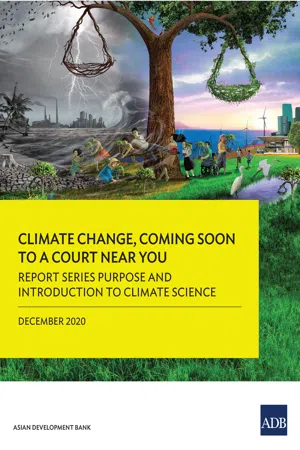
Climate change is the defining challenge of our time. Without urgent climate action, humanity faces a world that cannot sustain civilization as we know it. People around the globe are demanding action, some with climate litigation. This four-part report series recognizes the inevitability of increased litigation in the era of climate change and judges need a tool kit to respond. Report One explains how judges from Asia and the Pacific contribute to climate governance, along with the Asian Development Bank's rationale for producing this report series. It guides readers through some of the basics about climate change: What is causing it? How do we know? How bad might it get? What do we do about it?
- 74 pages
- English
- ePUB (mobile friendly)
- Available on iOS & Android
eBook - ePub
About this book
Trusted by 375,005 students
Access to over 1.5 million titles for a fair monthly price.
Study more efficiently using our study tools.
Information
Topic
Ciencias biológicasSubtopic
Derecho medioambiental
Destruction after Typhoon Haiyan. The typhoon battered Leyte in the Philippines in November 2013, leaving more than 6,000 people dead, affecting 12 million other people, and causing $8 billion in damages. It remains one of the strongest storms on record to make landfall (photo by Ariel Javellana/ADB).
PART ONE
REPORT SERIES RATIONALE
I. An Existential Threat in the 21st Century
“Climate change is, quite simply, an existential threat for most life on the planet—including, and especially, the life of humankind.”1 And humans are causing it.
In its 4.5-billion-year history, Earth has been far hotter than it is now.2 But humans did not exist in the age of dinosaurs, and neither did most of the species living around us. While climate change will not end our planet, it risks making Earth unrecognizable and inhospitable to current life. Our civilization and ecosystems emerged during the Holocene, which started around 11,700 years ago when Earth warmed after the last glacial maximum and the ice sheets covering North America and Europe retreated.3 The average temperature and stability of the Holocene allowed modern civilization to flourish.4 In short, modern civilization and agriculture are adapted to the Holocene climate.5
The Industrial Revolution’s steam engines hailed the beginning of large-scale fossil fuel use. Unfortunately, the by-product of burning fossil fuels for energy production—especially coal, oil, and gas—are greenhouse gas (GHG) emissions.6 GHGs occur naturally in Earth’s atmosphere and are essential for regulating the global climate.7 But artificially increasing atmospheric GHG concentrations by burning fossil fuels is warming Earth.8 (This report discusses climate science further in Part Two: Introduction to Climate Change.)
Contemporary global discussion about climate change focuses on human-caused global warming, which is elevating temperatures compared with the preindustrial temperature average of the Holocene—anthropogenic climate change. Preindustrial temperatures refer to global temperatures before large-scale industrial activity around 1750.9 However, the Intergovernmental Panel on Climate Change (IPCC) uses the 1850–1900 period as its preindustrial temperature baseline.10
A warming planet sets in motion chain reactions that will change and destabilize the climate in which humans evolved to thrive.11 Humans cannot separate themselves from Earth’s natural environment. We are innately connected to it, relying on Earth for air, water, food, and energy—the fundamental necessities of life. Climate change threatens our capacity to access these necessities and, therefore, undermines our enjoyment of human rights.12 Indeed, climate change is such a threat to humanity that the Bulletin of the Atomic Scientists lists it as one of the two existential dangers to humanity—the other is nuclear war.13
II. Climate Change Impacts in 2020
Climate change is not a future event—we live with it now. Human activity has already caused a 1°C warming above the preindustrial mean temperature.14 This 1°C shift has triggered increasingly frequent and intense extreme weather events, rising sea levels, and diminishing Arctic sea ice.15 Across Asia and the Pacific, populations endure severe weather, heat stress, flooding, droughts, and sea level rise.16 Impacts are sudden onset (severe weather events) or slow onset (rising sea levels and melting glaciers).
The IPCC has warned that based on current emissions and pledges, global temperatures will increase to 1.5°C above preindustrial temperatures between 2030 and 2052, bringing more intense impacts (footnote 14). Around 30% of people currently live with deadly heat events.17 By 2100, lethal heat waves will affect up to 75% of the world’s population. (This report summarizes the impacts of 1.5°C and 2°C of warming in Table 4: Summary of Projected Risks at 1.5°C and 2°C.)
Climate change shapes health in various ways. Beyond the obvious impacts of extreme weather events, factors such as heat, air quality, food and water security, and vector distribution (diseases) impair health.18 Conflict- and climate-induced migration also harm physical and mental health. The World Health Organization (WHO) estimates that climate change causes 150,000 deaths annually, including deaths from extreme weather.19 By 2030, WHO anticipates that climate change-associated heat, malaria and dengue fever, coastal flooding, and undernutrition will kill 250,000 people annually.20 More recent studies label this estimate conservative because it does not account for deaths from climate-sensitive health outcomes or disrupted health services (footnote 18). For example, less food could contribute to around 529,000 deaths by 2050 (footnote 18). The more startling fact is that air pollution—significantly contributed to by fossil fuels—kills around 7 million annually in 2020.21 Four million of these pollution-related deaths occur in Asia and the Pacific.22
III. Climate Change and the Coronavirus Disease
In 2020, the world grappled with the devastating impacts of the coronavirus disease (COVID-19). By 28 October 2020, there were around 43.8 million confirmed COVID-19 infections and more than 1 million deaths.23 Millions more had suffered from hunger and economic devastation as the world ground to a halt to contain infections and keep people safe. Widespread and sudden community lockdowns were akin to “war-time” responses.24
Many initially lauded the cleaner environment resulting from the COVID-19 global economic shutdown. Social media feeds filled with news that Delhi’s air had cleared and that satellites recorded lower atmospheric concentrations of pollutants.25 History, however, teaches us that these gains may not be sustained. The COVID-19 pandemic is not the first time that an economic downturn has shrunk fossil fuel emissions. Reduced fossil fuel and cement production during the 2009 global financial crisis saw carbon dioxide (CO2) emissions drop by 1.4%.26 By 2010, however, global CO2 emissions were growing faster than ever (footnote 26). A boom in fossil fuel emissions during recovery from an economic crash is not limited to the 2009 financial crisis. The Economist tracked emission spikes after the oil crises of the 1970s, the fall of the Union of Soviet Socialist Republics, and the Asian financial crisis (footnote 26).
COVID-19 is also affecting climate action and green energy expansion. The Secretariat of the United Nations Framework Convention on Climate Change (UNFCCC) has postponed the 26th Session of the Conference of the Parties scheduled for late 2020 and the midyear meetings leading up to it. COVID-19 has also slowed down the installation of solar and wind energy in 2020.27
When the COVID-19 pandemic passes, governments will redirect their attention to rebuilding their economies. Their choice of investments will be critical to the planet’s future. Rather than investing in high-emitting industries, governments could turn their focus to supporting green options. Governments might also opt to learn from the current crisis and see that their constituents are willing to contribute to global action because this issue affects every living thing.
Without urgent action, the effects of climate change will intensify over the next 30–50 years and beyond.28 As Earth’s climate evolves, the pace of climate change will get fa...
Table of contents
- Front Cover
- Title Page
- Copyright Page
- Contents
- Tables and Figures
- Forewords
- Preface
- Acknowledgments
- Abbreviations
- Executive Summary
- Part One. Report Series Rationale
- Part Two. Introduction to Climate Change
- Part Three. Conclusion
- Back Cover
Frequently asked questions
Yes, you can cancel anytime from the Subscription tab in your account settings on the Perlego website. Your subscription will stay active until the end of your current billing period. Learn how to cancel your subscription
No, books cannot be downloaded as external files, such as PDFs, for use outside of Perlego. However, you can download books within the Perlego app for offline reading on mobile or tablet. Learn how to download books offline
Perlego offers two plans: Essential and Complete
- Essential is ideal for learners and professionals who enjoy exploring a wide range of subjects. Access the Essential Library with 800,000+ trusted titles and best-sellers across business, personal growth, and the humanities. Includes unlimited reading time and Standard Read Aloud voice.
- Complete: Perfect for advanced learners and researchers needing full, unrestricted access. Unlock 1.5M+ books across hundreds of subjects, including academic and specialized titles. The Complete Plan also includes advanced features like Premium Read Aloud and Research Assistant.
We are an online textbook subscription service, where you can get access to an entire online library for less than the price of a single book per month. With over 1.5 million books across 990+ topics, we’ve got you covered! Learn about our mission
Look out for the read-aloud symbol on your next book to see if you can listen to it. The read-aloud tool reads text aloud for you, highlighting the text as it is being read. You can pause it, speed it up and slow it down. Learn more about Read Aloud
Yes! You can use the Perlego app on both iOS and Android devices to read anytime, anywhere — even offline. Perfect for commutes or when you’re on the go.
Please note we cannot support devices running on iOS 13 and Android 7 or earlier. Learn more about using the app
Please note we cannot support devices running on iOS 13 and Android 7 or earlier. Learn more about using the app
Yes, you can access Report Series Purpose and Introduction to Climate Science by in PDF and/or ePUB format, as well as other popular books in Ciencias biológicas & Derecho medioambiental. We have over 1.5 million books available in our catalogue for you to explore.