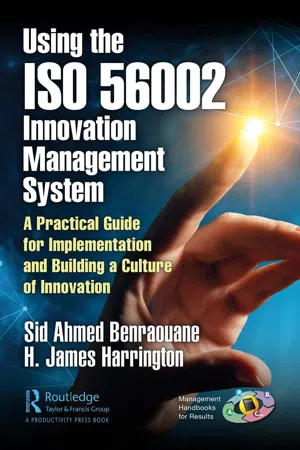
In 2019, ISO Technical Committee 279 released a new international standard on innovation management system called ISO 56002:2019. The objective of this standard is to provide a framework on how to build an innovation ecosystem that can be sustained over time. Similar to the quality management system that ISO established decades ago, this standard provides instructions related to best practices on how to manage innovation activities, projects, and programs. It does not describe detailed activities within the organization, but rather provides guidance at a general level. It does not prescribe any requirements or specific tools or methods for innovation activities. Essentially, the standard does not provide guidance on how to implement and/or use the standard. The standard basically tells you what to do and document – this powerful book tells you how to do it. The techniques in this book are directed at key tasks across the innovative process, such as maximizing quality, productivity, maintainability, usability, and reliability, while focusing on reducing the product cycle time and costs within the innovative process.
Currently, there are no other comprehensive books available on how to fully implement this standard in companies. This book is crucial for managers, business leaders, entrepreneurs, and consultants looking for help to reap the benefits of an innovation management system. This book takes you step by step through the process of developing an innovation ecosystem. In addition, it provides frameworks, tools, methodologies, cases, and best practices so your organization can experience the full value of the standard.
Trusted by 375,005 students
Access to over 1.5 million titles for a fair monthly price.
To acquaint the reader with Innovation Management System (IMS) theory, applications, operations, and benefits. It also provides them with an understanding of the scope of ISO 56002:2019.
Overview
It clarifies the difference between a creative organization and an innovative organization. A suggested scope for an innovative organization is discussed along with the advantages of being innovative. It consists of the introduction that will help you understand and make a decision related to upgrading your IMS. We make the basic assumption that most organizations had some type of IMS in place, as most organizations want to improve their performance and customer satisfaction. Included in this chapter is information related to four clauses that are within the ISO Standard 56002:2019. They are:
0. Introduction;
1. Scope;
2. Normative references; and
3. Terms and definitions.
Benefits
This ISO Standard has been created to provide the reader with best practices that will help to increase an individual and/or organizationߡs ability to improve its innovation and creativity.
• It provides the reader with a list of standard innovation terms and definitions.
• It provides the reader with a means to understand the breadth and depth of the IMS.
Classification of Action
This clause is written as a Should do activity. It provides a list of best practices, but each organization can select the clauses that they wish to include in their IMS. This clause is classified as a guidance document always.
Introduction to the IMS
The basic management structure of all organizations consists of a set of systems that define the way the organization operates. These operational systems can be formally documented systems similar to those used in large corporations and stored in corporate operating manuals; or they can be informal, as in a one-person operation where a few systems (other than financial) are normally documented.
• Definition of a system: The International Organization for Standardization (ISO) defines a system as the organizational structure, responsibilities, procedures, and resources needed to conduct a major function within an organization, or support a common business need.∗
Systems are usually made up of many major processes that take an input, add value to it, and produce an output. These processes may or may not be interconnected, for example, the new product development process, or the supply chain management system.
The first consideration in designing a system or a process is to produce a specific desired result. As a result, in addition to the basic process flow that creates the output, the following seven factors need to be designed into all systems and/or processes:
• ways to determine what the customer wants and needs;
• ways to identify improvement opportunities;
• ways to prevent errors from occurring;
• ways to segregate good items from bad items;
• ways to correct bad items; and
• ways to prevent the errors from recurring.
Keeping this in mind, it is easy to understand how this process control perspective is readily applicable across many of the functions within an organization, such as the design of products and services, human resources management, marketing, sales, and invoicing. They are often embedded within their management systems (see Table 1.1. for typical embedded systems). The notion that processes and their interfaces should be subject to analysis and continuous improvement is the key conceptual basis for the ISO 9000 family, and the fundamental building block for a Quality Management System and IMS.
• Definition of an Innovation Management System (IMS): An Innovation Management System is an organizational structure, procedures, processes, and resources needed to implement quality management.
Table 1.1 Inputs and/or Parts Systems that Support an IMS
Personnel System
Safety System
Environmental System
Security System
Production System
Financial System
Information System
Development System
Procurement System
Let us enlarge on this definition by suggesting that an IMS is an organizational structure, procedures, processes, and resources needed to implement innovation management.
An organizationߡs IMS impacts all areas of any business because every system, process, activity, and task have the potential of creating errors and being improved. Because of the size and complexity of the total IMS within most organizations, many of the IMS’s elements have been designed into the individual systems. For example, the IMS’s elements that support the financial system are designed into the financial system, and includes third-party audits. Universities have dedicated major parts of their accounting curriculum to this one small part of a total IMS. Major accounting firms like Ernst & Young LLP and Coopers & Lybrand provide third-party financial auditing services to organizations on a yearly basis. Although all areas of the business are involved in the IMS, this book simplifies its scope, by focusing on the activities that are involved in or impact the product and/or service cycle (see Figure 1.1).
Figure 1.1 The Product and/or Service Cycle.
Focusing this book’s scope to the IMS that supports the product and/or service cycle, greatly simplifies the remainder of this book. We realize that innovation/creativity should be present it every part of the organization independent of its size or product. This book also primarily focuses on mid- to large-size organizations ignoring innovative systems required to support a startup company, artists painting a landscape, individuals writing songs, etc. This also allows the book to focus on the parts of a total IMS that impact the most external customer and the products and/or services that the organization delivers to them.
Focusing this book’s scope on the IMS in this manner also aligns the book with a number of national and international guidelines and/or procedures, which are used to define the elements of an IMS that a supplier/organization should have. There are many such standards that have been and still are widely used throughout the world. Today, the most well-known standards are the:
• ISO 9000 Series of International Standards (updated in 1994);
• ISO 1400 Environmental Standard; and
• QS-9000 (Automotive Industry Suppliers Standards for Chrysler, Ford, and General Motors, released in 1994).
Most of these management system standards began as procurement requirements to meet two-party contractual needs. As such, they have been written in a way that explains the type of IMS a supplier should have. For example, QS-9000 applies to all of the first-tier suppliers to Ford, GM, and Chrysler, but does not apply to the “Big Three” themselves.
We truly believe that a good IMS is a basic building block that every organization should have in place prior to starting to deliver products or services to any customer or consumer. Keeping this in mind, we are going to talk about the supplier–customer relationship with much more proactive terms, as described in Figure 1.2.
Figure 1.2 Supplier–Customer Relationship.
There are very few natural work teams and/or processes that don’t make use of the cascading customer/supplier model.
Throughout this book, except when direct quotations are made relating to the ISO Standards, we will refer to the organization that is implementing the IMS as “the organization” or “your organization.” Also, we much prefer the term “supplier” to identify the organization(s) that provides key inputs (products and/or services) that form a part, and ultimately influence the innovative output from your IMS and your organizationߡs final product. This approach is taken because we believe all organizations can benefit from having a formal IMS in place, not just those organizations that are involved in contracting.
Flowcharts are a us...
Table of contents
Cover
Half Title
Series Page
Title Page
Copyright Page
Dedication
Contents
About the Authors
Acknowledgments
Authors’ Notes
Foreword
Chapter 1 Clauses 0, 1, 2, and 3
Chapter 2 Clause 4: Context of the Organization
Chapter 3 Clause 5: Leadership
Chapter 4 Clause 6: Planning
Chapter 5 Clause 7: Support
Chapter 6 Clause 8: Operations
Chapter 7 Clause 9: Performance Evaluation
Chapter 8 Clause 10: Improvement
Bibliography
Appendix A: Glossary
Appendix B: Most Used Tools
Appendix C: H. J. Harrington’s Value Statements
Appendix D: ISO 56000:2020 Standards
Index
Frequently asked questions
Yes, you can cancel anytime from the Subscription tab in your account settings on the Perlego website. Your subscription will stay active until the end of your current billing period. Learn how to cancel your subscription
No, books cannot be downloaded as external files, such as PDFs, for use outside of Perlego. However, you can download books within the Perlego app for offline reading on mobile or tablet. Learn how to download books offline
Perlego offers two plans: Essential and Complete
Essential is ideal for learners and professionals who enjoy exploring a wide range of subjects. Access the Essential Library with 800,000+ trusted titles and best-sellers across business, personal growth, and the humanities. Includes unlimited reading time and Standard Read Aloud voice.
Complete: Perfect for advanced learners and researchers needing full, unrestricted access. Unlock 1.5M+ books across hundreds of subjects, including academic and specialized titles. The Complete Plan also includes advanced features like Premium Read Aloud and Research Assistant.
Both plans are available with monthly, semester, or annual billing cycles.
We are an online textbook subscription service, where you can get access to an entire online library for less than the price of a single book per month. With over 1.5 million books across 990+ topics, we’ve got you covered! Learn about our mission
Look out for the read-aloud symbol on your next book to see if you can listen to it. The read-aloud tool reads text aloud for you, highlighting the text as it is being read. You can pause it, speed it up and slow it down. Learn more about Read Aloud
Yes! You can use the Perlego app on both iOS and Android devices to read anytime, anywhere — even offline. Perfect for commutes or when you’re on the go. Please note we cannot support devices running on iOS 13 and Android 7 or earlier. Learn more about using the app
Yes, you can access Using the ISO 56002 Innovation Management System by Sid Ahmed Benraouane,H. James Harrington,Sid Benraouane in PDF and/or ePUB format, as well as other popular books in Business & Business General. We have over 1.5 million books available in our catalogue for you to explore.