Dragonflies and damselflies are some of the most beautiful, fragile and resilient insects found in the natural world. With their complex behaviours, astonishing aerobatic skills and preference for freshwater habitats, they are a very rewarding group of animals to observe in the field.
Dragonflies and Damselflies of Britain and Western Europe features all 98 species found in the region. Packed with outstanding photography, this comprehensive book includes close-up illustrations to highlight key identification features, diagrams of wing venation, and detailed guides to dragonfly larvae and exuviae. Each species account includes an accurate distribution map and information on field characteristics, confusion species, habitat and ecology.
An introduction to the life cycle of Odonata, guidance on when and where to look for them, and the best ways to observe and photograph dragonflies and damselflies in the field are also included. These sections, combined with the identification guides, make this book the ultimate resource for any field naturalist or entomologist interested in these incredible insects.
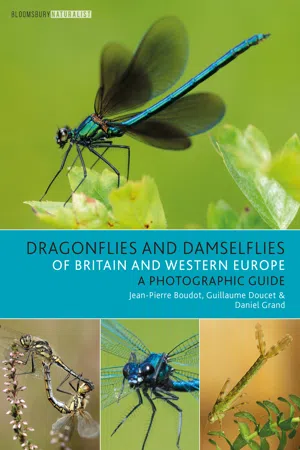
eBook - ePub
Dragonflies and Damselflies of Britain and Western Europe
A Photographic Guide
- 152 pages
- English
- ePUB (mobile friendly)
- Available on iOS & Android
eBook - ePub
Dragonflies and Damselflies of Britain and Western Europe
A Photographic Guide
About this book
Trusted by 375,005 students
Access to over 1 million titles for a fair monthly price.
Study more efficiently using our study tools.
Information
1.
The Life Cycle of Dragonflies and Damselflies
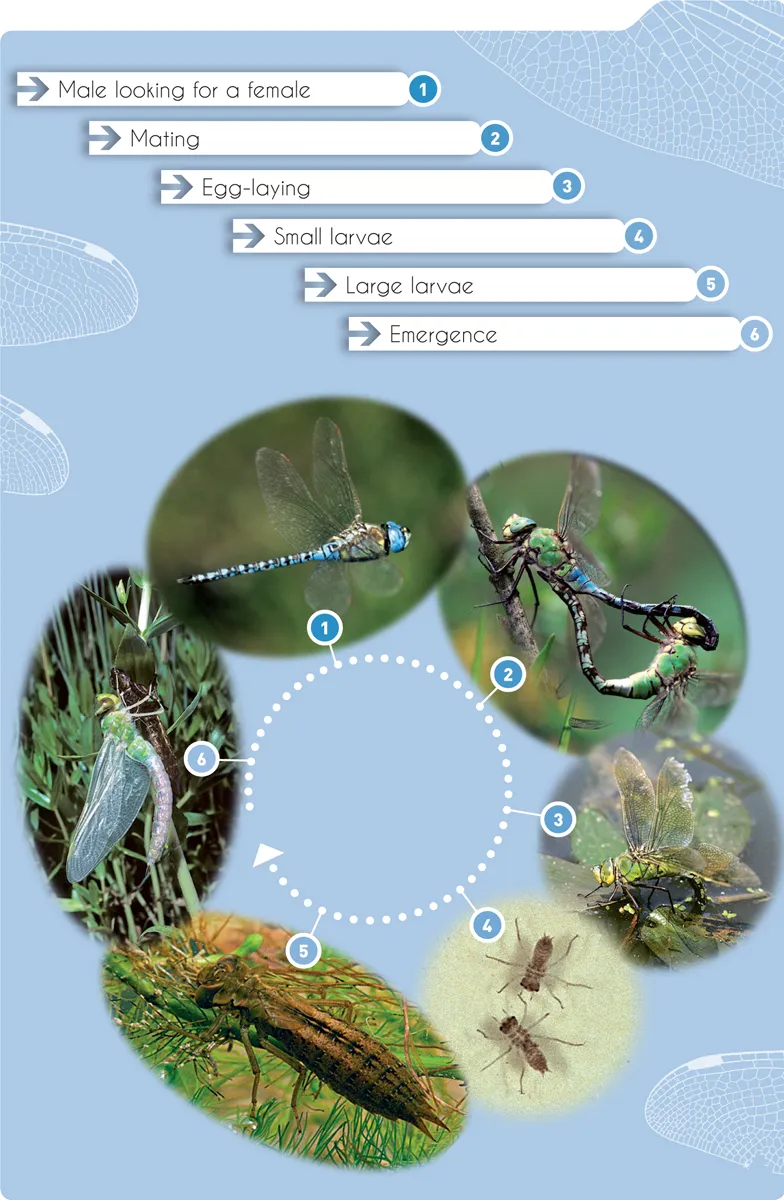
All dragonflies exhibit a similar life cycle, which can be divided into three main stages marked by a series of key events: egg, larva and adult. Together, they constitute a generation.
The number of generations per year varies with the species and, within the same species, with the climatic zone. Species that have only one generation per year are said to be univoltines; those that have more than one generation per year are called multivoltines (in our geographic region, these are bi- or trivoltines). Species with a longer larval cycle, spanning two years or more, are semivoltines (one generation every two years) or partivoltines (one generation every 3–6, or even 10 years).
EGG-LAYING AND INCUBATION
Dragonflies employ many different egg-laying strategies. Some species (Zygoptera, Aeshnidae) use their ovipositor to inject their eggs into the stems of herbaceous vegetation, into the bark of softwood trees, into floating plant debris, or into submerged rotten wood or peat; this is called endophytic egg-laying. Other species (certain Anisoptera) carefully deposit their eggs on the surface of submerged or emerged vegetation, which serves as a simple support and to which they adhere; this is called epiphytic egg-laying. Some species drop their eggs at regular intervals above or at the surface of the water, or (Cordulegastridae) sink their eggs into the sediment at the bottom of streams using their ovipositor, by hovering vertically and stabbing their abdomen into the stream-bed; this is called exophytic egg-laying. The eggs of most species are cream to light brown in colour when they are laid.
In all cases, the female may either lay alone or remain in tandem with the male, the latter holding her by the prothorax or behind the eyes. The male may also accompany the female by flying in close attendance.
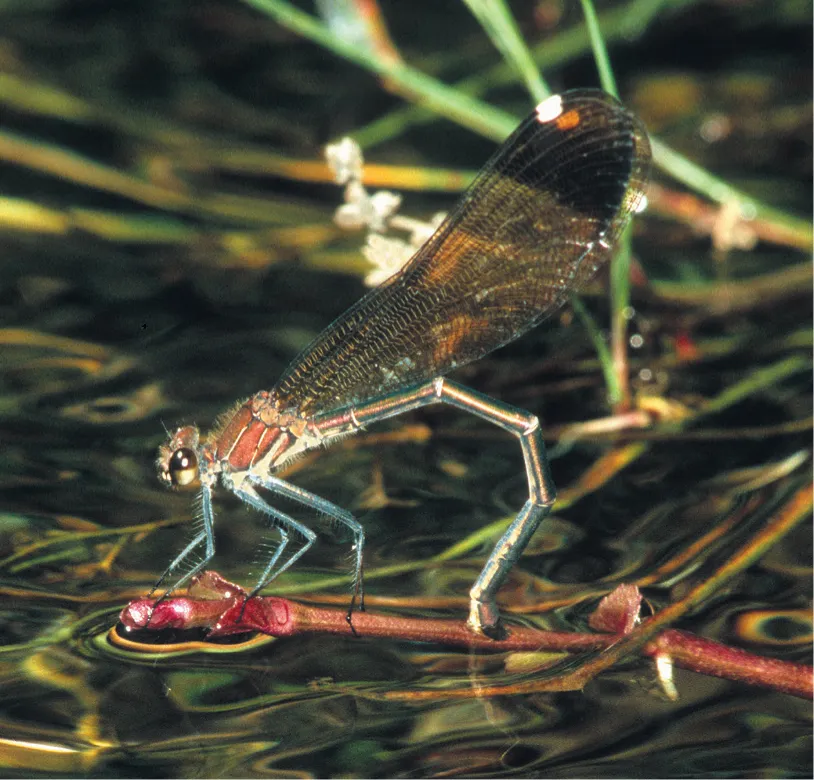
Endophytic egg-laying in Calopteryx haemorrhoidalis.
The duration of embryonic development is highly variable, depending on the species and environmental conditions. In some species, embryonic development begins immediately after the egg is laid and continues without interruption, so that hatching can occur before winter. In other species, embryogenesis is interrupted shortly after the egg is laid, and does not resume until after winter (winter diapause). Hatching is thus postponed until the following spring.
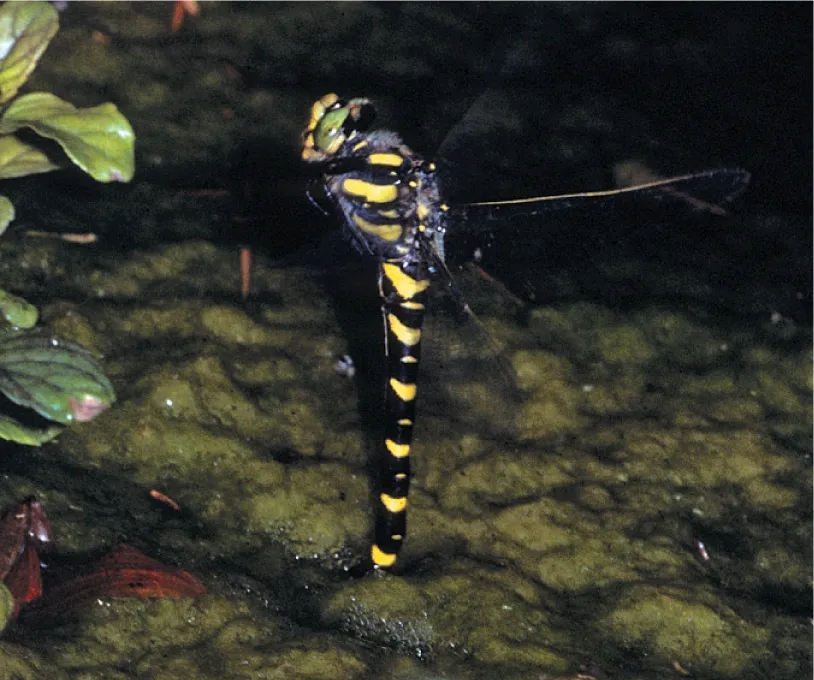
Exophytic egg-laying in Cordulegaster boltonii.
The Odonata life cycle
THE LARVAL PHASE
Each egg hatches into a prolarva or primary larva. The larval phase is always aquatic in our regions and includes several stages. Each larval stage ends with a moult, also called exuviation or ecdysis. There are 8–18 moults, depending on the species, but the majority of species in both Zygoptera and Anisoptera go through a series of 11–13 moults.
•ANATOMY OF LARVAE
During the different larval stages, the legs (initially reduced to one article) start to develop; the tarsi become specialised; the antennae acquire their final number of segments (4–7); the wing sheaths, absent at first, appear after the fifth moult and then develop; the genital organs are formed; the eyes grow; and, in Zygoptera, the caudal lamellae appear.
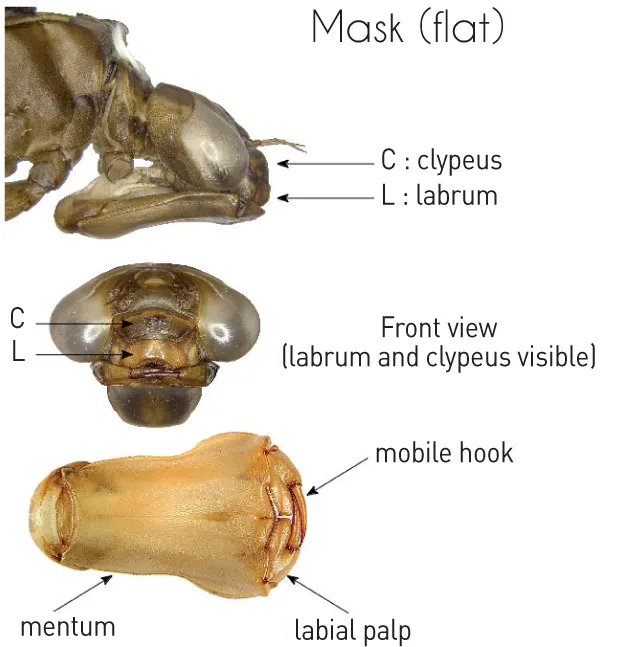
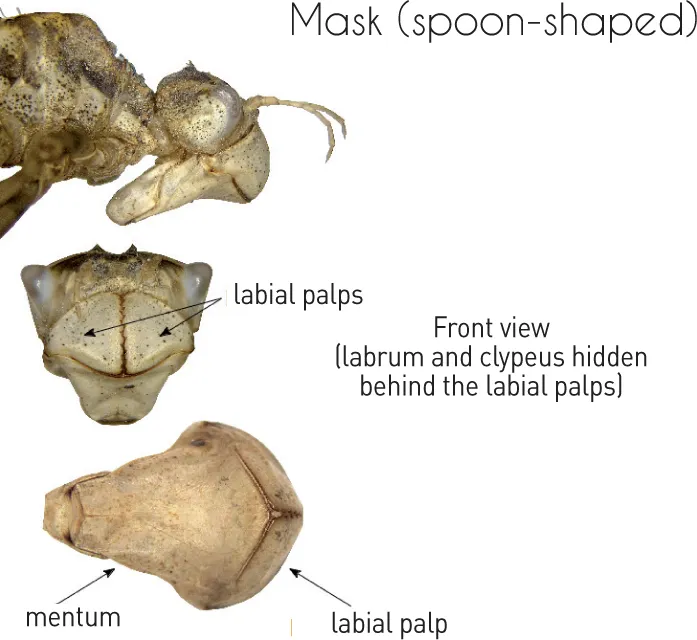
The head consists of the labrum, two mandibles, two maxillae and a prehensile mask. The main parts of the latter are the submentum, the mentum and two labial palps, each bearing a mobile hook. The mentum and the palps may be lined with setae (bristles).
The thorax bears three pairs of legs and the wing sheaths. On each side of the thorax are two pairs of respiratory stigmas (the meso- and metathoracic stigmas); these orifices and their internal extensions (tracheae and tracheoles) develop during successive moults and mark the progressive development of aerial respiration.
The abdomen is located behind the thorax and is made up of 10 segments, these sometimes bearing spiny growths. The apex of the abdomen ends in an excretory orifice surmounted by appendages that differ in the Zygoptera and Anisoptera.
In the Zygoptera, the appendages are made of three well-developed caudal lamellae, whereas in the Anisoptera they are reduced to small pointed outgrowths that fit together to form the anal pyramid. The anal pyramid is a complex structure that includes two cerci, two paraprocts and an epiproct, the base of which is more or less widened.
ANATOMY OF A LARVA (EXUVIA) OF ANISOPTERA

ANATOMY OF A LARVA (EXUVIA) OF ZYGOPTERA

•BEHAVIOUR OF LARVAE
Zygoptera larvae are rather slender and agile, and are able to move by undulating their body. In contrast, Anisoptera larvae propel themselves rhythmically by vigorously ejecting water from their rectum. Usually stouter, the latter are often reluctant to move and can be seen walking slowly or burrowing into the substrate.
Dragonfly larvae are carnivorous and have predators. They also exhibit different types of posture. Some larvae, notably in the Libellulidae, live at the bottom of waterbodies, lying on substrates such as sediment or stones with their legs spread widely. Some blend into their environment, hiding in the surroundin...
Table of contents
- Cover
- Title Page
- Contents
- Foreword
- 1. The Life Cycle of Dragonflies and Damselflies
- 2. Dragonflies and their Habitats
- 3. Dragonfly Surveying, Observation and Photography
- 4. Field Key to Adult Dragonflies
- 5. Field Guide to the Exuviae and Larvae (Final Instar) of Dragonflies
- Pterography (Wing photography)
- Comparative Plate of Dragonfly Morphology
- Bibliography
- Checklist of the Dragonflies and Damselflies of Britain and Western Europe
- Authors
- Acknowledgements
- eCopyright
Frequently asked questions
Yes, you can cancel anytime from the Subscription tab in your account settings on the Perlego website. Your subscription will stay active until the end of your current billing period. Learn how to cancel your subscription
No, books cannot be downloaded as external files, such as PDFs, for use outside of Perlego. However, you can download books within the Perlego app for offline reading on mobile or tablet. Learn how to download books offline
Perlego offers two plans: Essential and Complete
- Essential is ideal for learners and professionals who enjoy exploring a wide range of subjects. Access the Essential Library with 800,000+ trusted titles and best-sellers across business, personal growth, and the humanities. Includes unlimited reading time and Standard Read Aloud voice.
- Complete: Perfect for advanced learners and researchers needing full, unrestricted access. Unlock 1.4M+ books across hundreds of subjects, including academic and specialized titles. The Complete Plan also includes advanced features like Premium Read Aloud and Research Assistant.
We are an online textbook subscription service, where you can get access to an entire online library for less than the price of a single book per month. With over 1 million books across 990+ topics, we’ve got you covered! Learn about our mission
Look out for the read-aloud symbol on your next book to see if you can listen to it. The read-aloud tool reads text aloud for you, highlighting the text as it is being read. You can pause it, speed it up and slow it down. Learn more about Read Aloud
Yes! You can use the Perlego app on both iOS and Android devices to read anytime, anywhere — even offline. Perfect for commutes or when you’re on the go.
Please note we cannot support devices running on iOS 13 and Android 7 or earlier. Learn more about using the app
Please note we cannot support devices running on iOS 13 and Android 7 or earlier. Learn more about using the app
Yes, you can access Dragonflies and Damselflies of Britain and Western Europe by Jean-Pierre Boudot,Guillaume Doucet,Daniel Grand in PDF and/or ePUB format, as well as other popular books in Biological Sciences & Entomology. We have over one million books available in our catalogue for you to explore.