In The Failure of Death, John records the greatest conflict planet earth has ever experienced. It is not a conflict between nations or peoples, nor a conflict involving military weapons. It is a conflict for the hearts and souls of all men everywhere. It is a conflict in the spiritual dimension of reality that has raged on since the beginning of time, a conflict between good and evil, right and wrong.The Jewish leadership had grown to hate Jesus. Several times they had tried, unsuccessfully, to put a stop to His influence over men. The prophetic words of Caiaphas the high priest had finally come to fruition, "It is expedient for you that one man should die for the people, and that the whole nation should not perish."Jesus had finally been arrested, "tried" and crucified to appease the will of the Jewish leadership. Victory had finally been achieved in stopping the madness of The Way. The head of the snake had been cut off.John focuses our attention around two major players as the events of Jesus' crucifixion unfold, Peter and Pilate. With Peter a clear contrast is drawn between One suffering and dying and the other lying and denying. Pilate's struggle, who is caught up in the tangled web of the Jews, is expressed in the profound question, "What is truth?" Yet Pilate turns and walks away before the One who is "the truth" has a chance to respond.Neither Peter or Pilate, nor anyone expected that the One who had been crucified and buried would raise from the dead. The failure of death rocked the world in the first century and it continues to rock our world today. John concludes his gospel with the redemption of the lying denier. Pilate, on the other hand, is left on the trash pile of history. As you read, you will be caught up in the trauma and emotions of the events that unfold. Will the failure of death be your final reward? Like Peter and Pilate, you also have a choice!
eBook - ePub
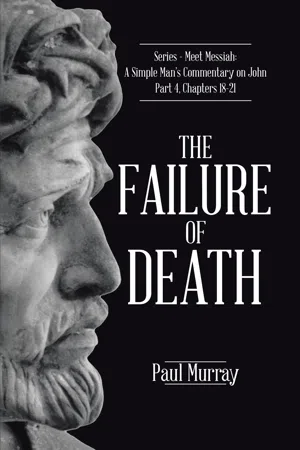
The Failure of Death
Series - Meet Messiah: A Simple Man's Commentary on John Part 4, Chapters 18-21
- 244 pages
- English
- ePUB (mobile friendly)
- Available on iOS & Android
eBook - ePub
The Failure of Death
Series - Meet Messiah: A Simple Man's Commentary on John Part 4, Chapters 18-21
About this book
Trusted by 375,005 students
Access to over 1.5 million titles for a fair monthly price.
Study more efficiently using our study tools.
Information
Topic
Theology & ReligionSubtopic
Biblical CommentaryChapter 1
The Garden Scene
John 18:1–4
Immediately before us in this opening section, John 18:1–4, we have an account of the setting just before Jesus’ arrest in the Garden of Gethsemane. This sets the stage for the tragic events that are about to take place in the next several hours. We are in the waning hours of Thursday night and the early morning hours of Friday.
The spring air is cool and damp, but not too cool to wrap your tunic around you and fall fast asleep in the quietness of the garden, to the tune of crickets chirping in the distance. It is already Friday, and Passover will begin at 6:00 PM later this day. Jesus will be dead before Passover begins in less than eighteen hours, but you have no clue about this or all that will lead up to it.
Right now, you are exhausted, not so much physically but mentally. The last three or more hours have been taxing. You just don’t want to think any more. Jesus has mentioned that He wanted to spend some time in prayer and you will do that. But even that seems like a chore at this point. You just want to lay down, get comfortable, and relax. You have no idea that things are going to feel like they have gotten out of control in just a few moments.
The context is set in verse 1–3:
1 When Jesus had spoken these words, He went forth with His disciples over the ravine of the Kidron, where there was a garden, into which He Himself entered, and His disciples.
2 Now Judas also, who was betraying Him, knew the place; for Jesus had often met there with His disciples.
3 Judas then, having received the Roman cohort, and officers from the chief priests and the Pharisees, came there with lanterns and torches and weapons.
One of the things that is so fascinating in John’s closing account of Jesus’ life and ministry is what is and is not included. We will note some of that as we go along. The differences of opinion among the commentary writers are also fascinating.
A Familiar Location
Jesus has concluded His Words to Loved Ones. All that needed to be said has been said. They cross the short distance across the Kidron Valley to the garden just up the hill a ways on the opposite side of the valley. Now is not a time for further discussion. Now is a time for prayer. Jesus is fully aware of the events just moments away.
Verse 2 gives us another clue about the scene. The garden was a place Jesus often took His disciples. According to what I’ve read, there were several gardens on the Mount of Olives. These were not public gardens or city-owned gardens. It was not a Manito Park, as exists in downtown Spokane or a Central Park as in New York City. Nor was it a state park run by the Department of Fish and Game.
These were private olive gardens owned by wealthy people who lived in Jerusalem. These gardens, only a short walk, provided some quietness and privacy away from the congestion and chaos of the city. Jesus apparently knew and befriended such a person and had permission to use his garden.
This was a place Jesus often went when He came to Jerusalem, to get away in the evenings from the daily masses. It was something of a “safe place” for Him, a place of solitude and prayer. It became a private place to re-connect with His men and His Father after a people-filled day.
We can surmise from Jesus’ routine that Judas knew exactly where He could be found after their supper. When John says “often met there” I would assume that meant whenever Jesus came to Jerusalem for all the feasts. At the end of the day, in the shade of the olive trees, they would go there to rest, talk, and pray. There was no doubt in Judas’ mind as to where he would find Jesus. The fact that the garden was “off limits” to the public, being private, made it an ideal place to get Him, apart from the crowds.
Having dismissed Judas earlier, Jesus knew that He would see him later that night. He knew that Judas had gone to betray Him because the Old Testament Scriptures had revealed that.1 As to when Judas would show up and whom he would bring with him, Jesus didn’t know. He knew the method of His death would be by crucifixion, so it was safe to assume some contingent of Romans might show up, and he knew the Jews had plotted to kill Him, so some contingent of temple guards might also show up.
Jesus didn’t flee or go to some other place to pray with His men because He knew with certainty that His hour had come.2 Three times earlier in John’s gospel Jesus had said, “My hour has not yet come.”3 However, now was the time. It was, for this reason, He had stepped out of eternity into human history. Jesus went to this garden because His very purpose was to give His life as a ransom for many.4 He went because He knew this was the cup of suffering the Father had given Him to drink.5 It was His Father’s will.
Here is a list of some of the things Jesus was aware of as He crossed the Kidron Valley and ascended into this private sanctuary.
He would be betrayed by one of His own.6
He knew He would be rejected, despised, and treated with contempt.7
He would be physically beaten beyond recognition, punched in the face and led to the slaughter like a defenseless lamb.8
All would mock him.9
They would spit on Him.10
His strength would be beaten out of Him.11
Both His hands and feet would be nailed to a cross.12
Worst of all, the Father would turn His back on Him and forsake Him in His greatest hour of need.13
These were just some of the things Jesus was aware and all of this was only a few hours away. How did He know all this? The Old Testament had revealed all of it. He knew it because He knew His Bible. It ...
Table of contents
- Chapter 1
- Chapter 2
- Chapter 3
- Chapter 4
- Chapter 5
- Chapter 6
- Chapter 7
- Chapter 8
- Chapter 9
- Chapter 10
- Chapter 11
- Chapter 12
- Chapter 13
- Chapter 14
- Chapter 15
Frequently asked questions
Yes, you can cancel anytime from the Subscription tab in your account settings on the Perlego website. Your subscription will stay active until the end of your current billing period. Learn how to cancel your subscription
No, books cannot be downloaded as external files, such as PDFs, for use outside of Perlego. However, you can download books within the Perlego app for offline reading on mobile or tablet. Learn how to download books offline
Perlego offers two plans: Essential and Complete
- Essential is ideal for learners and professionals who enjoy exploring a wide range of subjects. Access the Essential Library with 800,000+ trusted titles and best-sellers across business, personal growth, and the humanities. Includes unlimited reading time and Standard Read Aloud voice.
- Complete: Perfect for advanced learners and researchers needing full, unrestricted access. Unlock 1.5M+ books across hundreds of subjects, including academic and specialized titles. The Complete Plan also includes advanced features like Premium Read Aloud and Research Assistant.
We are an online textbook subscription service, where you can get access to an entire online library for less than the price of a single book per month. With over 1.5 million books across 990+ topics, we’ve got you covered! Learn about our mission
Look out for the read-aloud symbol on your next book to see if you can listen to it. The read-aloud tool reads text aloud for you, highlighting the text as it is being read. You can pause it, speed it up and slow it down. Learn more about Read Aloud
Yes! You can use the Perlego app on both iOS and Android devices to read anytime, anywhere — even offline. Perfect for commutes or when you’re on the go.
Please note we cannot support devices running on iOS 13 and Android 7 or earlier. Learn more about using the app
Please note we cannot support devices running on iOS 13 and Android 7 or earlier. Learn more about using the app
Yes, you can access The Failure of Death by Paul Murray in PDF and/or ePUB format, as well as other popular books in Theology & Religion & Biblical Commentary. We have over 1.5 million books available in our catalogue for you to explore.