When the Soviets launched Sputnik in 1957, thousands of ordinary people across the globe seized the opportunity to participate in the start of the Space Age. Known as the "Moonwatchers," these largely forgotten citizen-scientists helped professional astronomers by providing critical and otherwise unavailable information about the first satellites. In Keep Watching the Skies!, Patrick McCray tells the story of this network of pioneers who, fueled by civic pride and exhilarated by space exploration, took part in the twentieth century's biggest scientific endeavor.
Around the world, thousands of teenagers, homemakers, teachers, amateur astronomers, and other citizens joined Moonwatch teams. Despite their diverse backgrounds and nationalities, they shared a remarkable faith in the transformative power of science--a faith inspired by the Cold War culture in which they lived. Against the backdrop of the space race and technological advancement, ordinary people developed an unprecedented desire to contribute to scientific knowledge and to investigate their place in the cosmos. Using homemade telescopes and other gadgets, Moonwatchers witnessed firsthand the astonishing beginning of the Space Age. In the process, these amateur scientists organized themselves into a worldwide network of satellite spotters that still exists today.
Drawing on previously unexamined letters, photos, scrapbooks, and interviews, Keep Watching the Skies! recreates a pivotal event from a perspective never before examined--that of ordinary people who leaped at a chance to take part in the excitement of space exploration.
eBook - ePub
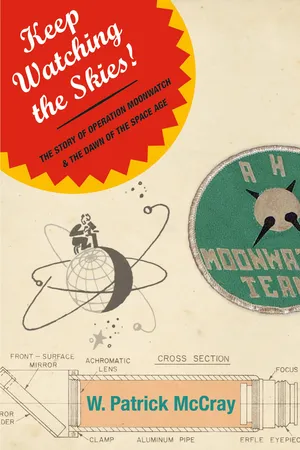
Keep Watching the Skies!
The Story of Operation Moonwatch and the Dawn of the Space Age
- 344 pages
- English
- ePUB (mobile friendly)
- Available on iOS & Android
eBook - ePub
Keep Watching the Skies!
The Story of Operation Moonwatch and the Dawn of the Space Age
About this book
Trusted by 375,005 students
Access to over 1.5 million titles for a fair monthly price.
Study more efficiently using our study tools.
Information
Topic
Scienze fisicheSubtopic
Storia nordamericana
Cultures of Observation
Imagine it is springtime in 1951 and teenagers, including future Moonwatchers, are going to the movies. They have transformed their dollar bills into tickets, popcorn, and sodas with some change still left. They take their seats with the rest of an expectant and comfortably slumped audience. Together they harbor dreams, nurtured by radio shows and comic books, about space travel and exploring the frontiers of science. The lights dim and the curtain goes up.
When RKO pictures released The Thing from Another World in 1951, film critics, a group indifferent if not hostile to the science-fiction genre, praised the movie’s “thrills and chills.” 1 Its plot centered around a small band of heroic Americans who barely defeat an alien invasion bent on planetwide destruction and subjugation. One viewer recalled years later that his parents would not let him see it because rumor held the picture was too unsettling for young viewers. 2 However, American audiences eager to be distracted from bad news emerging daily from the frontlines of the Cold War turned out in droves and made it a classic sci-fi film.
Later that year, another box office success, The Day the Earth Stood Still, introduced viewers to Klaatu, a kindly yet stern visitor from an advanced alien culture. The spaceman brought with him his menacing companion robot, which he controlled with a phrase soon repeated by kids everywhere: “Klaatu barada nikto.” With help from the world’s scientists, Klaatu managed to warn politicians and the public against continuing a suicidal nuclear arms race.
Both The Thing and The Day the Earth Stood Still became landmark films of the sci-fi genre. Each presented a different perspective on what shocks might come from the sky—devastation or a sign of peace. These movies and dozens more like them, with their high-tech spaceships, aliens from other planets, and powerful scientists, tapped into the psyche and popular culture of the early Cold War. They reflected the public’s intense interest in science and space exploration and stressed the need to maintain vigilance in the hope of spotting unknown, possibly dangerous, objects in the heavens. No doubt some moviegoers heard the final words of The Thing, flashed to all corners of the earth by a frantic reporter, as a call for watchfulness: “Watch the skies. Everywhere. Keep looking. Keep watching the skies!” 3
By November 1957, people all over the world watched the skies for the first satellites, which previously existed only in the realm of science fiction movies and stories. In the United States, citizens reacted to these new objects with a bewildering array of feelings shaped by media coverage that interpreted the Sputnik story as a “drama of dream and dread.” 4 Awe, paranoia, excitement all blurred together in the national consciousness as Sputnik became a symbol to which both fear or hope were fixed.
In the 1950s, a whole host of objects and activities related to science and space exploration—science fiction movies, board games, science kits, television shows, comic books, and pop songs—orbited through the cultural firmament. At the same time, a strong ideology in 1950s America encouraged civic participation and advocated the need to be alert. Government and community groups stressed duck-and-cover drills, bomb shelters, and urban evacuation as keys to national and personal survival.
Taken together, these cultural expressions about space, science, and watchfulness helped prime American citizens for Sputnik and the opening of the Space Age. Even as early as 1952, when a Saturday Evening Post cover featured a wide-eyed boy in a space suit boarding an airplane for the first time, the message was clear. People, especially kids, were crazy about space. For some, this childhood interest never waned but matured into a broader interest in science and technology. In the rest of this chapter, we will explore three communities from the 1950s—space buffs, vigilant and dutiful citizens, and devoted amateur scientists—that provided a reservoir of talent and enthusiasm for Moonwatch to draw upon.
Imagining Space Exploration
The Thing ended with a warning for people everywhere to watch the skies. But just what were average citizens in the 1950s expecting to see if they scanned the sky?
Many looked for flying saucers, the vehicle of choice for alien visitors to earth in the expanding universe of sci-films. Comics, films, and magazine articles convinced a significant part of the population—despite scientists’ explanations—that flying saucers were regularly observing us while the government covered up the phenomenon. 5 When the pulp comic Weird Science appeared on newsstands in the summer of 1950, its cover depicted government officials dismissing UFOs as “utter nonsense” despite saucers shown hovering in the background. Fiction reflected reality, and the air force investigated over 3,400 sightings of UFOs between 1947 to 1955. This number later doubled in the wake of Sputnik.
Saucers (and, later, Sputnik) sightings inspired musicians and authors. Take music, for example. In 1947, country singers The Buchanan Brothers released their novelty song “When You See Those Flying Saucers.” Like their earlier hit, a 1946 cover of the Fred Kirby–penned “Atomic Power,” this song tied the new phenomenon to fundamentalist prophecies of Judgment Day. After Sputnik appeared in the world’s skies, other songs on the airwaves echoed the Buchanan Brothers.
Just like the music that flowed out of recording studios in the wake of Hiroshima, some of these space and, later, Sputnik-themed tunes reflected a cautious attitude toward technology especially common among some rural Americans. 6 Like an earlier song that told of steel-drivin’ John Henry and his battle with a job-stealing, steam-powered machine, many folk and country tunes, circa 1950, expressed an ambivalence toward new machines and gadgets and chronicled the threat these posed to their rural listening audience. Space travel, UFOs, and satellites added new gloss to these traditional music themes that country artists refashioned for the Space Age.
Most Sputnik songs were goofy ditties. Sixteen-year-old singer Carl Mann put out “Satellite No. 2” in 1958 that had the rockabilly cats doing the “Sputnik hop.” 7 Mann, a regular on Tennessee radio stations, got much more airplay later that year with his version of the classic tune “Mona Lisa.” The space-song fad wasn’t limited to white artists. African American blues singer Roosevelt Sykes offered some support for a beleaguered Eisenhower. His 1957 tune “Sputnik Baby” bragged to Soviet premier Nikita Khrushchev that American satellites could outperform the Soviets’ hardware. While not as popular as tunes Elvis Presley and Buddy Holly sang that year, jukeboxes and radios helped these early Space Age songs reach listeners beyond the traditional country music audience.
If the appeal of musicians like these was perhaps limited to certain audiences, the same cannot be said for the flood of science fiction books and space-oriented comics that flew from American newsstands into the eager hands of teens and adults. Interest in science fiction and its presentation via books and comics was nothing new, of course. For decades, Jules Verne, H. G. Wells, Hugo Gernsback, and a host of lesser known authors helped establish science fiction’s popularity with their novels and pulp magazine stories. As early as 1869, the Atlantic Monthly serialized a story about an orbiting space station constructed from the high-tech material of the time—bricks.
The sheer volume of sci-fi stories that were churned out and the vast national audience they reached distinguished the postwar era. Traditional sci-fi comics used voyage-in-space plots with reliable characters like bugeyed aliens and imperialistic space adventurers fighting them with the help of ray guns and comely women. Other publishers pushed the limits of the genre. Consider Entertainment Comics, one of the most popular comic franchises of the early 1950s. Known to fans as EC, the company began to publish science fiction titles like Weird Science and Weird Fantasy . Often presenting intellectual themes with doses of irony and cynicism that appealed to older readers as well as teens, EC comics tackled social issues like nuclear disarmament and racial discrimination. EC comics also attracted major sci-fi writers and published adaptations of soon-to-be classic stories such as Ray Bradbury’s chilling postapocalyptic “There Will Come Soft Rains.” In the early 1950s, comics reached millions of American kids as over five hundred titles appeared monthly at newsstands. Only a 1954 outcry over comics’ horror and crime-laden content and accompanying congressional hearings caused sales figures to drop. Their vigorous rebound coincided with the formation of Moonwatch teams around the world and the launch of the first satellites.
The 1950s were, of course, a golden era for space operas that aired on radio and television. Space-themed television shows, beginning with the 1949 premiere of Captain Video and His Video Rangers, followed the vapor trail left by Flash Gordon and Buck Rogers. These shows became touchstones for millions of American kids and spun off closets full of children’s toys and games. With their melodramatic plots and heroic characters, shows like Captain Video and Tom Corbett, Space Cadet blended technological and military themes and reached millions of homes. In addition to popular comic titles, they formed part of a growing youth culture that featured space exploration and science as central themes.
While adults did not always understand kids’ fascination with space-themed toys and games, they could clearly see a potential profit in them. Boosted by increasingly sophisticated sales techniques that recognized children as a specific market, a cornucopia of material culture appeared that catered to their fascination with space. Every day, millions of kids played with toy ray guns and model rocket ships, joined clubs such as the Space Patrol and followed the Space Ranger code. In 1951, the Gimbel’s department store featured a “Space Cadet Christmas” with Tom Corbett’s ship, the Polaris, as a main attraction. Six thousand kids showed up the first day it opened, many no doubt with parents in tow, purses and wallets in hand. 8
In the 1950s, saucer and satellite songs, comic books, and an abundance of space toys manifested the American public’s broad fascination with space exploration and spaceflight. This interest coincided with dramatic shifts in public opinion about the feasibility of travel to outer space. 9 While skeptics first snickered at Robert Goddard’s ideas for space exploration, German missile technology exploded the idea that practical (and violent) uses of rockets were only the realm of dreamers and fabulists. In 1949, according to a Gallup poll, only 15 percent of Americans believed people would explore space by the year 2000. By 1955, this number had more than doubled, as some 38 percent of people polled believed humans would reach the moon within half a century. During the 1950s, as scientists and the military began to probe the frontiers of our atmosphere, events and ideas converged to convince many Americans that their children, if not themselves, would witness space travel.
In October 1951, the Hayden Planetarium at New York City’s Museum of Natural History held the first in a series of symposia devoted to the possibilities and challenges of space travel. Willy Ley, a German émigré and advocate for spaceflight, organized the meeting. Ley had already contributed to the canon of early spaceflight with books like Rockets: The Future of Travel beyond the Stratosphere (written while V-2 rockets pummeled European cities) and the award-winning Conquest of Space published in 1949. Devoted to promoting space exploration, Ley’s opening talk at the New York symposium predicted a coming era of earth-orbiting satellites and space stations. Harvard astronomer Fred Whipple, a specialist on meteors and comets, followed Ley at the podium and talked about the revolutionary science that astronomers could engage in from space.
Staff from Collier’s, one of the most widely circulated magazines of the time, attended the symposium and helped publicize it to a wider audience. Collier’s editor had a hunch that spaceflight would make a good story and dispatched Cornelius Ryan to a follow-up symposium held a few weeks later in San Antonio. Ryan, who later wrote The Longest Day, the classic chronicle of D-Day, was initially skeptical about his assignment. Whipple took Ryan out for cocktails and dinner, and famed German rocket scientist Wernher von Braun and Joseph Kaplan, a Hungarian-born physicist from Berkeley, joined them. A passionate all-night discussion ensued and, by the time their drinks were gone, they had sold the journalist on spaceflight.
Beginning in March 1952, Collier’s published a series of influential articles that presented the American public with a smorgasbord of information describing the exploration of space. The editors at Collier’s recognized the importance of visual imagery and asked Chesley Bonestell to depict what space travel might look like. An American artist and astronomy buff, Bonestell had previously illustrated Ley’s Conquest of Space and made set designs for sci-fi films. Before their exposure to his images, most Americans interested in space subsisted on a diet of UFO stories and sci-fi movies. Bonestell’s artwork, some of it based on von Braun’s own blueprints, helped Americans visualize outer space. Through a combination of photorealism and scientific fact, Bonestell made space exploration seem both plausible and awe inspiring. When the first issue hit American newsstands, Bonestell’s evocative image of a massive multistage launch vehicle on its way to an earth orbit graced the cover (which pronounced “Man Will Conquer Space Soon ”). 10 Inside, readers found articles by von Braun, Whipple, and other noted scientists, all telling readers that space exploration was not just possible but inevitable.
The Collier’s series had a tremendous influence on popular ...
Table of contents
- Cover Page
- Title Page
- Copyright Page
- Dedication
- Contents
- Acknowledgments
- Organizations and People
- Introduction: “They Said It Couldn’t Be Done!”
- Chapter 1: Cultures of Observation
- Chapter 2: An Astronomical Engineer
- Chapter 3: Wanted: Satellite Spotters
- Chapter 4: Of Spacehounds and Lunartiks
- Chapter 5: Seeing History through a Small Telescope
- Chapter 6: Amateurs Provide Strength on the Bench
- Chapter 7: Moonwatch Grows Up
- Chapter 8: The Legacy of Moonwatch
- Explanation of Sources Used
- Notes to the Chapters
- Index
Frequently asked questions
Yes, you can cancel anytime from the Subscription tab in your account settings on the Perlego website. Your subscription will stay active until the end of your current billing period. Learn how to cancel your subscription
No, books cannot be downloaded as external files, such as PDFs, for use outside of Perlego. However, you can download books within the Perlego app for offline reading on mobile or tablet. Learn how to download books offline
Perlego offers two plans: Essential and Complete
- Essential is ideal for learners and professionals who enjoy exploring a wide range of subjects. Access the Essential Library with 800,000+ trusted titles and best-sellers across business, personal growth, and the humanities. Includes unlimited reading time and Standard Read Aloud voice.
- Complete: Perfect for advanced learners and researchers needing full, unrestricted access. Unlock 1.5M+ books across hundreds of subjects, including academic and specialized titles. The Complete Plan also includes advanced features like Premium Read Aloud and Research Assistant.
We are an online textbook subscription service, where you can get access to an entire online library for less than the price of a single book per month. With over 1.5 million books across 990+ topics, we’ve got you covered! Learn about our mission
Look out for the read-aloud symbol on your next book to see if you can listen to it. The read-aloud tool reads text aloud for you, highlighting the text as it is being read. You can pause it, speed it up and slow it down. Learn more about Read Aloud
Yes! You can use the Perlego app on both iOS and Android devices to read anytime, anywhere — even offline. Perfect for commutes or when you’re on the go.
Please note we cannot support devices running on iOS 13 and Android 7 or earlier. Learn more about using the app
Please note we cannot support devices running on iOS 13 and Android 7 or earlier. Learn more about using the app
Yes, you can access Keep Watching the Skies! by W. Patrick McCray in PDF and/or ePUB format, as well as other popular books in Scienze fisiche & Storia nordamericana. We have over 1.5 million books available in our catalogue for you to explore.