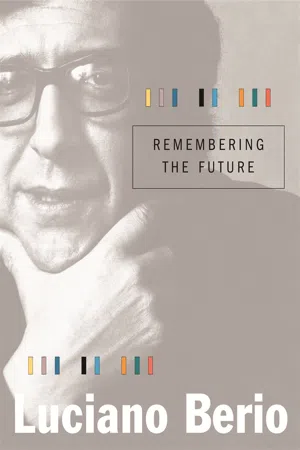
How one of the foremost experimental composers of the twentieth century approaches his métier.
Music is never confined to a single moment. Compositions play with our expectations of the future; musical notes are recorded on a page to be revived by future performers; and old compositions are remembered, quoted, and reconfigured in new ones. In his 1993–1994 Charles Eliot Norton Lectures, Luciano Berio skillfully explores the whirlpools and eddies of musical time, the intricate interplay between our moment-to-moment experience of music and the idioms, traditions, and histories that form our musical memory.
Remembering the Future is full of insights into Berio's own creative process. Writing these lectures, he says, "led me to formulate thoughts that might otherwise have remained concealed in the folds of my work." Thematically wide-ranging—reflecting on transcription and translation, poetics and analysis, opera and the "open work"—Berio offers a trenchant assessment of both his contemporaries and his forbears, from Boethius to Boulez. Like his friend and sometime collaborator Umberto Eco, he was also a figure of formidable intellect, fluently engaging with Heinrich Schenker, Theodor Adorno, Walter Benjamin, Carl Dahlhaus, and other critical luminaries.
But Berio wears his learning lightly. The cerebral complexity of these lectures is leavened with irony, humor, and arresting aphorisms. Ultimately, he points us back to the music: "The best possible commentary on a symphony," Berio says, "is another symphony."
eBook - PDF
Remembering the Future
About this book
Information
Subtopic
Classical MusicTable of contents
- Cover
- Title Page
- Copyright
- Preface
- Contents
- Chapter 1. Formations
- Chapter 2. Translating Music
- Chapter 3. Forgetting Music
- Chapter 4. O Alter Duft
- Chapter 5. Seeing Music
- Chapter 6. Poetics of Analysis
Trusted by 375,005 students
Access to over 1.5 million titles for a fair monthly price.
Study more efficiently using our study tools.
Frequently asked questions
Yes, you can cancel anytime from the Subscription tab in your account settings on the Perlego website. Your subscription will stay active until the end of your current billing period. Learn how to cancel your subscription
No, books cannot be downloaded as external files, such as PDFs, for use outside of Perlego. However, you can download books within the Perlego app for offline reading on mobile or tablet. Learn how to download books offline
Perlego offers two plans: Essential and Complete
- Essential is ideal for learners and professionals who enjoy exploring a wide range of subjects. Access the Essential Library with 800,000+ trusted titles and best-sellers across business, personal growth, and the humanities. Includes unlimited reading time and Standard Read Aloud voice.
- Complete: Perfect for advanced learners and researchers needing full, unrestricted access. Unlock 1.5M+ books across hundreds of subjects, including academic and specialized titles. The Complete Plan also includes advanced features like Premium Read Aloud and Research Assistant.
We are an online textbook subscription service, where you can get access to an entire online library for less than the price of a single book per month. With over 1.5 million books across 990+ topics, we’ve got you covered! Learn about our mission
Look out for the read-aloud symbol on your next book to see if you can listen to it. The read-aloud tool reads text aloud for you, highlighting the text as it is being read. You can pause it, speed it up and slow it down. Learn more about Read Aloud
Yes! You can use the Perlego app on both iOS and Android devices to read anytime, anywhere — even offline. Perfect for commutes or when you’re on the go.
Please note we cannot support devices running on iOS 13 and Android 7 or earlier. Learn more about using the app
Please note we cannot support devices running on iOS 13 and Android 7 or earlier. Learn more about using the app
Yes, you can access Remembering the Future by Luciano Berio in PDF and/or ePUB format, as well as other popular books in Media & Performing Arts & Classical Music. We have over 1.5 million books available in our catalogue for you to explore.