A revolutionary new framework that draws on insights from ecology for the design and analysis of long-duration robots
Robots are increasingly leaving the confines of laboratories, warehouses, and manufacturing facilities, venturing into agriculture and other settings where they must operate in uncertain conditions over long timescales. This multidisciplinary book draws on the principles of ecology to show how robots can take full advantage of the environments they inhabit, including as sources of energy.
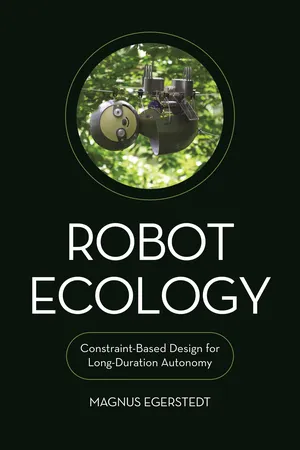
Magnus Egerstedt introduces a revolutionary new design paradigm—robot ecology—that makes it possible to achieve long-duration autonomy while avoiding catastrophic failures. Central to ecology is the idea that the richness of an organism's behavior is a function of the environmental constraints imposed by its habitat. Moving beyond traditional strategies that focus on optimal policies for making robots achieve targeted tasks, Egerstedt explores how to use survivability constraints to produce both effective and provably safe robot behaviors. He blends discussions of ecological principles with the development of control barrier functions as a formal approach to constraint-based control design, and provides an in-depth look at the design of the SlothBot, a slow and energy-efficient robot used for environmental monitoring and conservation.
Visionary in scope, Robot Ecology presents a comprehensive and unified methodology for designing robots that can function over long durations in diverse natural environments.
- 256 pages
- English
- ePUB (mobile friendly)
- Available on iOS & Android
eBook - ePub
About this book
Trusted by 375,005 students
Access to over 1 million titles for a fair monthly price.
Study more efficiently using our study tools.
Information
II Constraint-Based Control
4 Constraints and Barriers
As discussed in the past chapter, environmental constraints, phrased in ecological terms such as predation, territoriality, foraging, mutualism, and so on, give rise to a rich and sometimes surprising set of behaviors among animals [101, 137, 308, 357, 385]. Additionally, when robots are to be deployed over long time-scales, surviving, i.e, not ending up in a situation from which the robots cannot recover, takes precedence over acting in an optimal fashion, as survival is a prerequisite to thriving. In this chapter, we formalize these observations and, in particular, introduce the technical machinery needed to properly manifest constraint-based control design. The key construct towards this end is that of a Control Barrier Function (CBF), and we will build up towards establishing how robot survival can be expressed both compactly and elegantly through the use of CBFs.
Recall the vague yet suggestive statement from Chapter 1 that contained the essence of constraint-based control design for long-duration autonomy,

Here, x is the state of the robot, and the survival constraint has to hold at each instant of time. But, without explicitly calling out the decision variable over which the minimization takes place, this formulation is hopelessly ill-fated. As such, one needs to add the control input, u, to the formulation, i.e., incorporate the way control decisio...
Table of contents
- Cover
- Title Page
- Copyright
- Dedication
- Contents
- Preface
- I: Long-Duration Autonomy
- II: Constraint-Based Control
- III: Robots in the Wild
- Bibliography
- Index
Frequently asked questions
Yes, you can cancel anytime from the Subscription tab in your account settings on the Perlego website. Your subscription will stay active until the end of your current billing period. Learn how to cancel your subscription
No, books cannot be downloaded as external files, such as PDFs, for use outside of Perlego. However, you can download books within the Perlego app for offline reading on mobile or tablet. Learn how to download books offline
Perlego offers two plans: Essential and Complete
- Essential is ideal for learners and professionals who enjoy exploring a wide range of subjects. Access the Essential Library with 800,000+ trusted titles and best-sellers across business, personal growth, and the humanities. Includes unlimited reading time and Standard Read Aloud voice.
- Complete: Perfect for advanced learners and researchers needing full, unrestricted access. Unlock 1.4M+ books across hundreds of subjects, including academic and specialized titles. The Complete Plan also includes advanced features like Premium Read Aloud and Research Assistant.
We are an online textbook subscription service, where you can get access to an entire online library for less than the price of a single book per month. With over 1 million books across 990+ topics, we’ve got you covered! Learn about our mission
Look out for the read-aloud symbol on your next book to see if you can listen to it. The read-aloud tool reads text aloud for you, highlighting the text as it is being read. You can pause it, speed it up and slow it down. Learn more about Read Aloud
Yes! You can use the Perlego app on both iOS and Android devices to read anytime, anywhere — even offline. Perfect for commutes or when you’re on the go.
Please note we cannot support devices running on iOS 13 and Android 7 or earlier. Learn more about using the app
Please note we cannot support devices running on iOS 13 and Android 7 or earlier. Learn more about using the app
Yes, you can access Robot Ecology by Magnus Egerstedt in PDF and/or ePUB format, as well as other popular books in Technology & Engineering & Ecology. We have over one million books available in our catalogue for you to explore.