Eat to Treat
eBook - ePub

Eat to Treat

A Three-Step Plan to Reduce Inflammation, Detoxify Your Life, and Heal Your Body

  1. 336 pages
  2. English
  3. ePUB (mobile friendly)
  4. Available on iOS & Android
eBook - ePub

Eat to Treat

A Three-Step Plan to Reduce Inflammation, Detoxify Your Life, and Heal Your Body

About this book

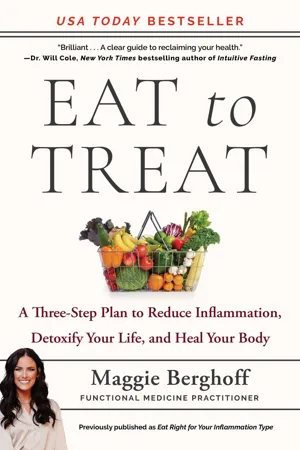
USA TODAY BESTSELLER A three-step plan to beat inflammation! Identify your specific type, set your lifestyle up to avoid triggers, and cook tailored recipes designed to help you heal. Functional medicine practitioner Maggie Berghoff presents a personalized, accessible approach to fighting inflammation. Using thorough questionnaires to identify your specific ailments, Eat to Treat prescribes a targeted plan that will help you live free of the major types of inflammation, including those triggered by hormones, digestive issues, stress, allergies, rheumatoid arthritis, and more. From easy tips for healing, eating, and detoxing, to targeted lifestyle advice, Berghoff offers the most up-to-date instructions for living your best and healthiest life based on your specific inflammation type.Inside you'll learn: - How to supercharge your immune system and feel better instantly
- How to set up an anti-inflammatory pantry
- Quick and easy recipes to ease your specific inflammation type
- The secret ways stress attacks your system and how to fight it
- The ingredients in your daily products to avoid—including how everything from your personal hygiene products to your showerhead could be affecting you
- Detailed detoxes tailored to your lifestyle
- Cutting-edge and easy household remedies you may have overlooked
Frequently asked questions

Yes, you can cancel anytime from the Subscription tab in your account settings on the Perlego website. Your subscription will stay active until the end of your current billing period. Learn how to cancel your subscription.
No, books cannot be downloaded as external files, such as PDFs, for use outside of Perlego. However, you can download books within the Perlego app for offline reading on mobile or tablet. Learn more here.
Perlego offers two plans: Essential and Complete
  • Essential is ideal for learners and professionals who enjoy exploring a wide range of subjects. Access the Essential Library with 800,000+ trusted titles and best-sellers across business, personal growth, and the humanities. Includes unlimited reading time and Standard Read Aloud voice.
  • Complete: Perfect for advanced learners and researchers needing full, unrestricted access. Unlock 1.4M+ books across hundreds of subjects, including academic and specialized titles. The Complete Plan also includes advanced features like Premium Read Aloud and Research Assistant.
Both plans are available with monthly, semester, or annual billing cycles.
We are an online textbook subscription service, where you can get access to an entire online library for less than the price of a single book per month. With over 1 million books across 1000+ topics, we’ve got you covered! Learn more here.
Look out for the read-aloud symbol on your next book to see if you can listen to it. The read-aloud tool reads text aloud for you, highlighting the text as it is being read. You can pause it, speed it up and slow it down. Learn more here.
Yes! You can use the Perlego app on both iOS or Android devices to read anytime, anywhere — even offline. Perfect for commutes or when you’re on the go.
Please note we cannot support devices running on iOS 13 and Android 7 or earlier. Learn more about using the app.
Yes, you can access Eat to Treat by Maggie Berghoff in PDF and/or ePUB format, as well as other popular books in Medicine & Diseases & Allergies. We have over one million books available in our catalogue for you to explore.

Information

Publisher
Atria Books
Year
2021
Print ISBN
9781982157654

1 UNDERSTANDING HOW INFLAMMATION WORKS IN YOUR BODY

Let’s start with the million-dollar question: What exactly is inflammation? Well, I’ll begin by setting a record straight: inflammation itself is not the enemy. Sure, this book is all about curing inflammation, but it goes deeper than that. Rather, it’s the root causes of inflammation, and the long-term impact chronic inflammation can have on the body, that can act as secret killers.
To understand inflammation, think back to a time you were stung by a bee. Ouch! Aside from the initial sting from the bee, you likely remember that the area became red and swollen, and was burning and throbbing, with a soreness and continued swelling.
Those symptoms were part of an acute inflammatory response, which is considered a “healthy physiological response aimed at wound healing.”1 Your body leaps into action to fight against the foreign substance that’s threatening your body from the cut, abrasion, sting, or other wound that you endure. What causes the redness and swelling isn’t the bee’s stinger itself, but your body’s defensive response to the sting and injury. Inflammation is your body’s response to an offender in its attempt to survive.
Your body also kicks off an immediate inflammatory response when you get acutely sick. When you have a virus, a foreign pathogen attacks your body, and your body goes into full defense mode to protect you. One of the ways it does this is by invoking a fever to kill the virus (which is another type of inflammation). We need this. We need a strong immune system and inflammatory response to help us in these situations, for sure.
The problem is that our bodies are not inflamed just to acute situations like a beesting, but are in “inflammatory mode” and thus damaging our immune systems almost all day every day, year after year, due to various offending stressors that are placed on our bodies in today’s modern world. This is what causes chronic illness and the nagging horrible symptoms you may have.

THE CAUSES OF INFLAMMATION

The causes of inflammation can include both infectious and noninfectious factors. The following table from the journal Oncotarget lists the etiologies of inflammation.2
Infectious factors (those that make us sick) include:
  • Bacteria
  • Viruses
  • Microorganisms
Noninfectious factors could be:
  • Physical (physical injury, burns, frostbite, trauma, radiation, and foreign bodies [including that beesting])
  • Chemical (glucose, fatty acids, toxins, alcohol, chemical irritants)
  • Biological (damaged cells)
  • Psychological (excitement or stress)
Inflammation is simply your body’s way of fighting against these injurious stimuli. When one of these factors enters or nears the body and poses a threat, a chemical response activates the release of leukocyte chemotaxis, which produce inflammatory cytokines.
Cytokines are secreted by the cells of your immune system to regulate immunity and inflammation. In nonmedical jargon, your body releases chemical soldiers to fight against the bad guys (pathogens and toxins), and the weapon those soldiers use to fight them is inflammation. Although the weapon is useful in attacking those toxins and bad guys, it also ruins the battlefield and some of the good guys. The body and the immune system take a hit when inflammation goes off, and both are greatly damaged when this process is happening each day.
The stressors, and the “bad guys,” are impossible to avoid completely, so if you aren’t decreasing your overall inflammation, and also working to boost your immune system every single day, your “battlefield” will become toxic, barren, and deadly. Your body will crash, and instead of feeling and looking vibrant and energetic, you’ll be like the dark and barren field without the resources to regain yourself.

HOW DOES INFLAMMATION HELP US?

Like I stated above, we need inflammation. Inflammation has an essential purpose to keep us safe and sometimes can even save our lives. When these acute inflammatory responses occur, it’s simply the body doing its job.
There are five cardinal signs of inflammation: redness, swelling, heat, pain, and loss of function.3 Each of these is a by-product of your body’s attempts to heal or protect you when infection or injury occurs.
Then, cytokines and other inflammation-inducing chemicals dilate blood vessels so that your plasma and immune cells can more swiftly get to the site of the injury or infection. Think of this as widening the tunnels on a highway so more “cars” (or, in this case, immune cells and plasma) can get through more quickly. “The sensation of heat is caused by the increased movement of blood through dilated vessels,” which also contributes to redness.
Swelling occurs as a “result of the increased passage of fluid into surrounding tissues,” as well as the infiltration of the cells to the damaged area. When plasma and defensive cells rush to the affected area, they cause swelling simply because of the increased amount of fluid.
Once at the site, the major cells of the immune system get to work. Antibodies and platelets stop the bleeding if there’s been a cut to the skin, and also attack any microorganisms. Then, neutrophils, which are a type of phagocyte (a white blood cell that surrounds and absorbs bacteria), get to work removing any further threats. A whole team works within your body to take care of you and protect you.
Pain can happen as a result of the initial damage (such as in the case of a beesting) or “the stretching of sensory nerves due to oedema.” Oedema (or edema) refers to the excess of fluids in the tissues of the body—again, all fluids that are helping to heal you. The edema or the pain can also contribute to the loss of function, as can the replacement of functional cells with scar tissue.
Edema can also look like visual swelling in the body. For example, when I first was struggling with my own health complications in my early twenties, edema was one of my major symptoms that was most noticeable. I’d swell up “like a balloon,” I’d always say. Truly. My legs, arms, and face would have so much excess fluid in them that I appeared massively swollen, and if you pressed on my skin it would leave a huge indent, known as pitting edema, from all the fluid. It was horrifying and so terrible to deal with. But note that my body, and likely yours, was not inflaming in this way due to a beesting and then going back to “normal”; it was a chronic and long-lasting response due to the excess stressors I was dealing with. My body was in inflammation overdrive.
While it’s important and helpful when part of an acute response, it’s worth noting that inflammation acts in a way that should be short-term oriented and actually helpful for our defense mechanisms. However, the more your body engages in an inflammatory response, the more damaging it can be in the long run. Dr. David Agus from the University of Southern California’s Department of Medicine noted that every time you get a fever—a normal, acute inflammatory response to a virus—it increases your chances of having cancer or heart disease down the road.4 Yikes! And this also decreases our immune system function due to the added stress and toll it takes on our body. Our bodies are programmed to care about survival right now, and when danger strikes in the form of a pathogen or toxic compound, your immune system immediately goes into attack mode to protect you, even though inflammation can hurt your health down the line. This is a horrible and messy cycle that we MUST put an end to or your world, our world, will never truly heal.
Reducing inflammation and spreading positivity are two of the most important things you can do each day.

WHEN INFLAMMATION BECOMES CHRONIC

The real danger of inflammation is when it becomes chronic. When day after day we are setting off our internal inflammatory responses not just to a beesting but to nearly everything—a fight with your spouse; anger in traffic; fear and worry; toxins in our food, air, water, hygiene, and household products; poor eating habits; lack of sleep; and a sedentary lifestyle. This all leads to chronic inflammation, and all the many nagging symptoms and diseases you now experience. Anxiety, depression, pain, insomnia, bloating, diarrhea/constipation, skin breakouts, hair thinning, migraines and headaches, even cancers, organ dysfunction, autoimmunity, and diseases, all can be linked back to chronic inflammation and the corresponding impacts it has within our body.
Image
According to the journal article “Obesity and Inflammation: The Linking Mechanism and the Complications,” chronic inflammation differs from acute inflammation in that “it lasts for a long time and is characterized by the presence of lymphocytes and macrophages and the proliferation of blood vessels and connective tissue.”5 OK, now let’s translate that into plain ole English, shall we? This essentially just means that inflammation that should be short-term continues for a really long time, which causes a whole bunch of problems in our health long-term. It also builds up, so the more inflammatory triggers you have, the more total inflammation is within your body, the less your body can compensate, and the more symptoms and diseases will develop.
When chronic, inflammation shifts from a healthy, normal response that is confined to the acute response time of responding to a wound or a sickness to a constant defense response. In a chronically inflammatory state, the body continues to attack anything it deems as toxic, and since you are presented with so many toxins in our day-to-day world—we all are—it wages a constant war within your body. You may not even know it is happening until your symptoms start to show up in bigger ways. You may even feel “healthy” and “fine” right now, but inside your body is telling a completely different story, and it’s only a matter of time until you crash if it’s not resolved.
This chronic inflammation can be from things like allergens and toxins in your environment, your mental state, food, and toxic ingredients in your household and hygiene items such as soap, lotion, cleaners, and makeup.
While redness, swelling, heat, pain, and loss of function seem similar to what we’d see externally after a beesting or in other cases of an abrasion or injury to the skin, chronic instances of inflammation more than likely happen internally and can contribute to autoimmune diseases, poor gastrointestinal function, food intolerances, headaches, anxiety, depression, sleep and energy complications, among other nagging symptoms and diseases. In other words, all the things that make you feel unwell… or like you want to press the snooze button another five times because you just can’t gather the energy, motivation, and drive to get up and get through another day of aches, pains, and frustrating symptoms. This is no way to live. You deserve better, and I believe you can reach that new level of vibrant health—it’s here for you!
Conditions that result from chronic inflammation can include:
  • Irritable bowel syndrome, inflammatory bowel disease, diarrhea/constipation, gut pain
  • Rheumatoid arthritis, osteoarthritis
  • Psoriasis, eczema, acne
  • Multiple sclerosis
  • Atherosclerosis
As well as:
  • Hormonal imbalances—PMS, lack of periods, heavy periods, irregular periods, low thyroid, infertility, adrenal insufficiency
  • Anxiety, depression, worry
  • Headaches and migraines
  • Insomnia, fatigue
Some of the above are considered in conventional medicine to be “inflammatory disorders.”6 Beyond these disorders, Chronic Inflammation notes that “chronic inflammation has been directly implicated in a wide range of degenerative human health disorders. These pathologies encompass almost all of present-day noncommunicable diseases such as obesity, diabetes, atherosclerosis, and high blood pressure, as well as cancer.”7
Additionally, autoimmune diseases such as Hashimoto’s thyroiditis occur when inflammation mistakenly targets and kills the body’s own healthy cells and tissue, believing that they are pathogens.
So, although inflammation is a good thing when it’s part of an acute response, the chronic presence of inflammation is turning out to be a major cause of almost every chronic disease and nagging symptom! It’s also at the root of what I call “mystery illnesses,” when a host of unidentifiable and odd symptoms are experienced with no explained diagnosis as to why. Not to mention how we respond to things like viruses.
An inflamed body and weakened immune system simply cannot handle all of the toxicity, viruses, mental stress, and poor lifestyle choices we’re exposed to today, and eventually it will stop being able to compensate and will crash. We must strengthen the internal environment of our body in order to get well and stay well.
The more inflammation that occurs now, the higher the chances are that you will develop heart disease, cancer, or other complications down the road. If one fever can increase your chances, imagine how heightened your chances are when you’re dealing with chronic inflammation! When heart disease, cancer, or other noncommunicable diseases arise, they are likely due to chronic inflammation that has been occurring internally for a long time. This is also the case with premature aging—no thank you! By addressing inflammation, we can “age backward,” not just in regard to the vibrant state of our skin but also in our brain health, heart health, and internal functions. By addressing inflammation, we give our body the tools to thrive year after year.

YOUR “TOTAL TOXIC BURDEN”

When I was constantly swelling, fatigued, gaining weight, stressed out, feeling down, and bloated—BLAH—it was the result of my own chronic inflammation. I say it happened “all of a sudden,” but really the accumulation of years’ worth of toxicities and stressors led my body to that state of health decline. A number of contributing factors had been causing damage beneath the surface for a long time, and the major symptoms just didn’t show up until my body was at its absolute breaking point. I now refer to your body’s ability to handle these toxic offenders as your “Total Toxic Burden,” which is a phrase I learned at the Institute for Functional Medicine and throughout many of my studies that really stuck with me. It helped me understand this mechanism of taxing my body. Your body can compensate for being under “attack” by outside stressors for a long time, but eventually, the body cannot compensate any longer, and those small symptoms you’d been ignoring, which have been slowly creeping in, exaggerate big-time. Essentially, you’ve hit your “max,” and your body says, “NOPE! Not today, Maggie—we’re done.”
Once I learned about all the things in our life that can cause chronic inflammation, toxicity, and a crash in our immune system, all I could think was, “No wonder I’m sick!” Honestly, I’m surprised that my “crash” in my early twenties didn’t happen sooner. My poor body was working in overdrive for far too long. But no one told me. No one warned me. No one talks about this stuff—it’s not “sexy” or “cool” to talk about how certain chemicals, the air quality, food, and even your own mindset can chemically imbalance and harm your body. Especially when you’re a twenty-one-year-old in college. I could not believe the choices I had been making, now that I know what our diet, stress, and environment can do to our body. I was pushing my body to the max, and the poor thing just couldn’t compensate any longer. I’m sorry, body! Thank you, thank you for taking care of me for so long even when I wasn’t treating you the best.
At the onset of my symptoms, I was under an incredible amount of mental stress from the indecision I was facing regarding my postgrad plans. When stressed, your body goes into a fight-or-flight response, which naturally causes inflammation even when you don’t need it physically. The fight-or-flight response sends your body into survival mode and kicks off the same internal response that would happen if you encountered a bear on a hike—it freaks out and does whatever it can to save you. Your body can’t tell the difference between one type of threat and another. It just knows that it’s stressed, and it reacts accordingly. We’ll talk more about how mental str...

Table of contents

  1. Cover
  2. Title Page
  3. Dedication
  4. Introduction
  5. Chapter 1: Understanding How Inflammation Works in Your Body
  6. Step One: Your Inflammation Type
  7. Step Two: An Anti-Inflammatory Way of Life
  8. Step Three: Eat to Treat
  9. Anti-Inflammatory Recipes
  10. To Less Stress… and a Happy Life!
  11. Identify Your Inflammation Type Quiz
  12. Total Toxic Burden Quiz
  13. Acknowledgments
  14. About the Author
  15. Notes
  16. Index
  17. Copyright