This publication presents a detailed overview of the current state of the public–private partnership (PPP) environment in the Philippines. In over three decades, the country developed a robust public–private partnership (PPP) enabling framework through the Build-Operate-Transfer Law of 2012 and the PPP Center. Among developing member countries of the Asian Development Bank, the Philippines has a relatively mature market that has witnessed 116 financially closed PPPs. Under the government's 2017–2022 Development Plan that has an infrastructure investment target of $180 billion, PPPs are expected to play a pivotal role in financing national and subnational infrastructure investments. With a pipeline of 37 PPPs, the government is taking various steps to further improve the environment for PPPs.
- 206 pages
- English
- ePUB (mobile friendly)
- Available on iOS & Android
eBook - ePub
About this book
Trusted by 375,005 students
Access to over 1 million titles for a fair monthly price.
Study more efficiently using our study tools.
Information
III.Sector-Specific Public–Private Partnership Landscape
ROADS
Parameter | Value | Unit |
Length of the total road network | 200,037 | kilometers |
Quality of road infrastructure | 3.70 | 1(low) – 7(high) |
✓ = Yes, × = No, NA = Not Applicable, UA = Unavailable
Sources: Trading Economics. Philippines-Road Total Network. https://tradingeconomics.com/philippines/roads-total-network-km-wb-data.html; The Global Economy. Compare Countries. https://www.theglobaleconomy.com/compare-countries/.
1. Contracting Agencies in the Road Sector
The Department of Public Works and Highways (DPWH) implements road projects and offers concessions for PPP projects. For the Metro Manila Skyway Stage 3 project, however, the Toll Regulatory Board (TRB) acted as the implementing agency.
The DPWH functions as the engineering and construction arm of the government and is tasked to continuously develop technology to ensure the safety of all infrastructure facilities and the highest efficiency and quality of construction for all public works and highways. It is currently responsible for the planning, design, construction, and maintenance of infrastructure, especially the national highways, flood control and water resources development system, and other public works in accordance with national development objectives.32
2. Road Sector Laws and Regulations
The TRB, created by the Toll Operation Decree (Presidential Decree 1112), acts as the main regulatory body for road sector PPP projects. It regulates the toll and publishes the toll rates on its website. As per the Limited Access Highway Act (Republic Act 2000), the Department of Public Works and Communications (now the DPWH) is authorized to design any limited access facility and to regulate, restrict, or prohibit access to best serve the traffic. The following are the key regulations that govern the road sector:
• Revised Philippine Highway Act (Presidential Decree 17, series of 1972),
• Limited Access Highway Act (Republic Act 2000),
• Right-of-Way Act (Republic Act 10752), and
• Prohibited Uses within the Right-of-Way of National Roads (Department Order 73, 2014, DPWH).
2.1 Foreign Investment Restrictions in the Road Sector
The maximum equity investment allowed for foreign investors in greenfield projects is 40%.33

2.2 Standard Contracts in the Road Sector
There are no standard contacts for PPPs in the road sector.
Type of contract | Availability |
PPP/concession agreement | × |
Performance-based operation and maintenance contract | × |
Engineering procurement and construction contract | × |
✓ = Yes, × = No, NA = Not Applicable, UA = Unavailable
3. Road Sector Master Plan
In 2010, the DPWH and the Japan International Cooperation Agency (JICA) developed the Masterplan on High Standard Highway Network Development. The masterplan covered areas within 200-kilometer radius from Metro Manila, Metro Cebu, and Tagum–Davao–General Santos Corridor, totaling 3,460 kilometers of highways. In 2019, the DPWH partnered with JICA to prepare a new master plan for high standard highway network.34 Table 13 shows the priority projects identified in the road sector for the PPP mode of implementation based on NEDA’s Revised List of Infrastructure Flagship Projects (published on 17 February 2020).
Table 13: Public–Private Partnership Priority Projects, 2020


DPWH = Department of Public Works and Highways, NLEX = North Luzon Expressway, SLEX = South Luzon Expressway
Source: NEDA. 2020. Revised List of Infrastructure Flagship Projects. Manila. https://www.neda.gov.ph/infrastructure-flagship-projects/.
3.1 Projects under Preparation and Procurement in the Road Sector
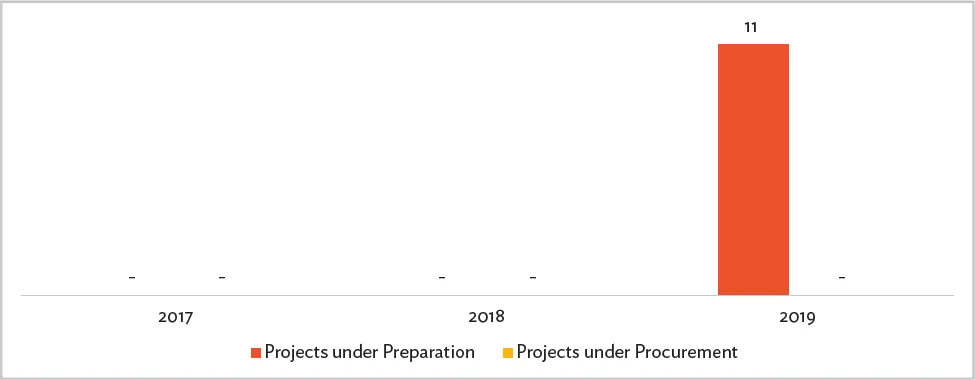
Figure 16 shows the number of PPP projects which are under preparation and procurement in the Philippines’ road sector.
Figure 16: Public–Private Partnership Roads under Preparation and Procurement
Source: Public–Private Partnership Center. List of Projects. https://ppp.gov.ph/list-of-projects/ (accessed 28 August 2020); Public–Private Partnership Center. 2019. Investment Opportunities. Manila. https://ppp.gov.ph/investors-corner/investment-opportunities-2/.
The PPP Center tracks the progress of a pipeline of PPP projects in the Philippines, which is updated regularly and published on the PPP Center website (Table 14).35
Table 14: Public–Private Partnership Pipeline Projects in the Road Sector

Sources: NEDA. 2020. Revised List of Infrastructure Flagship Projects. Manila; https://ppp.gov.ph/list-of-projects/; DPWH. List of Public–Private Partnership (PPP) Priority Projects. http://www.dpwh.gov.ph/dpwh/ppp/priority (accessed 28 August 2020); Public–Private Partnership Center. 2019. Investment Opportunities. Manila. https://ppp.gov.ph/investors-corner/investment-opportunities-2/.
4. Features of Past Public–Private Partnership Projects in the Road Sector
Figure 17 presents the number of PPP projects procured through various modes including direct appointment, unsolicited bids, and competitive bids in the Philippines’ road sector.
Figure 17: Modes of Procurement for Public–Private Partnership Roads
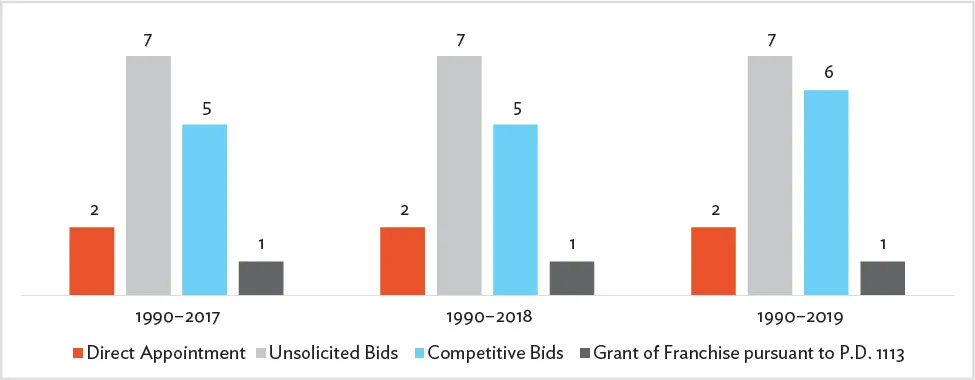
Note: Only active projects are considered in the above graph.
Source: ADB, World Bank. Infrastructure Finance, PPPs and Guarantees. Country Snapshots. Philippines. https://ppi.worldbank.org/en/snapshots/country/philippines (accessed 28 August 2020).
Figure 18 shows the number of PPP projects which have reached financial closure and the total value of those projects in the Philippines’ road sector.
Figure 18: Public–Private Partnership Projects Reaching Financial Closure

Note: Only active projects are considered in the above ...
Table of contents
- Front Cover
- Title Page
- Copyright Page
- Contents
- Tables and Figures
- Foreword
- Acknowledgments
- Definition of Terms
- Abbreviations
- Guide to Understanding the Public–Private Partnership Monitor
- Currency Equivalents
- I. Overview
- II. National Public–Private Partnership Landscape
- III. Sector-Specific Public–Private Partnership Landscape
- IV. Local Government Public–Private Partnership Landscape
- Appendixes
- References
- Footnotes
- Back Cover
Frequently asked questions
Yes, you can cancel anytime from the Subscription tab in your account settings on the Perlego website. Your subscription will stay active until the end of your current billing period. Learn how to cancel your subscription
No, books cannot be downloaded as external files, such as PDFs, for use outside of Perlego. However, you can download books within the Perlego app for offline reading on mobile or tablet. Learn how to download books offline
Perlego offers two plans: Essential and Complete
- Essential is ideal for learners and professionals who enjoy exploring a wide range of subjects. Access the Essential Library with 800,000+ trusted titles and best-sellers across business, personal growth, and the humanities. Includes unlimited reading time and Standard Read Aloud voice.
- Complete: Perfect for advanced learners and researchers needing full, unrestricted access. Unlock 1.4M+ books across hundreds of subjects, including academic and specialized titles. The Complete Plan also includes advanced features like Premium Read Aloud and Research Assistant.
We are an online textbook subscription service, where you can get access to an entire online library for less than the price of a single book per month. With over 1 million books across 990+ topics, we’ve got you covered! Learn about our mission
Look out for the read-aloud symbol on your next book to see if you can listen to it. The read-aloud tool reads text aloud for you, highlighting the text as it is being read. You can pause it, speed it up and slow it down. Learn more about Read Aloud
Yes! You can use the Perlego app on both iOS and Android devices to read anytime, anywhere — even offline. Perfect for commutes or when you’re on the go.
Please note we cannot support devices running on iOS 13 and Android 7 or earlier. Learn more about using the app
Please note we cannot support devices running on iOS 13 and Android 7 or earlier. Learn more about using the app
Yes, you can access Public–Private Partnership Monitor: Philippines by in PDF and/or ePUB format, as well as other popular books in Business & Government & Business. We have over one million books available in our catalogue for you to explore.