- 178 pages
- English
- ePUB (mobile friendly)
- Available on iOS & Android
eBook - ePub
About this book
Sometimes even a
New York Times–bestselling happiness expert could use some advice . . .
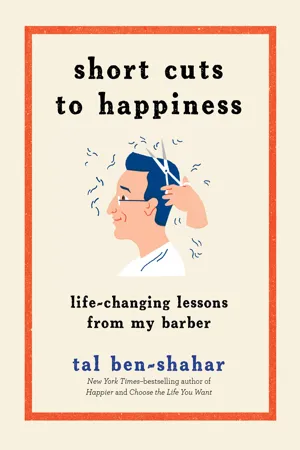
In his trailblazing Harvard courses, internationally bestselling books, and lectures and videos, positive psychologist Tal Ben-Shahar has shared his wisdom on finding fulfillment with people around the world. But even a happiness expert needs a sympathetic ear now and then. Tal found his—not in a fellow psychologist or guru, but in his longtime Israeli neighborhood barber, Avi, who (along with cutting hair) dispenses wisdom beyond his years:
Moving fast is important, but so is knowing when to wait.
The more you provide for your children, the less they gain for themselves.
If only people brought the same levels of commitment to their relationships as they do to their work.
The best way to gain trust is to give trust.
Short Cuts to Happiness distills two years of Tal and Avi's revelatory barbershop talk into forty brief chapters to dip in and out of, or to enjoy straight through. Each one reminds us how easy it is to find common ground on the things that matter most—and how good it is to talk with a tried-and-true friend.
"A charming read to remind you that wisdom about happiness is often right around the corner." —Adam Grant, #1 New York Times–bestselling author of Think Again
In his trailblazing Harvard courses, internationally bestselling books, and lectures and videos, positive psychologist Tal Ben-Shahar has shared his wisdom on finding fulfillment with people around the world. But even a happiness expert needs a sympathetic ear now and then. Tal found his—not in a fellow psychologist or guru, but in his longtime Israeli neighborhood barber, Avi, who (along with cutting hair) dispenses wisdom beyond his years:
Moving fast is important, but so is knowing when to wait.
The more you provide for your children, the less they gain for themselves.
If only people brought the same levels of commitment to their relationships as they do to their work.
The best way to gain trust is to give trust.
Short Cuts to Happiness distills two years of Tal and Avi's revelatory barbershop talk into forty brief chapters to dip in and out of, or to enjoy straight through. Each one reminds us how easy it is to find common ground on the things that matter most—and how good it is to talk with a tried-and-true friend.
"A charming read to remind you that wisdom about happiness is often right around the corner." —Adam Grant, #1 New York Times–bestselling author of Think Again
Tools to learn more effectively

Saving Books

Keyword Search

Annotating Text

Listen to it instead
Information
Introduction
Happier, No Matter What
To me, the only satisfactory definition of happiness is wholeness.
—Helen Keller
“So, Tal, shouldn’t we quarantine happiness now?” my friend asked me. He was only half joking.
We were deep into the coronavirus pandemic that swept the world. Undeniably, the COVID-19 crisis brought on a particularly intense series of challenges. Perhaps you got sick, feared becoming ill, or even endured the unimaginable pain of a loved one’s death. Perhaps you suffered the loss of your job. Parents struggled to balance the competing responsibilities of work and childcare. Families and teachers agonized over whether it was safe to attend school. And we all felt the malaise of being isolated from friends and loved ones. For many, as stresses mounted, the fog of depression set in. Simple activities that we took for granted and used to turn to for relaxation vanished overnight, like going out to dinner or seeing a play, and the joyous celebrations we looked forward to, like vacations and weddings, were suddenly canceled. As we masked our faces to protect ourselves and others from the virus, it even became hard to share a smile with a stranger while walking down the street.
In the midst of this new reality, what was the relevance of studying happiness? From the time the coronavirus saga started, many people have echoed my friend’s sentiment that perhaps we should quarantine happiness, that the science of happiness should be put on hold for a while. They figured, sure, once things are back to normal, we can look at happiness again. But given everything going on in the world right now, shouldn’t we press pause?
And my answer to that is no, we shouldn’t quarantine happiness. We definitely shouldn’t put it on hold! In fact, in challenging times—whatever they may be—studying the science of happiness is more vital and relevant than ever.
Growing from Hardship
We can roughly situate all human experiences along a continuum spanning from negative, through neutral, to positive. For example, pain, suffering, misfortune, and hardship fall on the negative end, while pleasure, joy, fortune, and comfort belong on the positive end. Right in the middle we have the zero point, the “I’m doing OK” point.

Many people believe that the role of the science of happiness is to deal with anything from neutral to positive. In other words, as long as you’re doing OK or better, you can benefit from the research findings in the field. And if you’re not doing well—if you’re sad or anxious, going through hard times and struggling—well, only psychotherapy or medication can help. Of course, I fully support seeking professional care. Therapy can help whether we’re doing fine overall or when our life feels out of control; medication, such as antidepressants or antianxiety drugs, has saved lives, and I would never recommend anyone stop medications without consulting with their physician. But the notion of having to reach “neutral” before one can benefit from the science of happiness is flawed.
The science of happiness is relevant for the entire spectrum of human experiences. Yes, it can certainly help us go from a 3 to a 5, from doing fine to doing really well. But it’s even more beneficial when we’re at minus 3, or minus 5. It can help us bounce back—and even launch us beyond. Why? Because the science of happiness strengthens our psychological immune system. Needless to say, bolstering your psychological immune system, or your biological immune system for that matter, doesn’t mean you won’t get sick. It simply means you’ll get sick less often, and when you do, you’ll recover more promptly. The science of happiness can help you become happier, even if slightly so, no matter where you are along the spectrum. It also equips you to be better able to deal with difficulties and hardships when they arise.
In fact, with a strong psychological immune system, you could go a step beyond resilience. You could become antifragile—what I think of as Resilience 2.0. Antifragile is a concept that was introduced by writer, epistemologist, and statistician Nassim Taleb, a professor at New York University. To understand antifragile, we need to start with resilience, a term taken from engineering. A particular substance or material is considered resilient if it returns to its original form after enduring stress or pressure. Along similar lines, to explain resilience we use the metaphor of a ball dropping and then bouncing back to its original point. According to Taleb, a substance or material is antifragile if, after enduring stress or pressure, it doesn’t merely return to its original state, but grows stronger as a result. If a resilient ball bounces back to where it was before, an antifragile ball bounces back higher. More generally, an antifragile system—and that could be an inanimate object or a living entity in the form of a person, a relationship, a group of people, or even a nation—goes through hardship and consequently grows stronger, better, happier.
When Friedrich Nietzsche, the nineteenth-century German philosopher, wrote that “Whatever does not kill me makes me stronger” he was describing antifragility. And, indeed, you can grow from adversity, and experience antifragility, even if you have gone through extreme hardship. Trauma can pull us down or raise us up, leave us weaker or make us stronger.
In fact, research by psychologists Richard Tedeschi and Lawrence Calhoun at the University of North Carolina suggests that people faced with hardships are more likely to experience post-traumatic growth (PTG) than post-traumatic stress disorder (PTSD). Most of us have heard of PTSD, which can include painful consequences like reliving the trauma, anxiety and depression, difficulty concentrating, and trouble sleeping. But there is another potential enduring experience, a beneficial one, and that is PTG. Nothing, unfortunately, can guarantee growth after trauma, however there are certain conditions we can put in place to significantly increase the likelihood of that outcome. As I see it, a central objective of the science of happiness is to help individuals, families, organizations, and communities understand and apply these conditions, and thereby grow from the difficulties associated with the pandemic or any other hardship. There is much that we can do to become more antifragile.
From Research to Me-Search
I wrote this book so that you can have something to anchor you during tumultuous times—ideas that you can hang on to, and most important, experiment with. I’m a psychologist and an academic. In my profession, I draw on research a great deal. However, even more essential than research is me-search. Research is about looking at what other people have done, evaluating their actions, and learning from the result. Me-search is doing the same for the self—looking inside, experimenting with change.
I’m a big fan of biographies. There’s much that we can learn from them, especially biographies of people who have done special and extraordinary things. One of my favorites is that of revered Indian leader and activist Mahatma Gandhi. Gandhi’s autobiography is subtitled The Story of My Experiments with Truth. Notice the language. It’s not My Finding Truth. It’s not My Discovery of Truth. It’s My Experiments with Truth. Throughout his life, standing up for social justice, Gandhi experimented. He tried things. And this is what I would like you to do as you read through this book. Yes, you will learn about a lot of happiness research; yes, you’ll find tips for incorporating these ideas in your life. But more than anything, I’d like you to play with these ideas and tips and see how things work for you. Some of the strategies may be highly relevant for you at this point in your journey; some may be relevant for you in the future; and some may not be relevant at all—but it’s difficult to know without trying.
Particularly in uncertain times, there’s a lot of advice out there on what we should and shouldn’t do, whether it’s as parents or as employees, whether it’s on the personal level or professional. With this book, I hope to distill some evidence-based information so that you can me-search based on psychological studies and create a bit of order amid the chaos. I want to give you strategies that you can apply and that will help you become happier now.
I started to study happiness because of my unhappiness. I’m not sure whether I passed the clinical threshold for depression or anxiety, but I certainly experienced sadness and stress much of the time. That’s what led to my interest in positive psychology. Thirty years later, people ask me: “So are you finally happy now?” And my answer to this question is: I don’t know. What I do know is that I am happier. As you will learn in this book, the purpose of building antifragility is not to lead you to the happily ever after. I don’t believe happily ever after exists. Happiness and unhappiness are not fixed or binary conditions—there isn’t a point before which we are unhappy and after which we are happy. Happiness resides on a continuum. I’ve made a lot of progress over the last thirty years on that continuum, and I certainly hope that five or ten years from now I’ll be happier than I am today—and that you will be, too. This is why this book is titled Happier, No Matter What rather than Happy, No Matter What. It’s a lifelong journey, one that ends when life ends.
The Myth of Success and Happiness
What exactly is happiness, anyway? Why is it important? And how do we obtain it?
Before we go into definitions, let me share with you a few studies that point to a profound and pervasive misunderstanding about happiness, its role in our lives, and how to get it. Most people believe that the path to happiness is through success. If only I could achieve my dream—attain this goal, reach that milestone—I would be happy. Or, following some significant failure, we think, My dream is over. Everything is ruined. I didn’t make it. I’ll never be happy now. According to this formula, success is the cause; happiness is the effect. It turns out, though, that this is wrong—not a little wrong, but very wrong.
There are numerous studies that challenge the formula that success leads to happiness. For example, Harvard professor Daniel Gilbert studied college professors at the most important point in their career: just as they were about to hear whether they would receive tenure. When Gilbert asked the professors how they would feel after the tenure decision was made, most predicted that if they received tenure they would enjoy lasting happiness, and if they were turned down, they would be crushed for a long time to come. After all, tenure is considered the holy grail for professors. Often a fifteen-year process, tenure means lifetime employment. It means not being under pressure to publish all the time anymore. It means you get to stay at your university. What actually happened after the decisions were announced? While those professors who received tenure were ecstatic upon hearing the news, and those who were denied tenure were understandably devastated, the major event had little consequences in the long-term for how happy or unhappy they were. In other words, the professors grossly over-estimated the impact of a major success—or failure—on their happiness. The event, perceived by most professors as so significant and potentially life changing, led to a temporary high or a temporary low—that’s it.
Similar studies have been conducted on lottery winners. How many of us imagine that if we won the lottery, everything would forever change for the better? Despite the windfall, it turns out that’s not what happens. Lottery winners experience an extreme high when they win, just like the tenured professors. But they go back to where they were before. The winners who had been unhappy usually returned to being unhappy after experiencing a short spike in their happiness levels; no change. The same goes for other big life events, like our wedding day or losing our job: More often than not, we experience a temporary high or temporary low and then go back to where we were before the event on the happiness continuum.
I once informally conducted a poll among my students when I was teaching at Harvard. I had around a thousand students in the class, and I asked them to think back to April 2 of the previous spring, or the years prior. Why April 2? Because that was the day when college acceptance letters used to arrive in the mail (these days it’s by email), telling you, Congratulations, you’re in!, or We’re sorry, our class was very competitive this year. Given that these students were sitting in my class, of course they had all been accepted. I then said to them: “Please put your hand up if on April 2 you were anywhere between very happy and ecstatic.” Just about every hand went up. Then I said, “Please leave your hand up if on April 2 you thought that you would be happy for the rest of your lives.” Almost all hands stayed up. Why? Because that’s what they were told and consequently believed when they were in high school: Sure, you may be struggling, stressed out, and even miserable now, but if you get into one of your top choices for college, it will forever have been worth it. Then I said, “OK, now leave your hand up if today you’re happy.” I didn’t say very happy. I didn’t say ecstatic. I just said happy. Most students put their hand down.
The majority of college students around the United States experience stress and are overwhelmed by everything that they have to do. Levels of depression are skyrocketing among teenagers and young adults, and this state of affairs was well underway before the onset of the coronavirus. It’s not looking good when it comes to mental health, and yet people continue to believe that success will lead them to the land of happiness. It won’t!
Successes do lead you to experiencing highs, while failures lead you to experiencing lows, however these fluctuations are fleeting and in and of themselves are not the building blocks of a happy or unhappy life. Does that mean there isn’t a relationship between success and happiness? No. In fact, there’s a very strong relationship, but it’s the opposite of what most people think. It’s not success that leads to happiness; rather it is that happiness leads to success.
Why Happiness Matters
Psychologists and organizational scholars consistently demonstrate that if you increase your levels of wellbeing, even by a little bit, you become a great deal more successful. And by successful, I mean not only in the traditional sense of goal achievement—but also in a much broader, multidimensional sense. You’ll be more successful as a parent, as a partner, as an employee, as a coach, and as a friend.
By increasing happiness levels even slightly, you become more creative and more innovative, whether in the workplace as an adult, or in school as a child. Productivity and engagement levels, at work and in school, increase significantly in tandem with an increase in wellbeing. Increasing happiness levels makes us kinder and more generous and reduces the likelihood of violence and immoral behavior in general. Our mental and physiological immune systems are linked, and increasing happiness levels fortifies our psychological resilience as well as boosts our physical resilience. Happy people are healthier, better able to ward off disease, and (controlling for all other factors) live longer!
And we’re not the only ones who benefit when we enjoy an increase in our happiness levels. Happiness improves our relationships, which is even more important when so many of us are rema...
Table of contents
- Introduction
- On Beginnings and What Really Matters
- On Growing Through Hardship
- On Highlights and Insights
- On Vacation
- On Touch
- On Posture
- On Generosity
- On Losing Our Minds
- On Business
- On Decision-Making
- On Lighthouses
- On Laughter
- On Complimenting
- On Love
- On Being Part of The Whole
- On Silence
- On Selfish Parenting
- On Avi’s Razor
- On Lifelong Learning
- On Anger Management
- On Hurt Management
- On Sharing
- On Praising Effort
- On Talk Therapy
- On Trust
- On Honoring Thy Mother
- On Being Lucky
- On Changing
- On the Wrong Foot
- On Relationships
- On Gardening
- On Dreaming
- On Golden Hands and Means
- On Slowing Down
- On Authenticity
- On Taking a Break
- On Words
- On Failing Safely
- On Divine Connection
- On Paying It Forward
- On Gifts, Great and Small
- Acknowledgments
- About the Author
- Excerpt from Happier, No Matter What
Frequently asked questions
Yes, you can cancel anytime from the Subscription tab in your account settings on the Perlego website. Your subscription will stay active until the end of your current billing period. Learn how to cancel your subscription
No, books cannot be downloaded as external files, such as PDFs, for use outside of Perlego. However, you can download books within the Perlego app for offline reading on mobile or tablet. Learn how to download books offline
Perlego offers two plans: Essential and Complete
- Essential is ideal for learners and professionals who enjoy exploring a wide range of subjects. Access the Essential Library with 800,000+ trusted titles and best-sellers across business, personal growth, and the humanities. Includes unlimited reading time and Standard Read Aloud voice.
- Complete: Perfect for advanced learners and researchers needing full, unrestricted access. Unlock 1.4M+ books across hundreds of subjects, including academic and specialized titles. The Complete Plan also includes advanced features like Premium Read Aloud and Research Assistant.
We are an online textbook subscription service, where you can get access to an entire online library for less than the price of a single book per month. With over 1 million books across 990+ topics, we’ve got you covered! Learn about our mission
Look out for the read-aloud symbol on your next book to see if you can listen to it. The read-aloud tool reads text aloud for you, highlighting the text as it is being read. You can pause it, speed it up and slow it down. Learn more about Read Aloud
Yes! You can use the Perlego app on both iOS and Android devices to read anytime, anywhere — even offline. Perfect for commutes or when you’re on the go.
Please note we cannot support devices running on iOS 13 and Android 7 or earlier. Learn more about using the app
Please note we cannot support devices running on iOS 13 and Android 7 or earlier. Learn more about using the app
Yes, you can access Short Cuts to Happiness by Tal Ben-Shahar in PDF and/or ePUB format, as well as other popular books in Personal Development & Personal Success. We have over one million books available in our catalogue for you to explore.