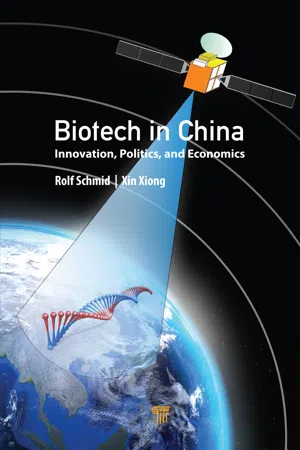
In her quest for global leadership in science and technology, the People's Republic of China has attained top ranks in the number of scientific publications, "hot papers," or national and international patent applications. However, analysis of the underlying structures and mechanisms is hindered by the sheer flood of data, stringent government control of all media, and ambiguities inherent in translation from Chinese. This book overcomes these difficulties and provides a concise picture of biotechnology-related research and development in China. It begins with brief accounts of China's geography, people, political and administrational structure, economy, finance, infrastructure related to science and technology, and educational system. It presents succinct accounts on structures and developments in biomedicine, diagnostics, agriculture, fermented food, bioindustry, and environmental biotechnology, with reference to government, industry, and academia. Finally, it predicts the next steps in Chinese biotechnology for the national agenda and, in view of China's ambitious global development strategy, the Belt and Road Initiative.
- 324 pages
- English
- ePUB (mobile friendly)
- Available on iOS & Android
eBook - ePub
About this book
Trusted by 375,005 students
Access to over 1.5 million titles for a fair monthly price.
Study more efficiently using our study tools.
Information
Topic
MedicineSubtopic
Biotechnology in MedicineChapter 1
Country and People
1.1 Geography
With 9.6 million km2, China ranks number four among the world’s largest countries, behind the Russian Republic (17.1 million km2), Canada (9.9 million km2), and the USA (9.8 million km2). China’s national borders with Kazakhstan, Kyrgyzstan, Tajikistan, Afghanistan, Pakistan, India, Nepal, Vietnam, Laos, Bhutan, Myanmar, Russia, Mongolia, and North Korea extend over 22,000 km.
The Chinese mainland ranges from subarctic to tropical climate zones and extends over desert areas, high alpine zones, and steppes in the west and north (Fig. 1.1). The heartland in the east and south is characterized by mountainous regions and fertile lowlands along a mainland coastline of over 18,000 km.1
China is crossed by the following three long rivers:
- 5464 km long Yellow River 黃河 has its source in Qinghai Province and flows into the Yellow Sea in Shandong Province.
- 6300 km long Yangtze River 長江 originates in Tibet and ends in the East China Sea near Shanghai. The course of the Yangtze River divides China’s north and south.
- 2320 km long Pearl River 珠江 with its tributaries drains China’s Southern provinces and enters the South China Sea in a huge delta near Hong Kong.

Figure 1.1 Geographic map of China. (Source: Wikimedia Commons, Author Alan Mak)
Nineteen out of China’s 34 administrative units are located along the river bank of either the Yellow or the Yangtze River. They provide fertile plains and good farmland and form the center of China’s agricultural production. The Yangtze is navigable for 2800 km, and much of China’s trade has developed in the cities along its banks, such as Chongqing, Wuhan, Nanjing, and Shanghai. The Yellow River and the Yangtze River are connected by the 1794 km long Grand Canal (Jing-Hang Grand Canal 京杭大運河), an artificial waterway, which was built between Beijing and Hangzhou over 1500 years ago for the transport of goods and troops.
The estuary of the Pearl River forms an almost continuous urban landscape with a high level of industrial concentration. Though China extends over 60o of longitude, there is only a single time zone for the whole country.
1.2 Resources
Out of China’s land mass of about 9.6 million km2, there is2
- ~0.4 million km2 of land used for human constructions,
- ~1.4 million km2 of arable land,
- ~2.2 million km2 of grass plots,
- ~2.5 million km2 of forests,
- ~2.6 million km2 of deserts, and
- ~1.7 million km2 of land menaced by sand.
Besides its extensive resources in forests, agricultural land, and fresh water, China is rich in coal, oil, and natural gas. Its coal deposits alone are an estimated 12% of the proven global reserves. The country has also rich sources of iron ore, baryte, bauxite, and phosphates and extensive resources of rare earths, indium, tungsten, antimony, bismuth, mercury, graphite, tin, lead, uranium, gold, zinc, lead, molybdenum, and many other important minerals.
1.3 History
China’s heartland between the Yellow River, the Yangtze River, and the Pearl River has been shaped by a long prehistory and over 3000 years of recorded history. Recorded history has alternated between periods of political unity and peace and periods of war and failed leadership. Twice, during the Yuan and the Qing dynasties, China was ruled by people from the steppe, which were eventually assimilated into Han Chinese (Table 1.1).
| ~10,000 BCE | Neolithic findings | |
| 2700–1600 BCE | Xia dynasty | Early bronze age |
| 1600–1046 BCE | Shang dynasty | Bronze age |
| 1046–256 BCE | Zhou dynasty | Iron age |
| 476–221 BCE | Warring States | Laozi, Confucius, Sun Tzu |
| 221–207 BCE | Qin dynasty | Great wall, terracotta army |
| 202 BCE–220 CE | Han dynasty | Art, culture, science |
| 220–280 | Three Kingdoms | Battle on the Red Cliff |
| 266–420 | Jin dynasty | |
| 420–589 | Northern and Southern dynasties | |
| 581–618 | Sui dynasty | Emperor’s canal |
| 618–907 | Tang dynasty | Cosmopolitan culture |
| 907–1234 | Five dynasties and Ten Kingdoms | A period of political disunity |
| 960–1279 | Northern and Southern Song dynasty | “Golden a... |
Table of contents
- Cover
- Half Title
- Title
- Copyright
- Contents
- Preface
- About the Information Provided in This Book
- Abbreviation
- 1. Country and People
- 2. Government and Political Structure
- 3. Economy and Finance
- 4. Infrastructure
- 5. Higher Education and Research
- 6. Health Care and Biomedicine
- 7. Agriculture and Fermented Food
- 8. Industrial Biotechnology
- 9. Environmental Biotechnology and Sustainable Development Goals
- 10. Next Steps
- Index
- Picture Credits
Frequently asked questions
Yes, you can cancel anytime from the Subscription tab in your account settings on the Perlego website. Your subscription will stay active until the end of your current billing period. Learn how to cancel your subscription
No, books cannot be downloaded as external files, such as PDFs, for use outside of Perlego. However, you can download books within the Perlego app for offline reading on mobile or tablet. Learn how to download books offline
Perlego offers two plans: Essential and Complete
- Essential is ideal for learners and professionals who enjoy exploring a wide range of subjects. Access the Essential Library with 800,000+ trusted titles and best-sellers across business, personal growth, and the humanities. Includes unlimited reading time and Standard Read Aloud voice.
- Complete: Perfect for advanced learners and researchers needing full, unrestricted access. Unlock 1.5M+ books across hundreds of subjects, including academic and specialized titles. The Complete Plan also includes advanced features like Premium Read Aloud and Research Assistant.
We are an online textbook subscription service, where you can get access to an entire online library for less than the price of a single book per month. With over 1.5 million books across 990+ topics, we’ve got you covered! Learn about our mission
Look out for the read-aloud symbol on your next book to see if you can listen to it. The read-aloud tool reads text aloud for you, highlighting the text as it is being read. You can pause it, speed it up and slow it down. Learn more about Read Aloud
Yes! You can use the Perlego app on both iOS and Android devices to read anytime, anywhere — even offline. Perfect for commutes or when you’re on the go.
Please note we cannot support devices running on iOS 13 and Android 7 or earlier. Learn more about using the app
Please note we cannot support devices running on iOS 13 and Android 7 or earlier. Learn more about using the app
Yes, you can access Biotech in China by Rolf Schmid,Xin Xiong in PDF and/or ePUB format, as well as other popular books in Medicine & Biotechnology in Medicine. We have over 1.5 million books available in our catalogue for you to explore.