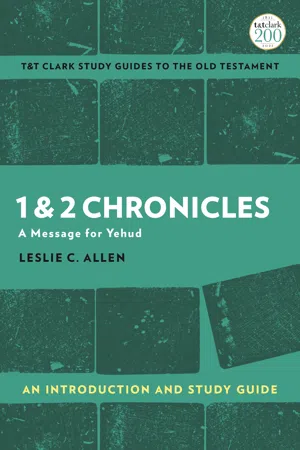
Leslie C. Allen introduces students to the 1 & 2 Chronicles in the Old Testament, incorporating insights from over two decades of previous scholarship while grounding his analysis in earlier key works.
"A Message for Yehud" sums up what has been judged to be a fundamental motivation underlying the whole book, a conviction that the obligation to "seek the Lord" in the light of the Torah and prophetic texts must be laid on the hearts of the community of Yehud in the fourth century BCE. To this end, using Samuel-Kings as a basis, Chronicles reviewed pre-exilic royal history for positive and negative clues as to how the generation for which it was written might achieve this spiritual ideal. In the book, Allen shows how this program was communicated all through the book by literary and rhetorical means.
- 144 pages
- English
- ePUB (mobile friendly)
- Available on iOS & Android
eBook - ePub
About this book
Trusted by 375,005 students
Access to over 1.5 million titles for a fair monthly price.
Study more efficiently using our study tools.
Information
1
Introduction
Judaism honored Chronicles when a widespread tradition placed it at the climactic close of the Hebrew Bible (HB), presumably for recapitulating its history from Adam to the postexilic period. Its alternative placement at the beginning of the Writings also witnesses to its value, with its hero, David, paving the way for the Davidic Psalms (cf. Goswell 2017). Chronicles fits well into the pattern of the theological progression of the three parts of that canon sketched by Marvin A. Sweeney (1997: 365–71). The Torah prescribes the ideal of a covenantal relationship between God and Israel on the world’s behalf; the Former and Latter Prophets point to the disruption of that ideal because of Israel’s failure to implement it, while the Writings present a potential for the implementation of the Torah’s ideal by the restored postexilic Jewish community.
Christianity has dealt Chronicles an unintended blow since in its continuing canon it reads the Latter Prophets at the end of the Old Testament (OT), as a bridge to the fulfillment of their prophecies claimed in the New Testament (NT), especially in the First Gospel. With a cruel logic that at least respected its historical basis, Chronicles has been relegated to a position after Samuel-Kings. Because our book mined the quarries of Samuel-Kings extensively for its re-presentation of Israel’s history, the juxtaposition leaves readers wondering why they should bother to read this literary copycat. Now its grand panorama of human history from Adam to Cyrus is overlooked. Its final chapter that contrasts the shameful degradation of deportation with a new postexilic beginning, when Cyrus was inspired to challenge God’s people to reclaim their spiritual heritage, goes unheard.
What should be the aim of a study guide to Chronicles? It should surely attempt to give back to the book the honor it warrants, as an incentive for further study. Chronicles reflects a sophisticated complexity characteristic of a later type of literature that builds discriminatingly upon a mass of earlier traditions and covers centuries of historical background up to its own era. The book focuses upon the past, not for its own sake but as having implicit significance for the generation for whom it was written. For the Chronicler, as for Dionysius of Halicarnassus, history was philosophy teaching by examples. Along the way, his work raises a host of difficult questions a commentator has to grapple with. Ralph W. Klein, at one point in his commentary (2012: 169), urges readers to get beyond the necessary historical and exegetical details of the text by appreciating its organizational clarity and theological message. His advice works as a virtual prescription for this guide, as a preliminary approach to the book. A mass of details can obscure the message. Kevin J. Vanhoozer (1998: 286) has similarly distinguished between knowing about a biblical text and knowing what that text is about.
Spiritual Exhortation
Chronicles was written for members of a little province known by the Aramaic name of Yehud (Ezra 5:8 in the HB). It was part of the Beyond the River satrapy of the Persian Empire, west of the Euphrates (Ezra 4:17). The book demonstrates in its own way the general principle that storytelling preserves the traditions of a people in order to constitute their moral fiber (Coats 1983: 7). Accordingly, it presents the era of David and Solomon as a period of divine revelation that should encourage them to stand tall and live in the light of that glorious and sacred past, understood in terms of the Torah and Prophets. These kings function as models for seeking God in worship and in their way of life. They establish a pattern against which later kings could be evaluated and implicitly postexilic hearers/readers could judge their own spiritual state. H. G. M. Williamson (1982: 33; 1997: 473) compared the book with its exhortatory purpose to a so-called Levitical sermon. It is like the Letter to the Hebrews in the NT, which challenges its readers with negative warnings, positive directives, and reasoned arguments to persevere in their faith. Hebrews 11 approximates to Chronicles’ presentation of its own heroes. The concluding call in Heb 12:1, “let us also…,” matches the closing challenge in 2 Chr 36:23, implicitly to each postexilic reader, “Let him go up”—to a form of worship and way of life that glorified God. The author has adapted Samuel-Kings, as necessary, to create a wide-ranging program of “seeking the Lord” that he urges his generation of believers to adopt.
There are important concerns in Chronicles that lie on the fringes of this multifaceted purpose, its reassurance to Benjamin of its close relationship with Judah (Giffone 2016) and the book’s advocacy of the Levites’ roles in worship (Kim 2014), as elements belonging to its themes of “all Israel” and worship respectively. But appreciation of its overall persuasive message is the key that opens the door to understanding Chronicles. Accordingly, this study guide will focus on the rhetorical and literary features of the book in order to capture the essence of the book. Chapter 2 will look at how Chronicles communicates; Chapters 3–6 will review how it achieves its purpose throughout each of the structural divisions of the book by adopting, adapting, reducing, and adding to its main literary sources; and Chapter 7 will discuss the book’s spirituality and theology.
Nevertheless, this Introduction must first set the scene by glancing at some pertinent issues. There is a rich plethora of relatively recent books and articles on Chronicles, much of which falls outside the limited range of this guide. Access to relevant literature has been facilitated by the surveys of John W. Kleinig (1994), covering 1982–93, and of Rodney K. Duke (2009), covering 1994–2007, while the extensive commentaries of Gary N. Knoppers (2003b, 2004), P. B. Dirksen (2005), and Klein (2006, 2012) are also valuable in this regard. Internationale Zeitschriftenschau für Bibelwissenschaft und Grenzgebiete/International Review of Biblical Studies (up to a publication date of 2009–10) and OTA supply summaries of subsequent literature.
Authorship
Scholars tend to refer to the putative author of Chronicles only with a label derived from the literature, “the Chronicler.” The Babylonian Talmud cites in the tractate Bava Batra (15a) an anonymous baraita, a ruling made by the earlier Tannaim (rabbis of the period c. 70–200 CE), but not included in the Mishnah. The baraita claims that for the book of Chronicles, Ezra wrote the genealogies up to his own time and Nehemiah finished it. The postexilic setting of both Chronicles and Ezra-Nehemiah obviously suggested the involvement of both Judean leaders, and portions of Ezra-Nehemiah do appear in Chronicles. Academic scholarship up to fairly recent times continued to speak of “the Chronicler” as responsible for both works. However, a majority of scholars now separates the two books. It is doubtful whether linguistics provides any help in this issue, but content is a vital factor.
Two significant treatments deserve mention. First, H. G. M. Williamson (1977a: 60–9) outlined six main thematic differences between the books: (i) the absence of Ezra-Nehemiah’s condemnation of mixed marriages in Chronicles; (ii) the quite different treatment of the early history of the nation, highlighting not Abraham but Jacob, generally known as “Israel,” and downplaying the exodus from Egypt in favor of David and Solomon’s era as inaugurating God’s new work for Israel; (iii) the lack of mention of foreign settlement of northern Israel, in contrast to Ezra 4; (iv) the Chronicler’s dominant doctrine of immediate retribution, which is absent from Ezra-Nehemiah; (v) over against the minimal mention of prophets in Ezra-Nehemiah, his emphasis on the role of prophecy, which involves miracles, inflates numbers, and idealizes situations into moral lessons, in contrast to Ezra-Nehemiah’s matter-of-fact presentation; and (vi) his wide concept of “all Israel,” rather than identifying Israel as Judah and Benjamin.
Second, Sara Japhet wrote an essay reviewing the issue (1991), in which she mentions further differences between the two works, notably (vii) hopes for redemption she found in Chronicles versus acceptance of an unchanging political present in the other work, (viii) the latter’s major function of the exile as the embodiment of Israel’s identity, (ix) Ezra-Nehemiah’s view of foreign rulers as agents of God’s benevolence in restoring Israel, something not stressed in Chronicles, and finally three literary features, (x) the lack in Ezra-Nehemiah of the type of speeches that abound in Chronicles, which von Rad famously called “the Levitical sermon,” (xi) the absence from Chronicles of the confessions of Ezra 9 and Neh 9, necessarily so since they involved accumulated sin, conflicting with the Chronicler’s notion of immediate retribution, and (xii) the Chronicler’s resume of a king’s reign, a genre taken over from Samuel-Kings, which has no parallel in Ezra-Nehemiah.
The term “Chronicler,” most often restricted to Chronicles, remains in general usage. It has survived a literary-critical shift to speaking of an impersonal text rather than an author. This is because of the strong sense of consistency that emerges from reading this lengthy book right through. Nevertheless, it reminds us that we know nothing explicit about the author from its contents. Strictly we may speak only of the implied author, a textual construct that credits the book’s overall coherence to the mind of an originator who invites his readers’ trust. Culturally we are obliged to think of a male author in view of the common allocation of gender roles and occupations in Yehud (Ben Zvi 2011: 17 n. 15). Should one speak instead of authors, envisioning the incorporation of redactional material? This has been a bone of contention in Chronicles scholarship, but the book now tends to be regarded as a substantial unity. Hesitation remains in a few places, such as concerning the genealogies in 1 Chr 1–9 and the priestly material in chs. 15–16 and parts of chs. 23–7 as a later, more normative balancing of the Chronicler’s general pro-Levite cultic stance. One must take into account both that the Chronicler was himself an editor in his citing and adaptation of lists and other literary sources and that any redactional material was a stage toward the canonical book.
It has often been suggested that the Chronicler was a Levite. This would help to explain the singular emphasis throughout his work on the roles of Levites in the running of the cult and elsewhere. Some of the Levites in his period were evidently scribes. Christine Schams, in her study of Jewish scribes in the Second Temple period (1998: 65–9), has focused on 1 Chr 24:6, where in David’s reign a scribe who was also a Levite is mentioned as recording the priestly courses, and on 2 Chr 34:13, where in Josiah’s reign some of the Levites are said to have been scribes, though the parallel 2 Kgs 22:3-7 does not mention Levites. She has concluded from the latter text that it probably reflects Levitical organization in the Chronicler’s own period, when some scribes were Levites. Jon L. Berquist (1995: 175 n. 28) has observed that the four times Chronicles mentions scribes have no parallels in Samuel-Kings, so that it shows a bias toward scribes and their role in society. A combination of Levite and scribe would be appropriate for the author of Chronicles. It is also significant that in the postexilic period Levites had the role of teachers. It was Levites who “instructed the people in the Law” in Neh 8:7 (NIV), while in 2 Chr 17:7-8 Levites make up the majority in a team assigned by Jehoshaphat to a similar teaching ministry and 35:3 mentions “Levites who taught all Israel.” A number of scholars have acknowledged that the Chronicler must have been a member of the elite literati in Jerusalem (e.g., Ben Zvi 2007, 2011; Goltz 2008; Davies 2015).
It is relevant to note that academic work has been done on the role of torah as “instruction” in postexilic literature. J. Clinton McCann, Jr. (1992) has referred to its use in Ps 1:2 (NRSV “law”) to describe the book of Psalms. Accordingly, we can appreciate that the Chronicler’s composite psalm in 1 Chr 16:8-36 has value as torah. John Barton (1988: 16–21, 154–6) has observed that in rabbinic times both prophecy and history were regarded as giving instruction (torah) on living in line with the covenant. He observes that Chronicles itself treats history in this way and regularly presents prophetic messages as so doing (1988: 157–8, 292 n. 8). One may include in this torah emphasis what Rex Mason (1990: 258) has called a temple tradition of teaching and preaching that pervades relatively early postexilic biblical literature.
Dating
As to the general dating of Chronicles, its content shows that it is a postexilic document. There are explicit references to the exile and return in 1 Chr 9:1-3; 2 Chr 36:20-3. Such literary evidence has for long encouraged scholars to brand the sort of Hebrew used in Chronicles as a core example of Late Biblical Hebrew in a variety of linguistic forms. Further precision is inhibited by the fact that the Chronicler concentrates his attention on Israel’s preexilic history and does not drop explicit clues about his own situation or that of his readership, though his descriptions of temple worship appear at times to reflect that of his own period—unless they represent changes he was advocating (Schweitzer 2007: 132–75; Kim 2014: 191–2) or are a mixture of both. As for particular periods for the composition of Chronicles, three have been suggested: the early postexilic period, the last years of the Persian period from the middle of the fourth century BCE onward, and the Hellenistic period after Alexander’s conquest in 332 BCE. The common separation of Chronicles from Ezra-Nehemiah speaks against the first option. The third period has been favored especially by scholars who hold that much OT literature originated in that time frame. Much recent study has settled on the middle dating. Kai Peltonen in an essay (2002) has surveyed the three options; so has Isaac Kalimi (2005a: 41–65). Both have pointed to the lack of Hellenistic traces in the book. Peltonen opined that if this indicates the Chronicler’s lack of knowledge of Hellenism, his date must have been in the Persian era or at the very beginning of the Hellenistic era before the new government’s influence had taken a hold. Knoppers (2003b: 102–5, critiqued by Kalimi 2005a: 49–50), while inclined to date Chronicles in the late fourth century or the early third century (2003b: 116), does find some Hellenistic influence that suggests cross-cultural influence even before Alexander’s conquest. The passages in 1 Chr 9; 2 Chr 36 that refer to the initial return from exile and/or to Cyrus and the postexilic temple—the latter topic implicitly via its personnel in the former case—surely have a significant role to play. Since they appear to function as parallel endings to the two literary divisions of the book, it must be asked whether they do not provide such a firm anchoring for the book in the Persian period that one can assume its continuance, in the absence of any reference to a change of imperial control. Then the Chronicler and his implied readers were essentially subjects of the Persian Empire, as for example Williamson (1997: 467) and Klein (2006: 16) hold.
Peltonen (2002: 229–30) has also reviewed traces evidently related to the Persian era that have been detected in Chronicles and regards them as suggesting a dating beyond the early period. “Darics,” mentioned in 1 Chr 29:7, were Persian coins originated by Darius I (522–486 BCE). A lapse of time would have been required before they could feature as an acceptable anachronism referring to the age of David. Second Chronicles 15:5; 16:9 contain quotations of Zech 8:10; 4:10 respectively. First Zechariah prophesied 520–516 BCE and again time had to pass before his message would have been invested with the authority given to preexilic prophets. Use of Ezra-Nehemiah is likely in 1 Chr 9:2-17 (cf. Neh 11:3-19); 2 Chr 36:22-3 (cf. Ezra 1:1-3), which warrants a later dating for Chronicles than for Ezra-Nehemiah. Such evidence points away from the early Persian period, which leaves us with the middle option.
The exceedingly long Davidic genealogy in 1 Chr 3 does little to settle the dating since complex issues are involved, such as whether the genealogy was meant to extend down to the Chronicler’s own time. The span of at least two generations between Zerubbabel and the last one does not support an early dating for the book. Another complexity is that there are two textual traditions in v. 21, that of the Masoretic Text and that of the Greek Septuagint, which has four more generations. The former is followed by the NIV and the latter by the NRSV. And how many years are to be assigned to a generation? Knoppers (2003b: 115–16, 322–3, 329–32) assumes a chronological gap of twenty years between generations because it is a typical figure used by anthropologists, though many biblical scholars work with a gap of twenty-five or thirty or more years. His calculations arrive at a closing date for the genealogy’s span of about 426 BCE for the shorter, masoretic version and about 346 BCE for the Greek-based one.
Sources
Long before fixed and closed conceptions of canon came about, there were books that were recognized as having religious and moral authority, which were available for Chronicles to use. William M. Schniewind (1999: 159–62, 179) and Eugene C. Ulrich (2002: 29–30) speak for a number of scholars in distinguishing between a fixed canon and an authoritative Scripture of earlier sacred writings. Steven J. Schweitzer (2011) has provided a useful survey and discussion of the Chronicler’s sources. The literary basis on which Chronicles selectively draws most often is Samuel-Kings in the Deuteronomistic History or Former Prophets. The two works contain a high degree of continuity as well as discontinuity (see Ben Zvi 2009). The Chronicler used Samuel-Kings as his starting point, but reworked it according to his own perspectives and the needs of a different community (see Knoppers 2012). In general, in assessing the Chronicler’s perspectives, it is important to base consideration not only on his independent material but also on his use of source texts. Students of the English text will find convenient a reference work that sets out the parallels, edited by Endres, Viviano, and Fitzgerald (1988), while Hebraists will appreciate J. Kegler and M. Augustin’s counterpart (1991). Steven L. McKenzie (1985; cf. the discussion of Nihan 2013) has concluded that the Kings source used in Chronicles reflected the same proto-rabbinic text type that appears in the masoretic Kings, but its Samuel source was different from the masoretic Samuel and corresponded to the Qumran fragments of 4Q51 (4QSama). This factor has to be taken into account in evaluating the contribution of Chronicles and will be addressed, as appropriate, in later chapters. A separate text-critical issue is the state of preservation of our present Hebrew text of Chronicles. The NRSV’s textual notes indicate the need for such considerations. Klein (2006: 26) has judged that the original text has been fairly well preserved. Both Knoppers (2003b: 52–65) and Klein (2006: 26–30) have provided general introductions to this field, as well as discussing particular cases in their commenting. Mention must be made of A. Graeme Auld’s striking and detailed proposal (1994, 2011, 2017) that both Samuel-Kings and Chronicles depend on a common source that can be reconstructed from the text shared by these fuller works, into which their different ideological concerns were incorporated. His thesis, which Peltonen (1996: 761–6) has discussed on the basis of Auld’s 1994 work, has important consequences for how the narratives in Chronicles are viewed, but it has won little academic support as yet (see the misgivings of, e.g., Van Seters 2007; Tiňo 2010: 23–9; Janzen 2017: 24–33) and so has not been pursued in this guide.
In the royal epilogues the Chronicler generally cites written sources, copying the custom in Kings, and often associates them with prophets active in particular reigns. Katherine M. Stott (2008: 60–7) has provided a general discussion of these citations, while Schweitzer (2011: 63–5) has tabulated the prophetic references. This guide judges that these citations generally refer to the form of Samuel-Kings available to the Chronicler, though occasionally they have only a rhetorical purpose. By such means the Chronicler apparently intended to acknowledge the inspired nature of his source texts and their factual reliability. If so, this raises the question why he felt free to change them, as he reused their narratives to provide the medium for his prime purpose. Presumably he judged that his spiritual message, itself based on other Scriptures, had priority and gave him freedom to do so (cf. Schweitzer’s reference to this as a better alternative reality [2016: 97]). His fellow literati evidently found it culturally acceptable that he adapted Samuel-Kings to ...
Table of contents
- Cover
- Halftitle Page
- Title Page
- Contents
- Preface
- Series Preface
- Permissions
- Abbreviations
- 1 Introduction
- 2 Chronicles as Communication
- 3 Israel: Elect, Inclusive, and Resilient (1 Chr 1:1–9:34)
- 4 David and Solomon as Spiritual Models (1 Chr 9:35-2 Chr 9:31)
- 5 Evaluating Judah’s Kings in the Divided Kingdom (2 Chr 10:1–28:27)
- 6 Evaluating Judah’s Kings in the Single Kingdom (2 Chr 29:1–36:23)
- 7 The Spirituality and Theology of Chronicles
- Bibliography
- Index of Authors
- Index of Biblical References
- Imprint
Frequently asked questions
Yes, you can cancel anytime from the Subscription tab in your account settings on the Perlego website. Your subscription will stay active until the end of your current billing period. Learn how to cancel your subscription
No, books cannot be downloaded as external files, such as PDFs, for use outside of Perlego. However, you can download books within the Perlego app for offline reading on mobile or tablet. Learn how to download books offline
Perlego offers two plans: Essential and Complete
- Essential is ideal for learners and professionals who enjoy exploring a wide range of subjects. Access the Essential Library with 800,000+ trusted titles and best-sellers across business, personal growth, and the humanities. Includes unlimited reading time and Standard Read Aloud voice.
- Complete: Perfect for advanced learners and researchers needing full, unrestricted access. Unlock 1.5M+ books across hundreds of subjects, including academic and specialized titles. The Complete Plan also includes advanced features like Premium Read Aloud and Research Assistant.
We are an online textbook subscription service, where you can get access to an entire online library for less than the price of a single book per month. With over 1.5 million books across 990+ topics, we’ve got you covered! Learn about our mission
Look out for the read-aloud symbol on your next book to see if you can listen to it. The read-aloud tool reads text aloud for you, highlighting the text as it is being read. You can pause it, speed it up and slow it down. Learn more about Read Aloud
Yes! You can use the Perlego app on both iOS and Android devices to read anytime, anywhere — even offline. Perfect for commutes or when you’re on the go.
Please note we cannot support devices running on iOS 13 and Android 7 or earlier. Learn more about using the app
Please note we cannot support devices running on iOS 13 and Android 7 or earlier. Learn more about using the app
Yes, you can access 1 & 2 Chronicles: An Introduction and Study Guide by Leslie C. Allen in PDF and/or ePUB format, as well as other popular books in Theology & Religion & Biblical Studies. We have over 1.5 million books available in our catalogue for you to explore.