A historian's personal journey into the complex questions of immigration, home and nation
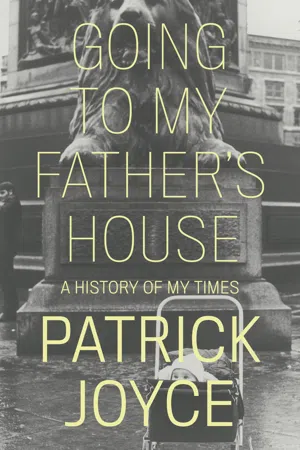
From Ireland to London in the 1950s, Derry in the Troubles to contemporary, de-industrialised Manchester, Joyce finds the ties of place, family and the past are difficult to break. Why do certain places continue to haunt us? What does it mean to be British after the suffering of Empire and of war? How do we make our home in a hypermobile world without remembering our pasts?
Patrick Joyce's parents moved from Ireland in the 1930s and made their home in west London. But they never really left the homeland. And so as he grew up among the streets of Paddington and Notting Hill and when he visited his family in Ireland he felt a tension between the notions of home, nation and belonging. Going to My Father's House charts the historian's attempt to make sense of these ties and to see how they manifest in a globalised world. He explores the places - the house, the street, the walls and the graves - that formed his own identity. He ask what place the ideas of history, heritage and nostalgia have in creating a sense of our selves. He concludes with a plea for a history that holds the past to account but also allows for dynamic, inclusive change.
- 368 pages
- English
- ePUB (mobile friendly)
- Available on iOS & Android
eBook - ePub
About this book
Trusted by 375,005 students
Access to over 1.5 million titles for a fair monthly price.
Study more efficiently using our study tools.
Information
PART I
BEGINNINGS

© Magnum Photos
Josef Koudelka, Ireland 1972. Croagh Patrick Pilgrimage.
1
The Journey West
The most blood-stained of the districts of Ireland.Alexander Shand, 1885
Josef Koudelka, Ireland 1972. Croagh Patrick Pilgrimage. The three men in this image kneel at the summit of Croagh Patrick, which has been a place of Christian pilgrimage for over a millennium and a half. Before then it was a sacred place for perhaps twice that time. Below the summit, and in the background, is Clew Bay, the Atlantic Ocean speckled with islands, drowned drumlins marooned by geological time. Josef Koudelka called this photograph Ireland 1972. It is part of a collection of his work entitled Exiles. In the other photographs in the collection, Koudelka photographed the margins of Europe, margins that are both geographical – Croagh Patrick is at the outermost western limits of Europe – and social. He was drawn to images of gypsies, one of Europe’s most powerful symbols of what it is to be at the margins of an acceptable social life.
Indeed, Koudelka was himself an exile, an in-between person, having fled from Prague after the Russian invasion of 1968 and then taken up a relentlessly peripatetic professional life as a photographer, much of it as a stateless person. A man sans state is without a home, and Koudelka’s photographs probe time as well as space in the pursuit of the in-between. Just as the people in the photograph are caught in a precise moment of time, they are also outside time. All photographs negotiate time in similar fashion and produce this effect: one frozen, timeful moment endlessly prolonged, the timeful outside time. Reality itself seems in exile, outside space and time. Koudelka’s photographs powerfully accentuate this double effect.
The three men in Koudelka’s image are kneeling, their individuality caught in their faces and the attitudes of their bodies as each leans on his pilgrim’s stick in a different way. One uses it as an oar to steady himself, another as a rest for his head, while the last leans into the stick’s point that is firmly embedded in the rocky ground. The men are decidedly in time, and of this place, but they are also outside time. They are separated from the others around them not only by distance, but by the gravity of their demeanour. The other figures in the background seem to be admiring the view, while the three men look inward, into themselves, compelled by the power of this holy place. It is said that St Patrick appeared at this site. They are kneeling, the others stand. They may indeed have completed the final stage of the ascent on their knees, which was, and is still sometimes, the custom, just as it is to walk up barefoot.
This tableau, evoking the disciples at the foot of Christ’s cross, gives the trio an epic, monumental quality, and this further exiles them, sets them apart, from those around them. These surrounding figures dress casually; the short skirt of the young woman in the background reminds us it is 1972. The men, on the other hand, are dressed in what must be for them the appropriate attire for pilgrimage: dark suits and white shirts. The formality and the monochrome tones enhance their separateness from the others – something also caught by the striking deep black of their hair. This blackness further expresses being apart, for it is a genetic trait often found in the far west of Ireland. I too carry this mark. I too am of this place. Their hands are big. These men work with their hands. The blackthorn sticks on which they lean were fashioned by these hands. They know hardship.
Two of these men are my kin. The younger man on the right is my first cousin, Seán Joyce (Seán Seoighe), the man on the left, Paddy Kenny (Pádraig Ó Cionnaith), the husband of Sean’s sister Sally, and so in Ireland a ‘friend’, which means of my family, unlike the meaning of ‘friend’ in English English. The third man, in the middle, is a neighbour of Paddy’s, Máirtín Maingín. The steadying oar of Paddy’s stick was to aid his injured legs. Embedded in the rocky ground, Sean’s stick is an emblem of a life lived embedded on a mountainside farm, all rock, and all slopes that might give way. All three men have now died. For them, Croagh Patrick was always known as ‘the Reek’. Carrying their mark – the height of my kin, their black hair – I share these bodies, our genes, a collective deep history.
I first saw this photograph in 1984, on public display in an art gallery in Manchester. It had very quickly become something new. Sean and Paddy had been ‘hung’ in a gallery, an aesthetic execution that pleased and puzzled me then just as it does now, as I write this. Pleased because my kin had become ‘high art’, unsure as to what this translation meant, for my kin had become symbolically possessed by others. A copy had been given to the family shortly after it had been taken but put aside and forgotten, or at least regarded as of insufficient importance to be mentioned to visitors.
The three men come from Joyce Country, Dúiche Sheoighe, twenty miles south of Croagh Patrick and to the immediate north of Connemara. The three men would have walked to and from the Reek as well as climbing it, walking over the summits in between. Dúiche Sheoighe spans the territory between the mountain of Maamtrasna (the south Partry mountains) in the north to the isolated settlement of Maam Cross in the south, and runs east–west from the village of Clonbur to Leenane on the Atlantic coast. These points are identified in the map below.
My father was born in 1905 in the townland of Kilbride, on the northern shore of lower Lough Mask, where the lake forms almost a small lake of its own, known on maps as ‘Maskeen’. Kilbride is in the extreme south of County Mayo, another in-between place, looking south to Connemara and north and west outside the Gaeltacht, or Irish-speaking district, of which it is nonetheless firmly a part. Kilbride is near the tiny settlement of Finny, which leads into the mountains to the gaunt majesty of a separate lake, Nafooey, an unfortunate Anglicization of the Irish Loch na Fuaiche. This is a region of immense rain, and immense beauty, though as Seán Seoighe was quick to say, ‘You can’t eat a view.’

© Magnum Photos
Joyce Country, north Connemara.
I, however, was not born here. I first made the journey west from London to Joyce Country in 1948, as a child of three. It was in those days such a taxing business that my parents did not repeat it for many years. There was the seemingly endless train journey from the city to the port, choked by rail smoke when the wind was not right, then the sea crossing on something not far from a cattle boat, and then another inexorable rail journey on the other side. Wexford, just across the sea from Wales, was easier, and there I spent the long, happy and yearning summers of childhood and adolescence. My mother, Catherine Bowe, always known as Kitty, was born three years later than my father in the settlement of Loughstown, in the townland of Great Island, in the parish of Kilmokea. The place lies on the river Barrow, near the confluence of the Barrow and the Suir, the Nore flowing into the Suir beforehand, the ‘Three Sisters’ as they are called – another place of rare beauty.
The names of places matter there, for townland and parish, village, town and county make up different layers of the deep preoccupation of the Irish with land, locality and origin. Dúiche Sheoighe is different again, and the same. Dúchas is an Irish noun that conveys the sense that the quality of a person or a way of life is innate in a native land or place, which themselves come down to one as an inheritance.1 It conveys more than ‘country’ or ‘birthright’ in its English translations, more also than the sense that ‘home’ has, which it nonetheless embraces. Places inscribe dúchas and are inscribed by it – Croagh Patrick for instance, which embraces multiple times but also stabilizes time, as with our conceptions of the places we call ‘home’.
For my emigrant mother and my father, the departed Irish places remained the guiding star of who they were and what they became, for it seems true that our sense of place becomes most active when we are ‘out’ of place. To the emigrant, who is by definition always out of place and denied home, this sense is always keen, and is often passed on to the second generation.
The concentration of similar names in one small area in my father’s case, Joyce Country, compounds the force of the place as one of origins, though there are scores of Flynns, Lydons, Coynes and others who also have their claims. Besides, they are all intermarried over time anyway. In the burial ground local to Kilbride, Rosshill, just outside the village of Clonbur, some of the names and graves have in recent years been rescued from anonymity, recorded as they now are outside the cemetery walls. The Joyces preponderate. There are over 150 graves, though the Coynes (O’Cadhain) are a decent second. Even so, the ground here is studded by little stumps of stone for which there are no names, and its uneven ground betokens century upon century of the unmarked peasant dead below the stumps. No names, but still the same names, unsaid but said, for these families have been here now so long.
My Joyces descend from Dúiche Sheoighe, the name Joyce deriving from the thirteenth-century Norman-Welsh Galway colonizers, who were rapidly either embourgeoisified as Galway city bigwigs (the Joyces are one of the seven ‘tribes’ of Galway city, each now with a traffic roundabout named after it) or Gaelicized, as with my lot, the great and mostly poor rural majority. My namesake James’s family left Galway for east Cork in the late seventeenth century – there were 641 Joyce households on the Galway–Mayo borders in the mid nineteenth century immediately after the Great Famine, only eighty-three in east Cork. James, we are told, not differentiating Cork from Connemara, carried the Joyce coat of arms, ‘with care’, from home to home across Europe.2
‘The soul is seen through its hardships’, as the curator of Koudelka’s Exiles puts it in describing his photographs. ‘Hardship’ can be defined as that which exacts physical or mental endurance, so that my parents’ is also a story of endurance, and of the adaptation hardship necessitates if it is to be borne. The hardship of the peasant on the land and the peasant on foreign ground. The most emphatic example of this hardship was endurance of unimaginable catastrophe in the form of the Great Famine of the 1840s – or, as it was called in the Irish-speaking west of Ireland, in places like Joyce Country, am an droch-shaoil, the time of the bad life, or am an ghorta, the time of the hunger. Proportionate to population, this was the greatest catastrophe in nineteenth-century European history. During this period death and enforced emigration claimed a quarter of the population of around 8 million. In the western areas the toll was even greater.
One of the consequences of this death and scattering was the near-total eradication of the old Gaelic culture. Modern Ireland was ‘spat out of the horror and squalor’ of the Famine,3 born in a form that eventually brought to pass the vision of the British governors: one of the small farmer operating on the model of the free market, replacing the unwanted remnants of the old subsistence agriculture of the rundale system and the clachan.’4 If the modern Irish state emerged from such horror – the ‘curse of reason’ as this highly effective form of state-building has been called – so too did the British one, for it was in the decades surrounding the 1840s that the modern bureaucratic state took the form we recognize today.5 This form involved the routinization of suffering and deprivation in such a way that they became amenable to the operations of paperwork, whether locally or far away in the English capital. At the centre of this was Charles Trevelyan, not only the administrator of the famine but the inventor of state ‘administration’, and a father of the modern British Civil Service.6
But, at the same time as hunger and departure, enchantment. The famine cleared the landscape for a new gaze: that of the tourists who started to visit this region from the 1850s. This new tourist gaze was as callous as it was quick to find expression: these are the words of the historical geographer Kevin Whelan in his fine account of the making of the modern Irish rural landscape:
In pre-Famine Ireland one of the commonplaces of historical writing was that poverty spoiled the tourist’s view, the contamination of the aesthetic by the visible, noisy, dirty poor The post-Famine emptying of the west and the absence of poor people allowed the Irish landscape to be presented in appealing terms, just as its accessibility increased. The advent of reliable steamship passenger services between Britain and Ireland, allied to the spread of the railway system, ferried tourists into hitherto inaccessible areas. Trains carrying tourists into the west met those carrying emigrants out of it.7
In 1852 William Wakeman published in Dublin (not in London) A Week in the West of Ireland. The cover of the book shows a well-proportioned young man dressed in tight white trousers, a blue jacket, and a straw hat – the costume of the leisure classes at play. Fishing rod in hand, he scales a hill, his left foot planted on ‘Joyce Country’, his right, as he ascends a hill on his way to Galway, on ‘Connemara’. The Joyces have played their assigned role in this depiction of the ‘Western peasant’, being both stood on and eulogized.8 From one perspective, the people of Joyce Country represented the noble Irish savage. Black’s Picturesque Tourist of Ireland, published in Edinburgh in 1872, for example, tells us: ‘Much has been written about the Joyces, and the many marvels of their stateliness and strength are on record Mr Inglis describes them as a magnificent race of men, the biggest, tallest and stoutest he has ever seen in Ireland, eclipsing even the peasantry of the Tyrol.’9 In contrast, Alexander Shand’s Letters from the West of Ireland (Edinburgh, 1885) portrays the local people as brutally ignorant: it is ‘the most blood-stained of the districts of Ireland’.
Long before even the emergence of tourism, in the 1750s the Joyces had presented to those in authority a world that was felt to be strikingly different to their own. Lord Chief Justice Baron Edward Williams wrote to the earl of Warwick sometime around 1760 that the part of Connemara on the west side of the lakes, where the Joyces lived, was but little known ‘to the gentleman even of Mayo for the inhabitants are not reduced so as to be amenable to the laws, and have very little communication with what they call the continent of Ireland They keep to the manners of the old Irish and are almost to a man bigoted papists.’10
The transformation of revulsion and contempt into enchantment is explained by Whelan:
Tourists were attracted to the West as an antidote to full-blooded industrial capitalism. The metropolitan centre redefined its rural periphery as unspoiled, and inhabited by uncorrupted and therefore noble peasants, living in harmony with their environment. In Ireland, this conception of the west was also taken up by cultural nationalists, who presented its distinctive landscape as evidence of a unique, ancient and unchanging cultural identity. The west was constructed as the bearer of the authentic Irish identity in the rural, archaic and unspoilt landscape, an instructive contrast to modern, industrial and urbanized Britain. Escaping modernity and its brutalizing mass values, the western peasant became the timeless emblem of a pristine world, a precious ancient remnant on the remote rim of modern Europe.11
Does not Koudelka share in this ‘enchantment of the West’ in his depiction of t...
Table of contents
- Cover Page
- Halftitle Page
- Title Page
- Dedication
- Copyright Page
- Contents
- Introduction
- Part I: Beginnings
- Part II: War
- Part III: North
- Acknowledgements
- Notes
- Index
Frequently asked questions
Yes, you can cancel anytime from the Subscription tab in your account settings on the Perlego website. Your subscription will stay active until the end of your current billing period. Learn how to cancel your subscription
No, books cannot be downloaded as external files, such as PDFs, for use outside of Perlego. However, you can download books within the Perlego app for offline reading on mobile or tablet. Learn how to download books offline
Perlego offers two plans: Essential and Complete
- Essential is ideal for learners and professionals who enjoy exploring a wide range of subjects. Access the Essential Library with 800,000+ trusted titles and best-sellers across business, personal growth, and the humanities. Includes unlimited reading time and Standard Read Aloud voice.
- Complete: Perfect for advanced learners and researchers needing full, unrestricted access. Unlock 1.5M+ books across hundreds of subjects, including academic and specialized titles. The Complete Plan also includes advanced features like Premium Read Aloud and Research Assistant.
We are an online textbook subscription service, where you can get access to an entire online library for less than the price of a single book per month. With over 1.5 million books across 990+ topics, we’ve got you covered! Learn about our mission
Look out for the read-aloud symbol on your next book to see if you can listen to it. The read-aloud tool reads text aloud for you, highlighting the text as it is being read. You can pause it, speed it up and slow it down. Learn more about Read Aloud
Yes! You can use the Perlego app on both iOS and Android devices to read anytime, anywhere — even offline. Perfect for commutes or when you’re on the go.
Please note we cannot support devices running on iOS 13 and Android 7 or earlier. Learn more about using the app
Please note we cannot support devices running on iOS 13 and Android 7 or earlier. Learn more about using the app
Yes, you can access Going to My Father's House by Patrick Joyce in PDF and/or ePUB format, as well as other popular books in Politics & International Relations & Political Biographies. We have over 1.5 million books available in our catalogue for you to explore.