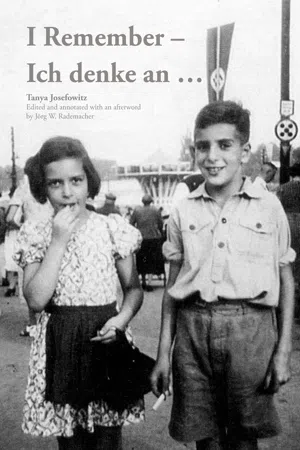
"Zweisprachig ediert, erzählt dieses Memoir die Geschichte von der Flucht aus Worms und Hitler-Deutschland wie von der Ankunft in Amerika und New York im Jahr 1938, erlebt von Tanya Josefowitz geb. Kagan, geboren 1929. Sie wurde Künstlerin, die ihre Geschichte zuerst für ihre Nachkommen aufschrieb (1999). Herausgegeben, übersetzt, mit Anmerkungen und Nachwort von Jörg W. Rademacher.In a bilingual edition, this memoir tells the story of the escape from Worms and Hitler Germany as well as the arrival in America and New York in 1938 as lived by Tanya Josefowitz née Kagan, born in 1929. She became an artist and first set down her story in 1999 for her descendants. The book is edited with notes and an afterword by Jörg W. Rademacher."
- 132 pages
- English
- ePUB (mobile friendly)
- Available on iOS & Android
eBook - ePub
I Remember - Ich denke an ...
About this book
Trusted by 375,005 students
Access to over 1.5 million titles for a fair monthly price.
Study more efficiently using our study tools.
Information
Subtopic
Social Science BiographiesIndex
Social SciencesEditor’s notes. Anmerkungen des Herausgebers
1 Strictly speaking, it ought to be “city”, for Worms has a cathedral. Editor’s note.
2 In the Auswandererbuch der israelitischen Religionsgemeinde in Worms 1933 – 1941 (original author: Herta Mansbacher (1885-1942)), the date of Ilya Kagan’s emigration is set down as the 6th February 1938, while that of his wife Hildi and their children Tanya and Vladimir is set down as the 11th February 1938. Note by Elke Scheiner (Gabsheim). Cf. Henry R. Huttenbach, The Emigration Book of Worms. The Character and Dimension of the Jewish Exodus from a small German Jewish Community 1933-1941, Koblenz, 1974.
3 This was her nickname in the family: Hilde Wallach was printed on the “engagement announcement” reproduced in: Vladimir Kagan, Vladimir. A Lifetime of Avant-Garde Design, New York: Pointed Leaf Press, 2015, p. 20. Editor’s note.
4 Vladimir Kagan comments: “Like Babylon, Hitler managed to disperse our family throughout Europe.” (Vladimir, ibid., p. 22.) Editor’s note.
5 Vladimir Kagan explains: “Our store was sold and all we had left was the workshop in the back of the house. Father’s main business became building the wooden containers with which one Jewish family after another moved their belongings and migrated to the United States. Still, this wasn’t happening to us; it was only happening to ‘them.’” Later, he continues: “Now it was our turn to leave, and Father built his last container, this time for us.” (Vladimir, ibid., p. 21, p. 22.) Editor’s note.
6 Vladimir Kagan uses the term “city”, too. (Vladimir, ibid, p. 22.) Editor’s note.
7 Identity card: German in the original. Editor’s note.
8 German in the original. Editor’s note.
8a The text implies that this man while being part of Gestapo actually wore an SS uniform. A “casket” is either a “case to put jewels in” or a “coffin”. There were different caps worn by SS men bearing the insignia on the peak. Cf. p. 65 for the German translation which resolves the problem of describing the uniform. The French text is no help either. Editor’s note.
9 German in the original. Editor’s note.
10 Vladimir Kagan recounts this slightly differently: “I was never musical. To this day, I cannot read a note, but Mother returning from a trip to Munich brought me an old push-button Ho[h]ner accordion, which I learned to play by ear. My most accomplished numbers were German nostalgic pieces and the Nazi songs of the day. This little gift also helped us greatly in our final escape from Germany. Some years later, waiting for Mother’s return from Gestapo headquarters, I entertained the Nazi officials with my expert knowledge of their national songs. They said, ‘Look at that Jewish boy, knowing all our songs.’” (Vladimir, ibid., p. 21.) Editor’s note.
11 German in the original. Editor’s note.
12 Vladimir Kagan writes: “Two of my father’s siblings had moved to the United States during the early-twentieth-century migration from Russia. My father hardly communicated with them and they in turn were not much interested in us. They had reluctantly provided my father with one immigration visa, but none for the rest of the family. A visa meant guaranteeing the well-being and support of the emigre, and they were horrified at the thought of their ‘German’ family arriving in America to encroach on their own meager existence.” (Vladimir, ibid., p. 22.) Editor’s note.
13 The author writes “ill child”. Editor’s note.
14 If their names and address in Metz were found, a “stepping-stone” could be laid in front of their house, while their names could be added to the wall of the dead in the Paris Mémorial de la Shoah. Perhaps all this has been done already, and all we have to do is to find their names. Only the families named Dreifus (four persons) and Stein (two persons) moved from Worms to Metz in 1933 where Mrs. Lucie Stein had been born in 1885. The Emigration Book of Worms, p. 60; p. 66. Editor’s note.
15 Vladimir Kagan also recalls his aunt Rebecca to have been at the “dock”. (Vladimir, ibid., p. 23). Editor’s note.
16 Vladimir Kagan recounts: “This was our first day in America. We loved playing with our neighbors, and for the first time we were treated as a novelty rather than children to be despised and ostracized.” (Vladimir, ibid., p. 23.) Editor’s note.
17 German in the original. Editor’s note.
18 In fact, this German word hails from Munich where the author’s mother had grown up. While the practice may have been general, the words used were different depending on the dialect spoken. Editor’s note.
19 German in the original. Editor’s note.
20 Vladimir Kagan writes: “One exterior wall of the [Worms synagogue] had a distinct indentation, which, by legend, was created when the exalted Rabbi Solomon bar Isaac Rashi, the world-famous Jewish scholar, born in 1040 [-1105], was viciously forced into the wall by a horsedrawn wagon.” (Vladimir, ibid., p. 21.) Editor’s note.
21 German in the original. The translation provided is imprecise: it is more of an “alley” or “lane” than a street. Editor’s note.
22 Here, brother and sister recall very different stories – both presumably legends. See note 20 above. Editor’s note.
23 Vladimir Kagan adds: “our railway flat, which looked onto either an air shaft or narrow vistas of 111th street, was not [our parents’] style”. (Vladimir, ibid., p. 23.) Editor’s note.
24 According to Vladimir Kagan, James Mont was “an eccentric Greek furniture designer” who was later imprisoned for attempted murder of his wife. (Vladimir, ibid., p. 23.) Editor’s note.
25 According to Vladimir Kagan, it was only “$12 a week”. (Vladimir, ibid., p. 23.) Editor’s note.
26 According to Vladimir Kagan, the apartment was “on Riverside Drive and 97th Street”. (Vladimir, ibid., p. 23.) Editor’s note.
27 Vladimir Kagan states the “cabinet shop” was on “East 53rd Street”. (Vladimir, ibid., p. 23.) Editor’s note.
28 German in the original. Editor’s note.
29 Vladimir Kagan writes: “[…] within a year [1939, that is] most of Mother’s remaining family members were deported to the lesser-known concentration camps that were dotted all over Germany, and in due course to the gas chambers.” (Vladimir, ibid., p. 22.) Editor’s note.
30 German in the original. Corrected spelling. Editor’s note. Deutsch im Original. Korrigierte Schreibweise. Anmerkung des Herausgebers.
31 Granny: German in the original. Editor’s note. Deutsch im Original. Anmerkung des Herausgebers.
32 English nuns, that is. German in the original. Editor’s note. Deutsch im Original. Anmerkung des Herausgebers.
33 Im Text kursiv geschriebene Worte sind entweder im Original bereits deutsch gefaßt, oder sie bleiben hier unübersetzt. Anmerkung des Herausgebers. ‒ Im Auswandererbuch der israelitischen Religionsgemeinde in Worms 1933 – 1941 (ursprüngliche Verfasserin: Herta Mansbacher (1885-1942)) ist das Datum der Ausreise von Ilya Kagan mit dem 06.02.1938 und die Ausreise von Hilde mit den Kindern Tanya und Vladimir mit dem 11.02.1938 vermerkt. Anmerkung Elke Scheiner (Gabsheim). Vgl. auch Henry R. Huttenbach, The Emigration Book of Worms. The Character and Dimension of the Jewish Exodus from a small German Jewish Community 1933-1941, Koblenz, 1974.
34 So lautete ihr Kosename in der Familie: Hilde Wallach stand gedruckt auf der «Verlobungsanzeige», reproduziert in: Vladimir Kagan, Vladimir. A Lifetime of Avant-Garde Design, New York: Pointed Leaf Press, 2015, S. 20. Anmerkung des Herausgebers.
35 Vladimir Kagan kommentiert: «Wie bei der babylonischen Vertreibung gelang es Hitler, unsere Familie über ganz Europa zu verstreuen.» (Vladimir, ebd., S. 22.) Anmerkung des Herausgebers.
36 Vladimir Kagan erklärt: «Unser Laden wurde verkauft, und wir hatten nur noch die Werkstatt im Hinterhaus. Vaters Hauptge...
Table of contents
- Cover
- Titel
- Table of contents / Inhaltsverzeichnis
- Worms, where I was born and where we lived,
- Once on the moving train, it was like turning a page of my life
- On our way to Le Havre we spent 24 hours in Paris.
- On the day of arrival Mother again was simulating emotion rather than illness.
- In Germany I don’t recall ever having been allowed alone on the street,
- In 1933/34 Vladi and I went to a Kindergarten run by nuns, where we were very happy.
- When Mother had fully recovered,
- I feel I had to write this true story …
- I wish also to remember those 30 members …
- I want to thank …
- Photographs/Photographien
- Worms, wo ich geboren wurde und wo wir lebten,
- Als wir im fahrenden Zug saßen, schien es mir, als sei in meinem Leben eine neue Seite aufgeschlagen.
- Auf unserem Weg nach Le Havre verbrachten wir 24 Stunden in Paris.
- Am Ankunftstag simulierte Mutter erneut Gefühle, statt Krankheit.
- Ich entsinne mich nicht, in Deutschland je allein auf die Straße oder in einen Park gedurft zu haben …
- 1933/34 gingen Vladi und ich in einen von Nonnen geleiteten Kindergarten, wo wir sehr glücklich waren.
- Nach Mutters völliger Genesung …
- Mich drängte ein Gefühl zur Niederschrift meiner eigenen Geschichte
- Denken möchte ich auch an jene 30 Mitglieder …
- Danken möchte ich …
- Editor’s afterword
- Nachwort des Herausgebers
- Acknowledgments
- Danksagungen
- Picture credits
- Abbildungsnachweise
- Editor’s notes / Anmerkungen des Herausgebers
- Index of names and places / Namens- und Ortsregister
- Impressum
Frequently asked questions
Yes, you can cancel anytime from the Subscription tab in your account settings on the Perlego website. Your subscription will stay active until the end of your current billing period. Learn how to cancel your subscription
No, books cannot be downloaded as external files, such as PDFs, for use outside of Perlego. However, you can download books within the Perlego app for offline reading on mobile or tablet. Learn how to download books offline
Perlego offers two plans: Essential and Complete
- Essential is ideal for learners and professionals who enjoy exploring a wide range of subjects. Access the Essential Library with 800,000+ trusted titles and best-sellers across business, personal growth, and the humanities. Includes unlimited reading time and Standard Read Aloud voice.
- Complete: Perfect for advanced learners and researchers needing full, unrestricted access. Unlock 1.5M+ books across hundreds of subjects, including academic and specialized titles. The Complete Plan also includes advanced features like Premium Read Aloud and Research Assistant.
We are an online textbook subscription service, where you can get access to an entire online library for less than the price of a single book per month. With over 1.5 million books across 990+ topics, we’ve got you covered! Learn about our mission
Look out for the read-aloud symbol on your next book to see if you can listen to it. The read-aloud tool reads text aloud for you, highlighting the text as it is being read. You can pause it, speed it up and slow it down. Learn more about Read Aloud
Yes! You can use the Perlego app on both iOS and Android devices to read anytime, anywhere — even offline. Perfect for commutes or when you’re on the go.
Please note we cannot support devices running on iOS 13 and Android 7 or earlier. Learn more about using the app
Please note we cannot support devices running on iOS 13 and Android 7 or earlier. Learn more about using the app
Yes, you can access I Remember - Ich denke an ... by Tanya Josefowitz in PDF and/or ePUB format, as well as other popular books in Social Sciences & Social Science Biographies. We have over 1.5 million books available in our catalogue for you to explore.