One in a series of twelve New Testament verse-by-verse commentary books edited by Max Anders. Includes discussion starters, teaching plan, and more. Great for lay teachers and pastors alike.
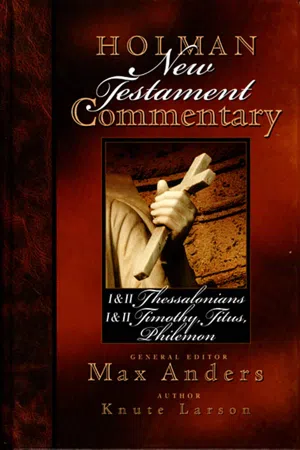
eBook - ePub
Holman New Testament Commentary - 1 & 2 Thessalonians, 1 & 2 Timothy, Titus, Philemon
- 400 pages
- English
- ePUB (mobile friendly)
- Available on iOS & Android
eBook - ePub
Holman New Testament Commentary - 1 & 2 Thessalonians, 1 & 2 Timothy, Titus, Philemon
About this book
Trusted by 375,005 students
Access to over 1.5 million titles for a fair monthly price.
Study more efficiently using our study tools.
Information
Topic
Teologia e religioneSubtopic
Commento della BibbiaIntroduction to
_________________________________________
1 Thessalonians
LETTER PROFILE: FIRST THESSALONIANS
- While in Corinth, Paul, Silas, and Timothy jointly authored a letter to the Christians in Thessalonica around A.D. 51.
- Sent to a young, inexperienced assembly of believers in the city of Thessalonica, many of whom were Gentiles.
- Letter written by Paul, but with the greeting and support of Silas and Timothy who had been with Paul when he first traveled to Thessalonica. The three men were jailed, then run out of town. Timothy was later sent back to encourage the believers.
- Paul praised the Thessalonians' faith; defended his ministry against outsiders' attacks; and laid down basic theology about righteous living in a decaying culture, and the final hope of all believers, both living and dead—eternity with God.
AUTHOR PROFILE: PAUL
- Jewish-born in Tarsus, near the Lebanese border in modern Turkey
- Roman citizen.
- Prominent, Jewish religious leader, highly educated as a Pharisee.
- Persecuted Christians before his own dramatic conversion in A.D. 35.
- Visited Thessalonica on his second missionary journey about A.D. 51 (see Acts 17). There he witnessed instant conversions followed by strong persecution.
- Known for his tireless pioneer work to Gentiles.
- Imprisoned by Nero's regime in A.D. 67 in Rome (see 2 Tim. 4), where he was executed the next year.
CITY PROFILE: THESSALONICA
- An urban center of the Roman Empire, the city of Thessalonica had strong Greek culture; it was built in 315 B.C. by Cassander, a general under Alexander the Great.
- Located in European Macedonia, present-day Balkans; the city's population in the first century was about two hundred thousand.
- Thessalonica, the capital of Macedonia, was a booming commercial center located at the crossroads of the great road from the north and the main east-west trade route.
- Many foreign merchants lived in the city, making Thessalonica an ethnically and culturally diverse city.
1 Thessalonians 1

A Working Model of
a Church
a Church
I. INTRODUCTION
Where and Why God Grows “Vegetables
II. COMMENTARY
A verse-by-verse explanation of the chapter.
III. CONCLUSION
A Divinely Charged Ability
An overview of the principles and applications from the chapter.
IV. LIFE APPLICATION
In Step with God
Melding the chapter to life.
V. PRAYER
Tying the chapter to life with God.
VI. DEEPER DISCOVERIES
Historical, geographical, and grammatical enrichment of the commentary.
VII. TEACHING OUTLINE
Suggested step-by-step group study of the chapter.
VIII. ISSUES FOR DISCUSSION
Zeroing the chapter in on daily life.


It is “impossible to separate works from faith—yea, just as impossible as to separate burning and shining from fire.”
Martin Luther

In summary, this is what Paul said to the Thessalonian Christians in chapter 1.
Greetings to the church in the city of Thessalonica, but especially to a group of people connected with our God, who is our constant help. I am so grateful for the loving way you are serving our Lord and each other. His strength has helped you receive his message and model it. People everywhere are talking about the way God has changed you for now and eternity.
A Working Model
of a Church
I. INTRODUCTION
Where and Why God Grows Vegetables
Our next door neighbor always grows a beautiful garden. With its carrots, beans, peas, squash, and other vegetables, it would be the envy of any neighborhood. Little green shoots poke out of the soil in early spring and continue to grow through the summer. Often I will see our neighbor just standing in the garden munching a green bean; sometimes she is carrying baskets of carrots and tomatoes into her house. It is not that 1 mind, of course. It is just that our backyard is right next to this burgeoning bit of horticulture. And despite our proximity, our plot has nothing of such vegetables.
Now why would God do that?
Everyone knows that only God can grow vegetables. So why would he favor our neighbor and go barren with us? I own a shovel and spade. I even brought home a free packet of seeds from the gas station once (cannot remember where I put it). Still, it does not seem fair. I keep hoping that a few seeds from next door will blow our way and take root. But, so far, nothing.
Of course it is God who gives the increase. Without the miracle of life which resides in the seed, nothing can happen. Without the grace of God's rain and sun, the seed shrivels. But, as any farmer knows, we have a part to play as well. No one expects a garden to appear spontaneously without some preparation and work. We must plant and water, weed and care.
And so it is with our spirits. God works in the hearts of those who work with him.
The old cliche, “God helps those who help themselves,” is horrible theology when it comes to receiving justification. This is a work of God which needs no added effort from us—only our trust. But it teaches a measure of truth when related to abiding in Christ with our faithful obedience.
God gives growth and spiritual strength and results (the fruits of righteousness) to everyone who works on the garden of his heart. And it is no easy task! It requires “work … labor … and endurance” (1 Thess. 1:3).
The Thessalonians clearly modeled the principle of cooperation with God in living the Christian life as defined in Philippians 2:12–14: “Work out your salvation with fear and trembling, for it is God who works in you to will and to act according to his good purpose. Do everything without complaining or arguing.”
The Thessalonians received the message of grace as a call to action and loving service to others. Paul saw this, so he spent his first chapter of 1 Thessalonians applauding them. Then, like the good teacher he was, he reminded them how it all happened.
We can study Paul's insights for help in working on our own hearts. And, like our next-door neighbors, the evidence of this cooperative effort will be in the harvesting.
II COMMENTARY
MAIN IDEA: People who receive God's call of grace are changed and strengthened by him to discipline their lives and become effective examples of the grace of Christ. Such Christians form God's idea of a healthy, productive church.

SUPPORTING IDEA: The church exists only in God the Father and his Son Jesus.
1:1. First Thessalonians reads like many of Paul's letters, but authorship of the book is attributed equally to Paul, Silas, and Timothy. The reason, most likely, is that all three men were well known to the Thessalonian Christians— Paul and Silas having started the church (Acts 17:1–9), and Timothy later being sent back to instruct and encourage the new believers (it was his report which inspired the letter). Paul was the recognized leader, but the respect and enormous help given by Silas and Timothy prompted the co-authorship; the three men spoke with a single voice.
Their letter was addressed to a gathering of people in a particular city— Thessalonica. Paul, Silas, and Timothy undoubtedly recalled names and faces as they wrote the letter. But, by adding the descriptive phrase “in God the Father and the Lord Jesus Christ,” the authors made more precise identity of this group and emphasized its spiritual nature. They wanted the believers to realize that the local church has a spiritual location just as real and even more important than Thessalonica.
This is also true today. God sees the church as specific gatherings of believers, varied in cultural expression and diverse in need and ministry. He also sees the church as the redeemed of all ages. Both realities are important.
Paul's standard greeting, “grace and peace to you,” was loaded with reminders that our best health and riches are the personal, relational gifts from God himself. ...
Table of contents
- Front Cover
- Half Title
- Full Title
- Copyright
- Contents
- Editorial Preface
- Holman Old Testament Contributors
- Holman New Testament Contributors
- 1 Thessalonians 1
- 1 Thessalonians 2
- 1 Thessalonians 3
- 1 Thessalonians 4
- 1 Thessalonians 5
- 2 Thessalonians 1
- 2 Thessalonians 2
- 2 Thessalonians 3
- 1 Timothy 1
- 1 Timothy 2
- 1 Timothy 3
- 1 Timothy 4
- 1 Timothy 5
- 1 Timothy 6
- 2 Timothy 1
- 2 Timothy 2
- 2 Timothy 3
- 2 Timothy 4
- Titus 1
- Titus 2
- Titus 3
- Philemon 1–25
- Glossary
- Bibliography
Frequently asked questions
Yes, you can cancel anytime from the Subscription tab in your account settings on the Perlego website. Your subscription will stay active until the end of your current billing period. Learn how to cancel your subscription
No, books cannot be downloaded as external files, such as PDFs, for use outside of Perlego. However, you can download books within the Perlego app for offline reading on mobile or tablet. Learn how to download books offline
Perlego offers two plans: Essential and Complete
- Essential is ideal for learners and professionals who enjoy exploring a wide range of subjects. Access the Essential Library with 800,000+ trusted titles and best-sellers across business, personal growth, and the humanities. Includes unlimited reading time and Standard Read Aloud voice.
- Complete: Perfect for advanced learners and researchers needing full, unrestricted access. Unlock 1.5M+ books across hundreds of subjects, including academic and specialized titles. The Complete Plan also includes advanced features like Premium Read Aloud and Research Assistant.
We are an online textbook subscription service, where you can get access to an entire online library for less than the price of a single book per month. With over 1.5 million books across 990+ topics, we’ve got you covered! Learn about our mission
Look out for the read-aloud symbol on your next book to see if you can listen to it. The read-aloud tool reads text aloud for you, highlighting the text as it is being read. You can pause it, speed it up and slow it down. Learn more about Read Aloud
Yes! You can use the Perlego app on both iOS and Android devices to read anytime, anywhere — even offline. Perfect for commutes or when you’re on the go.
Please note we cannot support devices running on iOS 13 and Android 7 or earlier. Learn more about using the app
Please note we cannot support devices running on iOS 13 and Android 7 or earlier. Learn more about using the app
Yes, you can access Holman New Testament Commentary - 1 & 2 Thessalonians, 1 & 2 Timothy, Titus, Philemon by Knute Larson, Max Anders in PDF and/or ePUB format, as well as other popular books in Teologia e religione & Commento della Bibbia. We have over 1.5 million books available in our catalogue for you to explore.