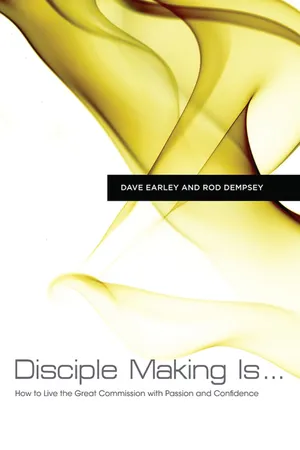
Disciple Making Is... stands as one of the most thorough books yet offered regarding how to make disciples. In thirty brief, hard-hitting but easily accessible chapters, the entire scope of disciple making is presented in a way that will inspire and inform the reader to obey the Great Commission with great passion. Grounded on a solid biblical foundation, authors Dave Earley and Rod Dempsey -- both veterans of one-on-one, collegiate, small group, and local church discipleship -- share their practical insights on how to best reproduce reproducers of Christ's message.
Each compelling entry is set up to finish the sentence that begins with the book's title. For example, Disciple Making Is... "Embracing the Cross, " "Forsaking All to Follow Jesus, " "Living on Mission, " "Launching an Unstoppable Force, " "Mentoring Disciples as Jesus Did, " "Multiplying Disciple-Makers as Paul Did, " "Creating a Healthy Church, " and more.
eBook - ePub
Disciple Making Is . . .
How to Live the Great Commission with Passion and Confidence
- 320 pages
- English
- ePUB (mobile friendly)
- Available on iOS & Android
eBook - ePub
Disciple Making Is . . .
How to Live the Great Commission with Passion and Confidence
About this book
Trusted by 375,005 students
Access to over 1.5 million titles for a fair monthly price.
Study more efficiently using our study tools.
Information
Topic
Theology & ReligionSubtopic
Christian ChurchPart 1
Disciple-Making Philosophy: Biblical and Theological Foundations
Foundations are critically important in most every endeavor known to man. Our government has a foundational document called the Constitution. A successful business leader learns to be successful from good foundational business principles. In education, you need a good foundation at the elementary level. In sports, you need a good foundation to excel at the highest levels.
The same is true when it comes to being a disciple of, and making disciples for, Jesus Christ. In order to accomplish this task, we will need to understand certain biblical and theological underpinnings. With this in mind, part 1 will examine several foundational concepts and priorities from the Scriptures upon which to build a disciple-making system. These chapters seek to answer fundamental questions such as: What is a disciple? Why should we make disciples? And, what is the role of the Spirit and the church in the disciple-making process?
1
Disciple Making Is . . .
Discovering an Organizing Principle
Let’s Begin with a Purpose
Why did God create the universe? Why did He create the earth? Why did He create the animals? Why did He create human beings? Why did God create you? What is God’s purpose in creating you and me? We find the answer to that last question in Isa 43:7: “. . . Everyone called by My name and created for My glory. I have formed him; indeed, I have made him.” You were created by God to bring Him glory.
John Piper states, “The Scriptures teach throughout that all the works of God have as their ultimate goal the display of God’s glory.”1 It is a fact that God created everything to bring Him glory. In Rev 4:11 we read, “Our Lord and God, You are worthy to receive glory and honor and power, because You have created all things, and because of Your will they exist and were created.” In Isa 6:3 we are told that His glory fills the earth, and in Hab 2:14 we are told that all the earth will be filled with the knowledge of His glory. God’s glory is the highest aim in all creation. John Calvin echoed this when he said that “creation is the theater of God’s glory.”2 You and I are a part of God’s creation and, as such, are designed to bring God glory.
The apostle Paul puts it this way, “And in view of this, we always pray for you that our God will consider you worthy of His calling, and will, by His power, fulfill every desire for goodness and the work of faith, so that the name of our Lord Jesus will be glorified by you, and you by Him, according to the grace of our God and the Lord Jesus Christ” (2 Thess 1:11–12). So the apostle Paul affirms . . . God’s purpose is for you to bring Him glory.
How Can I Bring Glory to God?
As disciples, bringing glory to God should be present in every facet of our lives. There are several different stages in our development as disciples of Jesus. Yet in all phases we are created to bring God glory: we are saved to bring God glory; we grow spiritually to bring God glory; we serve to bring God glory; in our suffering we bring God glory; we use our gifts, bearing fruit to bring God glory. Every aspect of our lives should be lived to fulfill God’s plan for our lives, namely, to bring Him glory. This is the organizing principle for the person who would follow King Jesus. This principle guides our daily decisions and affects the way we organize our lives.
Let’s consider these stages of development and how they bring God glory. First, we are saved to bring God glory. In Eph 1:12 we understand that the purpose of salvation is “that we who had already put our hope in the Messiah might bring praise to His glory.” God’s plan when He called you to salvation is that His glory would be revealed in your life. Second Thessalonians 2:14 states, “He called you to this through our gospel, so that you might obtain the glory of our Lord Jesus Christ.” We are saved to share in God’s glory and to bring God glory.
Second, we are not only saved to bring God glory, but we also grow to bring God glory. In 2 Pet 3:18 we see the motivation for spiritual growth: “But grow in the grace and knowledge of our Lord and Savior Jesus Christ. To Him be the glory both now and to the day of eternity. Amen.” This organizing principle of bringing glory to God affects every area of our lives. We are saved to bring God glory, and we grow in Christ for the same purpose. Second Corinthians 3:18 puts it this way: “We all, with unveiled faces, are looking as in a mirror at the glory of the Lord and are being transformed into the same image from glory to glory; this is from the Lord who is the Spirit.” We grow spiritually to reflect God’s glory and thereby bring Him glory.
Third, the apostle Peter says that we serve God to bring Him glory. “If anyone speaks, [his speech should be] as one who speaks God’s words; if anyone serves, [his service should be] from the strength God provides, so that God may be glorified through Jesus Christ in everything. To Him belong the glory and the power forever and ever. Amen” (1 Pet 4:11). The author of the book of Hebrews also confirms that we serve God to bring Him glory when he says, “Now may the God of peace, who brought up from the dead our Lord Jesus—the great Shepherd of the sheep—with the blood of the everlasting covenant, equip you with all that is good to do His will, working in us what is pleasing in His sight, through Jesus Christ. Glory belongs to Him forever and ever. Amen” (Heb 13:20–21).
Fourth, the apostle Peter also says that in addition to all these things, even our suffering is to bring God glory, “so that the genuineness of your faith—more valuable than gold, which perishes though refined by fire—may result in praise, glory, and honor at the revelation of Jesus Christ” (1 Pet 1:7). Even in our suffering we can reflect God’s purpose in our lives.
Finally, every believer is imbued with spiritual gifts that, when employed, bear fruit to the glory of God. John 15:8 states, “My Father is glorified by this: that you produce much fruit and prove to be My disciples.” Jesus says here that God is glorified as we are producing fruit. Furthermore, it is in producing fruit that we prove to be His disciples. There is, then, an important connection between discipleship, fruit bearing, and the glory of God.
In every phase of our existence—salvation, spiritual growth, service, suffering, and bearing fruit—God has created us to bring Him glory. Although that purpose was short-circuited when Adam sinned, nevertheless, that purpose has now been restored. Paul states that “if anyone is in Christ, he is a new creation; old things have passed away, and look, new things have come” (2 Cor 5:17). Part of the “new things” is the restoration of our ability to bring glory to God as the believer progresses in their conformity to the image of Jesus (Rom 8:28–29). When we live and walk like Jesus, we bring glory to God. You were saved to bring God glory. You grow to bring God glory. You serve to bring God glory. You endure suffering to bring God glory. You discover and use your gifts to bring God glory (bear much fruit).
The Organizing Principle and Disciple Making
THE organizing principle, then, is the glory of God. Consider 1 Cor 10:31: “Therefore, whether you eat or drink, or whatever you do, do everything for God’s glory.” The glory of God is, likewise, the organizing principle for the disciple. The apostle John links the glory of God with being a disciple when he says, “My Father is glorified by this: that you produce much fruit and prove to be My disciples” (John 15:8). God’s ultimate plan for your life is to bring glory to His name as a follower of Jesus Christ (a disciple), the fundamental proof of which is bearing fruit, or disciple making. Disciple making in its purest form is helping people find Jesus and then helping them to grow and become all they can be for Christ. In turn, they will become committed to following His commands and obeying the Great Commission. This passionate pursuit enables followers of Jesus to bring the maximum amount of glory to God on an individual basis, and it connects the disciple to God’s global mission as well. Bringing glory to God is an individual pursuit and a global plan at the same time. As disciple makers, we have the privilege of sharing the good news of Jesus with everyone and then encouraging those who accept Christ to grow and develop for Christ.

God’s will for you and God’s glory are inextricably linked. God’s will is found in God’s Word, and as we have already established, God’s will for your life is that you would bring Him glory. In every stage of your growth and development as a disciple, God’s will is that you would live your life in such a way that God would be glorified. Yet the question always comes down to how? How do I bring glory to God? And similarly: “How do I help others bring glory to God?”
Moving People onto God’s Agenda
As we mentioned above, there are several stages in our development as a disciple. Each stage must be connected to God’s will and the organizing principle of bringing Him glory. Our goal as disciple makers is for God’s name to be glorified. We accomplish this goal by “moving people on to God’s agenda.”3 Moving people onto God’s agenda involves helping them discover and experience God’s will for their lives. As we examine God’s will in each stage, we will also discover specific aspects of God’s will for the disciple.
In this regard, disciple making is very similar to being a parent. In order to be a physical parent, you must have children. In order to be a spiritual parent, people must receive Jesus as Lord and Savior. Natural parents want to see their children grow and develop. When they grow up, they will most likely marry and become parents in their own right, and they in turn will have children of their own. In a similar manner, spiritual parents want to see their children grow and develop as well.
As new believers mature spiritually, they should grow to the point where they reproduce new spiritual babies. As the new babies are born, the spiritual parents watch out for them and help them to “grow up” to the point where they will have spiritual children of their own. Ultimately our goal as spiritual parents is to see the “kids” grow up and go out! Those children will grow up being a reflection of their parents. They will bring glory to their parents. This is the natural pattern and should be the spiritual pattern as well. Children are the glory of their parents, and grandchildren are the “crown of the elderly” (Prov 17:6).
Where Do I Start?
To review, the first stage of God’s will for every person is salvation. He desires that every person would come into a right relationship with Jesus Christ. New birth is the entry point for living a life that brings God glory. Second Peter 3:9 says, “The Lord does not delay His promise, as some understand delay, but is patient with you, not wanting any to perish but all to come to repentance.” It is not God’s will that any person would die in their sins and perish. That is why God sent His Son to die on the cross. He took our place on the cross. He was our substitute, and as a result, we can be forgiven of our sins and live a life that is glorifying to Him.
The next stage of God’s will for the disciple is that he or she would grow spiritually. Consider what Paul says in 1 Th...
Table of contents
- Preface
- Introduction: Fulfilling the Great Commission
- Part 1. Disciple-Making Philosophy: Biblical and Theological Foundations
- Part 2. Disciple-Making Basics: Being a Disciple
- Part 3. Disciple-Making Methods: Making a Disciple
- Part 4. Disciple-Making Models: Pastoral Leadership and the Local Church
- Conclusion: Putting It All Together
Frequently asked questions
Yes, you can cancel anytime from the Subscription tab in your account settings on the Perlego website. Your subscription will stay active until the end of your current billing period. Learn how to cancel your subscription
No, books cannot be downloaded as external files, such as PDFs, for use outside of Perlego. However, you can download books within the Perlego app for offline reading on mobile or tablet. Learn how to download books offline
Perlego offers two plans: Essential and Complete
- Essential is ideal for learners and professionals who enjoy exploring a wide range of subjects. Access the Essential Library with 800,000+ trusted titles and best-sellers across business, personal growth, and the humanities. Includes unlimited reading time and Standard Read Aloud voice.
- Complete: Perfect for advanced learners and researchers needing full, unrestricted access. Unlock 1.5M+ books across hundreds of subjects, including academic and specialized titles. The Complete Plan also includes advanced features like Premium Read Aloud and Research Assistant.
We are an online textbook subscription service, where you can get access to an entire online library for less than the price of a single book per month. With over 1.5 million books across 990+ topics, we’ve got you covered! Learn about our mission
Look out for the read-aloud symbol on your next book to see if you can listen to it. The read-aloud tool reads text aloud for you, highlighting the text as it is being read. You can pause it, speed it up and slow it down. Learn more about Read Aloud
Yes! You can use the Perlego app on both iOS and Android devices to read anytime, anywhere — even offline. Perfect for commutes or when you’re on the go.
Please note we cannot support devices running on iOS 13 and Android 7 or earlier. Learn more about using the app
Please note we cannot support devices running on iOS 13 and Android 7 or earlier. Learn more about using the app
Yes, you can access Disciple Making Is . . . by Dave Earley,Rod Dempsey in PDF and/or ePUB format, as well as other popular books in Theology & Religion & Christian Church. We have over 1.5 million books available in our catalogue for you to explore.