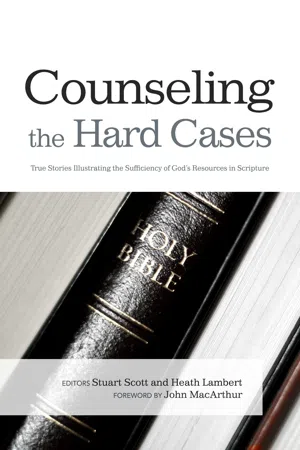
eBook - ePub
Counseling the Hard Cases
True Stories Illustrating the Sufficiency of God's Resources in Scripture
- 368 pages
- English
- ePUB (mobile friendly)
- Available on iOS & Android
eBook - ePub
Counseling the Hard Cases
True Stories Illustrating the Sufficiency of God's Resources in Scripture
About this book
Biblical counselors have worked for decades to demonstrate that God’s resources in Scripture are sufficient to help people with their counseling-related problems. In Counseling the Hard Cases, editors Stuart Scott and Heath Lambert use the true stories of real patients to show how the truths of God’s Word can be released to bring help, hope, and healing into the lives of those who struggle with some of the most difficult psychiatric diagnoses.
From pastors and academics to physicians and psychiatrists, a world-class team of contributing counselors share accounts of Scripture having helped overcome bipolar, dissociative identity, and obsessive compulsive disorders, postpartum depression, panic attacks, addiction, issues from childhood sexual abuse, homosexuality, and more.
The book also shows how the graces of Christ, as revealed in the Bible, brought powerful spiritual change to the lives of such people who seemed previously burdened beyond hope by mental and emotional roadblocks.
Contributors include John Babler, Ph.D., Kevin Carson, D.Min., Laura Hendrickson, M.D., Garrett Higbee, Psy.D., Robert Jones, D.Min., Martha Peace, RN, Steve Viars, D.Min., and Dan Wickert, M.D.
From pastors and academics to physicians and psychiatrists, a world-class team of contributing counselors share accounts of Scripture having helped overcome bipolar, dissociative identity, and obsessive compulsive disorders, postpartum depression, panic attacks, addiction, issues from childhood sexual abuse, homosexuality, and more.
The book also shows how the graces of Christ, as revealed in the Bible, brought powerful spiritual change to the lives of such people who seemed previously burdened beyond hope by mental and emotional roadblocks.
Contributors include John Babler, Ph.D., Kevin Carson, D.Min., Laura Hendrickson, M.D., Garrett Higbee, Psy.D., Robert Jones, D.Min., Martha Peace, RN, Steve Viars, D.Min., and Dan Wickert, M.D.
Trusted by 375,005 students
Access to over 1 million titles for a fair monthly price.
Study more efficiently using our study tools.
Information
Table of contents
- Foreword
- Preface
- Chapter 1: Introduction: The Sufficiency of Scripture, the Biblical Counseling Movement, and the Purpose of This Book
- Chapter 2: “Mariana” and Surviving Sexual Abuse
- Chapter 3: “Brian” and Obsessive-Compulsive Disorder
- Chapter 4: “Sarah” and Postpartum Depression
- Chapter 5: “Mary” and Paralyzing Fear
- Chapter 6: “Ashley” and Anorexia
- Chapter 7: “Tony” and Bipolar Disorder
- Chapter 8: “Jackie” and Dissociative Identity Disorder
- Chapter 9: “Jason” and Homosexuality
- Chapter 10: “Julie” and Addictions and Adultery
- Chapter 11: “Jennifer” and an Apparent Hard Case
- Contributors
- Name Index
- Scripture Index
Frequently asked questions
Yes, you can cancel anytime from the Subscription tab in your account settings on the Perlego website. Your subscription will stay active until the end of your current billing period. Learn how to cancel your subscription
No, books cannot be downloaded as external files, such as PDFs, for use outside of Perlego. However, you can download books within the Perlego app for offline reading on mobile or tablet. Learn how to download books offline
Perlego offers two plans: Essential and Complete
- Essential is ideal for learners and professionals who enjoy exploring a wide range of subjects. Access the Essential Library with 800,000+ trusted titles and best-sellers across business, personal growth, and the humanities. Includes unlimited reading time and Standard Read Aloud voice.
- Complete: Perfect for advanced learners and researchers needing full, unrestricted access. Unlock 1.4M+ books across hundreds of subjects, including academic and specialized titles. The Complete Plan also includes advanced features like Premium Read Aloud and Research Assistant.
We are an online textbook subscription service, where you can get access to an entire online library for less than the price of a single book per month. With over 1 million books across 990+ topics, we’ve got you covered! Learn about our mission
Look out for the read-aloud symbol on your next book to see if you can listen to it. The read-aloud tool reads text aloud for you, highlighting the text as it is being read. You can pause it, speed it up and slow it down. Learn more about Read Aloud
Yes! You can use the Perlego app on both iOS and Android devices to read anytime, anywhere — even offline. Perfect for commutes or when you’re on the go.
Please note we cannot support devices running on iOS 13 and Android 7 or earlier. Learn more about using the app
Please note we cannot support devices running on iOS 13 and Android 7 or earlier. Learn more about using the app
Yes, you can access Counseling the Hard Cases by Stuart Scott, Heath Lambert, Stuart Scott,Heath Lambert in PDF and/or ePUB format, as well as other popular books in Theology & Religion & Christian Ministry. We have over one million books available in our catalogue for you to explore.