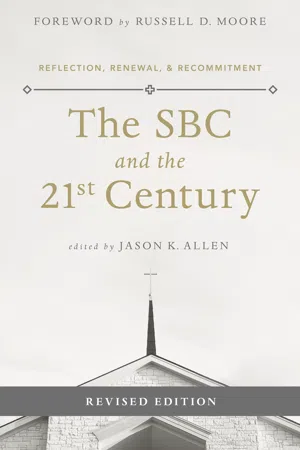
The Southern Baptist Convention is currently facing issues that challenge its identity, heritage, and future. In The SBC and the 21st Century, Revised Edition, key leaders address critical issues such as:
· Will the SBC grow more unified around shared convictions and mission or will it fragment over secondary concerns and tertiary doctrinal differences?
· Will the SBC be able to maintain a distinct Baptist identity while engaging and partnering with the broader evangelical community?
· Will the SBC be willing to reimagine its structures, programs, and efforts to effectively reach the world for Christ or will it risk being a past-tense denomination?
This volume not only promotes meaningful dialogue, it calls leaders throughout the SBC into action. Extensive thought, research, assessment, and wisdom from some of the SBC’s brightest minds have been poured into this volume with the intent of rendering a helpful contribution to SBC life that will propel forward the collective work of Southern Baptists well into the 21st century.
- 266 pages
- English
- ePUB (mobile friendly)
- Available on iOS & Android
eBook - ePub
About this book
Trusted by 375,005 students
Access to over 1.5 million titles for a fair monthly price.
Study more efficiently using our study tools.
Information
Topic
Theology & ReligionSubtopic
Christian Denominations
PART 1: SOUTHERN BAPTIST CONVENTION AND COOPERATION
Chapter 1
How the Cooperative Program Empowers Churches to Gospel Ministry
Robert J. Matz & John Mark Yeats
Consider two missionaries: they have the same education, the same passion for taking the gospel to the unreached, the same mission. One is fully funded; the other is constantly fund-raising. Or think about two seminary students, both called to ministry. Both pursue education at evangelical schools. The first takes out loans, is saddled with debt, and must reject the call of a church because it cannot pay enough for him to service his loans. He never enters the ministry because of the burden his degree imposes. The other receives a scholarship from the Southern Baptist Convention. He completes his schooling in three years without debt and is pastoring today.
THE NEED FOR COOPERATION
Evangelical missionaries, mission societies, seminary students, benevolence ministries, disaster relief organizations, church planters, orphanages and children’s homes, collegiate ministries, and a host of other ministry organizations have long struggled with the questions of funding. Such needs have often overwhelmed churches with requests for help.
The Southern Baptist Convention (SBC) was no different in wrestling with these competing needs. The SBC was founded “for the purpose of carrying into effect the benevolent intention of our constituents by organizing a plan for eliciting, combining, and directing the energies of the denomination for the propagation of the gospel.”1 Yet, how to best elicit, combine, and direct the energies of the churches befuddled Southern Baptists for their first seventy-five years.
In these early years, various missions and ministries sent out agents to churches seeking funding. This methodology bogged down ministry.
It was inefficient, with costs of raising the funds sometimes amounting to almost half the amount raised. The agents also created problems for the churches, often one or more of them showing up unannounced and expecting pulpit time to make an appeal for his cause, a pattern disruptive and often demoralizing to pastor and people alike. The method also led to imbalance. The boards which got to the churches first with the best speakers raised the most money; those caught by bad weather or bad roads, or who followed hard on the heels of others, raised less money, however worthy their cause. By raising its own funds, each board was practically independent and the convention itself more an observer than a determiner of Baptist ministries.2
The solution? In 1919, Southern Baptists launched the Seventy-Five Million Campaign to raise $75 million for Southern Baptist causes. All Southern Baptist ministries worked together to raise funds. They would then divide them according to a formula determined by the state conventions and the Executive Committee.3 No longer would every ministry, missionary, and minister be competing for limited church funds. Now all ministries would work together to support their respective needs. While partially derailed by a depression in 1920, the Seventy-Five Million Campaign provided a new model for ministry funding.4 This one-time offering became the foundation for a new method of ministry support: the Cooperative Program.
Since then, the Cooperative Program has served Southern Baptists as a unified plan of giving through which Southern Baptist churches give a portion of their undesignated receipts to support the missions and ministries of both their respective state conventions and of the SBC.5 As a result, Southern Baptist missionaries, seminary students, church planters, children’s homes, college ministries, and a host of other ministries are freed to do the work of ministry.
SHOULD CHURCHES WORK TOGETHER? A RATIONALE FOR THE COOPERATIVE PROGRAM
In the Baptist Faith and Message, Southern Baptists assert their belief in the independence of each local congregation stating that “a New Testament church of the Lord Jesus Christ is an autonomous local congregation.”6 This Baptist principle of autonomy means that churches embrace the priority of the local church through our ecclesiology. Yet, as one considers both the Scriptures and the realities of ministry, one sees a compelling biblical and practical rationale for cooperative ministry.
Biblical Reasons
In several places in Scripture independent churches are shown to be working together.
First, consider the church council, recorded in Acts 15, as the early churches in Antioch and Jerusalem worked together toward doctrinal refinement that resulted in them sending out gospel missionaries. Acts 15:1–3 tells of the initial dispute in Antioch. Jewish Christians argued that the new Gentile converts to Christianity needed to keep the Jewish law to be saved. Specifically the Gentile men needed to be circumcised. Paul and Barnabas objected. To obtain the apostles’ input, the Antiochian church as a whole appointed a group to go to Jerusalem.7
When the group arrived in Jerusalem, they were welcomed by the church (v. 4). After a discussion, a decision was reached by the whole church (v. 22)8 that the gospel was for everyone—both Jews and Gentiles. As a result, the Gentiles did not need to be circumcised.
Paul and Barnabas returned to Antioch where the whole church assembly celebrated the news from Jerusalem (vv. 30–31). A few verses later, Luke recounted the result of this message. Paul and Barnabas were each sent out from the existing churches with this message, that the gospel is for both the Jew and the Gentile (16:4–5). The rest of Acts outlines how new churches were started and how many more people became Christians.9 When these early churches worked together to understand God’s plan, they sent out people who shared the gospel, saw people converted, and started new churches. As Scott Hildreth notes of this chapter, these churches became partners “in the mission of proclaiming the gospel to the unreached.”10
A second way that biblical churches cooperated with one another is found in Acts 11:27–30. The Antiochian church had learned that a famine would soon strike Judea and Jerusalem. They knew the believers there would be adversely affected. As a result, they collectively decided to “send relief to the brothers and sisters who lived in Judea” (v. 29 CSB). Paul and Barnabas then took their gifts to those in Judea and Jerusalem.
When churches come together around New Testament doctrine, they work together to reach the lost, to plant churches that proclaim the gospel message, and to meet the needs of those in crisis. “We are on mission together, not merely because it seems to work better, but because we are one church serving the same mission.”11
Practical Reasons
Ministry is often lonely.12 Pastors can feel isolated and churches can often seem disconnected from one another. The SBC is a platform that combats this loneliness both personally and corporately. Cooperating churches are never alone. The Cooperative Program (CP) serves as a powerful, collaborative tool that enables Southern Baptist congregations to stand together in advancing the cause of Christ. Because of the CP, church size is irrelevant. Multicampus churches, rural congregations, suburban megachurches, and new urban plants all partner in sharing the love of Jesus with the lost.
Some question the benefit of cooperative funding for missions, preferring a more “direct” system, which they believe has greater accountability for the missionary or organization. But there are limitations to what a single congregation can do. For example, some large congregations may be able to fund mission ventures on their own, but this type of “direct funding” model is not fully scalable to smaller congregations. And the budget for even larger congregations goes only so far. No church can reach every people group. Only in partnering together can churches reach everyone with the gospel.
Part of the tension lies in challenges between corporate giving, societal giving, or cooperative giving. Corporate giving allows the individual congregation to fund persons or organizations that they believe best represent the interests of the congregation. Like all ministry budgets, the number of people or organizations are limited to the number of people they can connect with directly.
Societal giving is tightly connected to individual or corporate giving in that the society relies on congregations directly funding the ministry of the society. Frequently the organization will send out representatives into churches to fund-raise for the specific ministries of the society. Prior to the advent of the CP, this was the main model used by the SBC to fund its international and domestic efforts. The key challenges for this model are competition between peer organizations and congregational request fatigue.
In contrast, cooperative giving takes a designated portion of a congregation’s mission budget and combines those resources with other congregations to be used for agreed-upon goals and aims. Through shared work, mutual benefits are realized that dynamically multiply the contributed resources. This cooperative work increases accountability between independent congregations and heightens the expectations placed upon those serving the cooperating churches.
This is a biblical reflection of what we see in the early church. In Acts 4:32–35, the example is given of how the members of the early church cooperatively contributed to meet the needs of people and fund the ministries of the church. The example set for our congregations should be the same. The more we share in the work together, the more we can accomplish.
THE STATE OF THE COOPERATIVE PROGRAM TODAY
As of September 30, 2017, Southern Baptists have given more than $18 billion to the Cooperative Program cumulatively since 1930. Of this, nearly $11.5 billion was given to various state convention ministries and just under $7 billion has been distributed to national SBC entities.
In recent years, there has been a move toward increased funding for national ministries. While total CP giving has decreased over the past ten years, the percentage states have forwarded to the national ministries has increased.13
| CP YEAR | TOTAL COOPERATIVE PROGRAM | STATE SHARE | SBC SHARE |
| 2016–17 | $462,662,332 | 58.51% | 41.49% |
| 2015–16 | $4... |
Table of contents
- Foreword
- Preface
- Acknowledgments
- Introduction
- Part 1: Southern Baptist Convention and Cooperation
- Part 2: Southern Baptist Doctrine and Distinctives
- Part 3: Southern Baptist Ministry and Mission
- Conclusion
- Appendix A
- Appendix B
- Contributors
- Name and Subject Index
Frequently asked questions
Yes, you can cancel anytime from the Subscription tab in your account settings on the Perlego website. Your subscription will stay active until the end of your current billing period. Learn how to cancel your subscription
No, books cannot be downloaded as external files, such as PDFs, for use outside of Perlego. However, you can download books within the Perlego app for offline reading on mobile or tablet. Learn how to download books offline
Perlego offers two plans: Essential and Complete
- Essential is ideal for learners and professionals who enjoy exploring a wide range of subjects. Access the Essential Library with 800,000+ trusted titles and best-sellers across business, personal growth, and the humanities. Includes unlimited reading time and Standard Read Aloud voice.
- Complete: Perfect for advanced learners and researchers needing full, unrestricted access. Unlock 1.5M+ books across hundreds of subjects, including academic and specialized titles. The Complete Plan also includes advanced features like Premium Read Aloud and Research Assistant.
We are an online textbook subscription service, where you can get access to an entire online library for less than the price of a single book per month. With over 1.5 million books across 990+ topics, we’ve got you covered! Learn about our mission
Look out for the read-aloud symbol on your next book to see if you can listen to it. The read-aloud tool reads text aloud for you, highlighting the text as it is being read. You can pause it, speed it up and slow it down. Learn more about Read Aloud
Yes! You can use the Perlego app on both iOS and Android devices to read anytime, anywhere — even offline. Perfect for commutes or when you’re on the go.
Please note we cannot support devices running on iOS 13 and Android 7 or earlier. Learn more about using the app
Please note we cannot support devices running on iOS 13 and Android 7 or earlier. Learn more about using the app
Yes, you can access The SBC and the 21st Century by Jason K. Allen in PDF and/or ePUB format, as well as other popular books in Theology & Religion & Christian Denominations. We have over 1.5 million books available in our catalogue for you to explore.