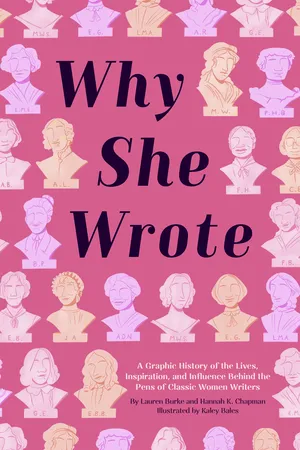
In Why She Wrote, dive into the fascinating, unexpected, and inspiring stories behind the greatest women writers in the English language. This compelling graphic collection features 18 women—including Jane Austen, Louisa May Alcott, Alice Dunbar Nelson, Anne Lister, and more—and asks a simple question: in a time when being a woman writer often meant being undervalued, overlooked, or pigeonholed, why did she write?Why did Jane Austen struggle to write for five years before her first novel was ever published? How did Edith Maude Eaton's writing change the narrative around Chinese immigrant workers in North America? Why did the Brontë sisters choose to write under male pennames, and Anne Lister write her personal diaries in code?Learn about women writers from the 18th, 19th, and early 20th centuries, from familiar favorites to those who have undeservedly fallen into obscurity, and their often untold histories, including: • The forgotten mother of the gothic genre
• The unexpected success of Little Women
• The diaries of the "first modern lesbian"
• The lawsuit to protect Little Lord Fauntleroy
• The personal account of a mastectomy in 1811
• Austen's struggles with writer's block
• And much, much more! Why She Wrote highlights a significant moment from each writer's life and retells it through engaging and accessible comics, along with biographical text, bibliographies, and fun facts. For aspiring writers, literary enthusiasts, and the Janeite who has everything, this new collection highlights these incredible women's hardships, their influence, and the spark that called them to write.• GREAT GRAPHIC NOVEL FOR ALL AGES: Librarians and teachers recommend graphic novels for readers of all ages, especially beloved nonfiction titles like Marjane Satrapi's Persepolis and Raina Telgemeier's Smile, Sisters, and Guts. Immerse yourself in the stories of these fascinating women through the fun, approachable, and dynamic medium of the graphic novel!
• CELEBRATION OF WOMEN WRITERS: Want to read more books by historical women writers, but aren't sure where to start? The stories and bibliographies of the women featured in Why She Wrote is an inspirational deep dive.
• OVERVIEW OF WOMEN'S HISTORY: Add it to the shelf alongside other collections of women's history, including Women in Science: 50 Fearless Pioneers Who Changed the World by Rachel Ignotofsky, Brazen: Rebel Ladies Who Rocked the World by Pénélope Bagieu, and Amazons, Abolitionists, and Activists: A Graphic History of Women's Fight for Their Rights by Mikki Kendall and A. D'Amico.
eBook - ePub
Why She Wrote
A Graphic History of the Lives, Inspiration, and Influence Behind the Pens of Classic Women Writers
- English
- ePUB (mobile friendly)
- Available on iOS & Android
eBook - ePub
Why She Wrote
A Graphic History of the Lives, Inspiration, and Influence Behind the Pens of Classic Women Writers
About this book
Trusted by 375,005 students
Access to over 1.5 million titles for a fair monthly price.
Study more efficiently using our study tools.
Information

“Oh! I am quite delighted with the book! I should like to spend my whole life in reading it,” Catherine Morland, the heroine of Jane Austen’s Northanger Abbey, declares. A fan of “horrid” novels, Catherine is gushing over The Mysteries of Udolpho by Ann Radcliffe, which features all of the hallmarks of a classic Gothic text—gloomy atmosphere, wild landscapes, castle ruins, and supernatural twists and turns. When asked why she doesn’t read serious and respectable histories, Catherine complains about the lack of female representation. Histories were written by men, while women had found their voice in Gothic novels.
Horace Walpole may have invented the Gothic genre with his novel The Castle of Otranto in 1764, but Ann Radcliffe made it her own starting in 1789. She is known as the mother of the Gothic novel, and her influence is palpable in the subsequent work of Jane Austen, Mary Shelley, and the Brontë sisters. Radcliffe’s brand of Gothic novel was female-centric. Her stories were told through the eyes of the damsel in distress, who suffered at the hands of a villainous patriarch but prevailed in the end.
Radcliffe also played tricks on her readers. While her novels promised lurid tales of ghosts and monsters, ultimately, the strange phenomenon is always explained. As Sir Walter Scott said of Radcliffe’s writing, “All circumstances of her narrative, however mysterious and apparently superhuman, were to be accounted for on natural principles at the winding up of the story.” Emily St. Aubert in The Mysteries of Udolpho would find that the creature lurking beneath the black veil was nothing more than (spoiler alert) a wax figure. The supernatural served as a misdirect, while the true horror in The Mysteries of Udolpho, Emily’s abuse and imprisonment at the hands of her uncle, is never concealed.
Radcliffe’s heroines found themselves caught up in what Charlotte Brontë would describe in her own Gothic novel Villette as a “homely web of truth.” Brontë employed Radcliffe’s “supernatural explained” device most famously in Jane Eyre, when it is revealed that Thornfield Hall is haunted not by a ghost, but rather by the imprisoned wife of the novel’s romantic interest, Mr. Rochester. Radcliffe’s reveals were rational, but Brontë’s were like a loaded gun. In their book Madwoman in the Attic, feminist scholars Sandra Gilbert and Susan Gubar assert that Mrs. Rochester serves as the “truest and darkest double” for the titular Jane, a physical manifestation of her repressed rage and anxiety. Through her characters and locked-room imagery, Brontë vents her own feelings and frustrations at the position of women in society.
In the summer of 1816, Mary Shelley was reading Gothic novels, looking for inspiration for her own ghost story. Like Radcliffe, Shelley promised the reader an otherworldly tale in Frankenstein: the story of a monster run amok. But the creature’s origins are scientific, not supernatural. His pathos, violence, and motivations are revealed. Much like Radcliffe’s damsels in distress, he is born and at the mercy of the patriarchal Dr. Frankenstein, a man who dares to take creation into his own hands but abandons his responsibility. Shelley asks the question: Who is the monster, the creature or the man who created his own dark double?
Gothic literature was often referred to as the trash of circulating libraries. Critics of Brontë and Shelley labeled them as coarse, antireligious works and demanded to know what sort of women would write such horrid books. But a better question to ask is: Why they were writing about monsters that weren’t monsters, or ghosts that weren’t gho...
Table of contents
- Cover
- Half title
- Title
- Dedication
- Copyright
- Contents
- Introduction
- Chapter One: The Horror of the Everyday
- Chapter Two: Finding Their Voice
- Chapter Three: Activism as Art
- Chapter Four: Private Lives
- Chapter Five: Public Identities
- Chapter Six: Protection and Profit
- Conclusion
- Acknowledgments
- Sources and Further Reading
- Author Bios
- Chronicle Ebooks
Frequently asked questions
Yes, you can cancel anytime from the Subscription tab in your account settings on the Perlego website. Your subscription will stay active until the end of your current billing period. Learn how to cancel your subscription
No, books cannot be downloaded as external files, such as PDFs, for use outside of Perlego. However, you can download books within the Perlego app for offline reading on mobile or tablet. Learn how to download books offline
Perlego offers two plans: Essential and Complete
- Essential is ideal for learners and professionals who enjoy exploring a wide range of subjects. Access the Essential Library with 800,000+ trusted titles and best-sellers across business, personal growth, and the humanities. Includes unlimited reading time and Standard Read Aloud voice.
- Complete: Perfect for advanced learners and researchers needing full, unrestricted access. Unlock 1.5M+ books across hundreds of subjects, including academic and specialized titles. The Complete Plan also includes advanced features like Premium Read Aloud and Research Assistant.
We are an online textbook subscription service, where you can get access to an entire online library for less than the price of a single book per month. With over 1.5 million books across 990+ topics, we’ve got you covered! Learn about our mission
Look out for the read-aloud symbol on your next book to see if you can listen to it. The read-aloud tool reads text aloud for you, highlighting the text as it is being read. You can pause it, speed it up and slow it down. Learn more about Read Aloud
Yes! You can use the Perlego app on both iOS and Android devices to read anytime, anywhere — even offline. Perfect for commutes or when you’re on the go.
Please note we cannot support devices running on iOS 13 and Android 7 or earlier. Learn more about using the app
Please note we cannot support devices running on iOS 13 and Android 7 or earlier. Learn more about using the app
Yes, you can access Why She Wrote by Lauren Burke,Hannah K. Chapman,Kaley Bales in PDF and/or ePUB format, as well as other popular books in History & Women in History. We have over 1.5 million books available in our catalogue for you to explore.