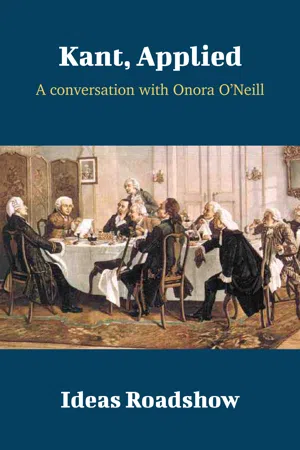
This book is based on an in-depth conversation between Howard Burton and Onora O'Neill, Emeritus Professor of Philosophy at the University of Cambridge and a crossbench member of the House of Lords. After intriguing insights into Onora O'Neill's path to becoming a Kant scholar, this wide-ranging conversation explores how Kant's philosophy is relevant for many thorny issues in our contemporary social world, from human rights to patient consent to corporate transparency and more.This carefully-edited book includes an introduction, The Benefits of Struggling, and questions for discussion at the end of each chapter: I. A Circuitous Route - Philosophy via history, psychology and physiologyII. Becoming Philosophical - Towards KantIII. The Categorical Imperative - And its complicationsIV. Human Rights - Duties and how to implement themV. Implementation - Trust, trustworthiness and appreciating limitsAbout Ideas Roadshow Conversations: This book is part of a series of 100 Ideas Roadshow Conversations. Presented in an accessible, conversational format, Ideas Roadshow books not only explore frontline academic research featuring world-leading researchers but also reveal the inspirations and personal journeys behind the research.
- English
- ePUB (mobile friendly)
- Available on iOS & Android
eBook - ePub
Kant, Applied - A Conversation with Onora O'Neill
About this book
Trusted by 375,005 students
Access to over 1.5 million titles for a fair monthly price.
Study more efficiently using our study tools.
Information
Topic
PhilosophySubtopic
Epistemology in Philosophy
Ideas Roadshow conversations present a wealth of candid insights from some of the world’s leading experts, generated through a focused yet informal setting. They are explicitly designed to give non-specialists a uniquely accessible window into frontline research and scholarship that wouldn’t otherwise be encountered through standard lectures and textbooks.
Over 100 Ideas Roadshow conversations have been held since our debut in 2012, covering a wide array of topics across the arts and sciences.
See www.ideas-on-film.com/ideasroadshow for a full listing.
Copyright ©2021 Open Agenda Publishing. All rights reserved.
ISBN: 978-1-77170-151-8
Edited with an introduction by Howard Burton.
All Ideas Roadshow Conversations use Canadian spelling.
Contents
A Note on the Text
Introduction
The Conversation
I. A Circuitous Route
II. Becoming Philosophical
III. The Categorical Imperative
IV. Human Rights
V. Implementation
Continuing the Conversation
A Note on the Text
The contents of this book are based upon a filmed conversation between Howard Burton and Onora O’Neill in London, England, on October 3, 2016.
Onora O’Neill is an Emeritus Professor of Philosophy at the University of Cambridge and a crossbench member of the House of Lords.
Howard Burton is the creator and host of Ideas Roadshow and was Founding Executive Director of Perimeter Institute for Theoretical Physics.
Introduction
The Benefits of Struggling
Immanuel Kant is not the easiest philosopher to read.
To start with, he is German, which not only makes him notoriously hard to grapple with for many of those who don’t speak German as a native language, but is surprisingly troublesome even for those who do, with many German scholars rather bizarrely opting to ponder his ideas in English.
Then there is the fact that Kant was known to be a particularly formal and scrupulous thinker even by 18th-century Prussian standards—which is indeed saying something—a philosopher who prized our capacity for reason above all else, developing a highly systematic and abstract interpretation of how we come to know and have confidence in the world around us through the medium of our human minds and associated categories of understanding.
But Kant—rigorous, all-encompassing sort that he was—didn’t limit himself to matters of metaphysics and epistemology. He also had a great deal to say about ethics and morality in his Groundwork of the Metaphysics of Morals, which has the dubious reputation of being particularly challenging to penetrate even by Kantian standards—which, as you’ve doubtless recognized by now, is truly saying something.
The celebrated moral philosopher and Kantian scholar Onora O’Neill remembers that her own path to Kant was hardly straightforward. As a young graduate student she was initially intrigued by the “extremely fashionable rational choice models” that surrounded her before eventually becoming convinced of its fundamental implausibility.
“I didn’t feel that it gave one any insight into good reasons for doing anything. To say, ‘I prefer X,’ or ‘I like X’ is not a very good reason for doing X. It might be a good reason in certain circumstances with lots of other stuff put in there.
“So the idea that preferences and desires have either normative or explanatory force seems to me a bit over the top, although they’re widely taken to have that sort of force of weight.”
What she was looking for, was some clear structure—some straightforward, objective, defensive way of being able to determine what should be done in a given situation. That brought her, naturally enough, to Kant—but not straight away.
“The detour I took before I started reading Kant seriously during my second or third year as a graduate student, was a detour to look at people who were trying to use certain formal constraints on top of utilitarianism, although their utilitarianism was muted and masked.
“It was the formalism that attracted me. I suppose the fundamental intuition is: If you can get places with minimal assumptions, that’s much more valuable than getting places on the back of extravagant assumptions. And that parsimony in premises is what I thought I was going to find in looking at some of these 20th-century writers—people like Marcus Singer and Kurt Baier.”
Eventually, appropriately enough, she discarded the vestiges of utilitarianism injected by later thinkers and recognized that what she was looking for was clearly delineated by Kant himself.
“Kant is different. The categorical imperative combines two aspects of what is loosely called universalism.
“One is the idea that principles have the form of law: they cover all cases in a certain domain. So whether it is ‘Thou shalt not bear false witness’ or ‘Remember to renew your subscription at the end of the month’, it is universal in form—it’s addressed to anybody.
“But what is interesting about the categorical imperative is that Kant is also asking whether it is universal in scope. And that’s a different matter, because universal in scope means that it is a principle for anybody and everybody. So, “Renew your subscription at the beginning of the month” does not have universal scope—it will only apply to people whose subscription falls due this month, et cetera.
“Kant is putting forward both a formal criterion and a scope criterion. He’s saying, ‘Principles that do not meet both are not fit to be universal laws and should be rejected.’”
Well, you might think, I can see how using such a decision procedure can be profitably used to guide my individual moral behaviour, but surely it doesn’t have many implications in terms of my relationships with others throughout society.
But you’d be wrong. Because the universality that Kant places so much stress on, naturally implies a high level of direct interaction, potential or actual, with our fellow human beings.
“Kant thinks that the key is to realize that there’s a plurality of agents. Otherwise, what would this universality be for? It’s got to be able to reach, not just those of a particular sentiment or particular outlook, but just anybody.
“Kant thinks of reason, or reasoning, in a transactional way: I give someone a reason; he accepts or rejects the reason and gives me a reason in return.
“From there you can get to the thought, “Well, whate...
Table of contents
- A Note on the Text
- Introduction
- The Conversation
- Continuing the Conversation
Frequently asked questions
Yes, you can cancel anytime from the Subscription tab in your account settings on the Perlego website. Your subscription will stay active until the end of your current billing period. Learn how to cancel your subscription
No, books cannot be downloaded as external files, such as PDFs, for use outside of Perlego. However, you can download books within the Perlego app for offline reading on mobile or tablet. Learn how to download books offline
Perlego offers two plans: Essential and Complete
- Essential is ideal for learners and professionals who enjoy exploring a wide range of subjects. Access the Essential Library with 800,000+ trusted titles and best-sellers across business, personal growth, and the humanities. Includes unlimited reading time and Standard Read Aloud voice.
- Complete: Perfect for advanced learners and researchers needing full, unrestricted access. Unlock 1.5M+ books across hundreds of subjects, including academic and specialized titles. The Complete Plan also includes advanced features like Premium Read Aloud and Research Assistant.
We are an online textbook subscription service, where you can get access to an entire online library for less than the price of a single book per month. With over 1.5 million books across 990+ topics, we’ve got you covered! Learn about our mission
Look out for the read-aloud symbol on your next book to see if you can listen to it. The read-aloud tool reads text aloud for you, highlighting the text as it is being read. You can pause it, speed it up and slow it down. Learn more about Read Aloud
Yes! You can use the Perlego app on both iOS and Android devices to read anytime, anywhere — even offline. Perfect for commutes or when you’re on the go.
Please note we cannot support devices running on iOS 13 and Android 7 or earlier. Learn more about using the app
Please note we cannot support devices running on iOS 13 and Android 7 or earlier. Learn more about using the app
Yes, you can access Kant, Applied - A Conversation with Onora O'Neill by Howard Burton in PDF and/or ePUB format, as well as other popular books in Philosophy & Epistemology in Philosophy. We have over 1.5 million books available in our catalogue for you to explore.