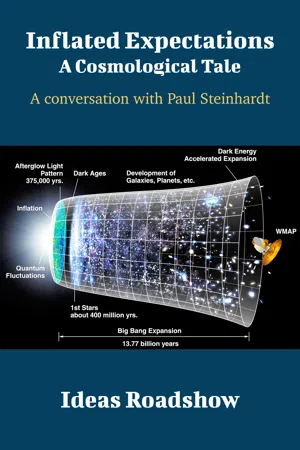
This book is based on an in-depth conversation between Howard Burton and Paul Steinhardt, the Albert Einstein Professor of Science and Director of the Center for Theoretical Science at Princeton University. He is one of the originators of the theory of cosmic inflation and has become one of its fiercest critics. This fascinating conversation covers topics such as Paul Steinhardt's scientific development, his formative experiences at Caltech including his encounters with Richard Feynman, his development and later scepticism of the theory of cosmic inflation, the response of the scientific community to the failure of this theory, his theory of cosmology, The Ekpyrotic Universe, and more.. This carefully-edited book includes an introduction, Not Even Wrong, and questions for discussion at the end of each chapter: I. Scientific Beginnings - Marie Curie, Richard Feynman, and finding one's pathII. Inflationary Excitement - A captivating talk and subsequent insightsIII. Progress, Tuned Appropriately - The Nuffield Workshop and its aftermathIV. Two Major Issues - The initial value problem and eternal inflationV. Cosmological Denial - Resolutely clinging to a good storyVI. Bouncing Back? - Considering a key changeAbout Ideas Roadshow Conversations Series: Presented in an accessible, conversational format, Ideas Roadshow books not only explore frontline academic research featuring world-leading researchers but also reveal the inspirations and personal journeys behind the research.
eBook - ePub
Inflated Expectations: A Cosmological Tale - A Conversation with Paul Steinhardt
- English
- ePUB (mobile friendly)
- Available on iOS & Android
eBook - ePub
Inflated Expectations: A Cosmological Tale - A Conversation with Paul Steinhardt
About this book
Trusted by 375,005 students
Access to over 1.5 million titles for a fair monthly price.
Study more efficiently using our study tools.
Information
Topic
Physical SciencesSubtopic
Astronomy & Astrophysics
Ideas Roadshow conversations present a wealth of candid insights from some of the world’s leading experts, generated through a focused yet informal setting. They are explicitly designed to give non-specialists a uniquely accessible window into frontline research and scholarship that wouldn’t otherwise be encountered through standard lectures and textbooks.
Over 100 Ideas Roadshow conversations have been held since our debut in 2012, covering a wide array of topics across the arts and sciences.
See www.ideas-on-film.com/ideasroadshow for a full listing.
Copyright ©2015, 2020 Open Agenda Publishing. All rights reserved.
ISBN: 978-1-77170-087-0
Edited with an introduction by Howard Burton.
All Ideas Roadshow Conversations use Canadian spelling.
Contents
A Note on the Text
Introduction
The Conversation
I. Scientific Beginnings
II. Inflationary Excitement
III. Progress, Tuned Appropriately
IV. Two Major Issues
V. Cosmological Denial
VI. Bouncing Back?
Continuing the Conversation
A Note on the Text
The contents of this book are based upon a filmed conversation between Howard Burton and Paul Steinhardt in Princeton, New Jersey, on May 15, 2015.
Paul Steinhardt is the Albert Einstein Professor in Science and Director of the Center for Theoretical Science at Princeton University.
Howard Burton is the creator and host of Ideas Roadshow and was Founding Executive Director of Perimeter Institute for Theoretical Physics.
Introduction
Not Even Wrong
Physicists are pretty good at coming up with memorable phrases to express their scientific disdain.
Einstein famously decreed, God does not play dice with the universe, as his justification for denying the inherently statistical nature of the world that quantum mechanics seemed to present.
Of course, the development of quantum mechanics was known to wreak considerable intellectual havoc among even its most significant contributors, such as Einstein. Erwin Schrödinger became so uncomfortable with the implications of his celebrated equation that he even came up with a notorious thought experiment involving a half-dead and half-alive cat to demonstrate the palpable absurdity of a standard interpretation of the theory, while plaintively summing up his view on quantum theory later on in his life with a pithy, I don’t like it, and I’m sorry I ever had anything to do with it.
Not all such dismissive remarks were specifically geared towards quantum mechanics, however. Perhaps the most notorious physics put-down is attributed to Wolfgang Pauli, who was said to have summarily rejected the work of a young physicist that was put before him by archly declaring, It is not even wrong.
Pauli’s meaning, it seems reasonable to conclude, is that the young physicist’s work was not only incorrect, it couldn’t even be coherently expressed in such a way as to be clearly and explicitly falsified. For falsification, too, is a form of scientific progress—albeit of a much less triumphant sort—that sometimes paves the way for deeper and more accurate theories.
Enter Paul Steinhardt, the Albert Einstein Professor and Director of the Center for Theoretical Science at Princeton University. Paul is a remarkably broad theoretical physicist who has made singular contributions to both cosmology and condensed matter physics. Among cosmologists he is perhaps best known for his seminal work in the early 1980s, together with Alan Guth and Andrei Linde, that led to the establishment of the theory of cosmic inflation as the primary paradigm of modern cosmology.
These days, however, Paul has decidedly broken ranks with his erstwhile inflationary colleagues, consistently drawing attention to the fact that there are deeply unsettling aspects of the theoretical framework of inflationary cosmology that should give all of us serious pause.
“Instead of driving the universe the way we had hoped from some random, initial state into a common, final condition consistent with what we observe, in fact the story of inflation is the following: it’s very hard to start; and if you do manage to start it, it produces a mess—what we call a “multiverse”—consisting of an infinitude of patches of possible, cosmic outcomes.”
Given the propensity of today’s theorists to invoke the notion of infinity, the reader might well be excused for not appreciating the seriousness of this problem. But this, Paul explains, is hardly the sort of thing to be swept under the rug, as it implies that, since any outcome is possible, there is no conceivable way we might one day be able to rule out the theory, even in principle.
Even worse still, however, sweeping it under the rug is precisely what many of his colleagues seem very much determined to do.
“I’ve had this discussion where I’ll say, ‘Well, what do you think about the multiverse problem?’ and they reply, ‘I don’t think about it.’
“So I’ll say, ‘Well, how can you not think about it? You’re doing all these calculations and you’re saying there’s some prediction of an inflationary model, but your model produces a multiverse—so it doesn’t, in fact, produce the prediction you said: it actually produces that one, together with an infinite number of other possibilities, and you can’t tell me which one’s more probable.”
“And they’ll just reply, ‘Well, I don’t like to think about the multiverse. I don’t believe it’s true.’
“So I’ll say, ‘Well, what do you mean, exactly? Which part of it don’t you believe is true? Because the inputs, the calculations you’re using—those of general relativity, quantum mechanics and quantum field theory—are the very same things you’re using to get the part of the story you wanted, so you’re going to have to explain to me how, suddenly, other implications of that very same physics can be excluded. Are you changing general relativity? No. Are you changing quantum mechanics? No. Are you changing quantum field theory? No. So why do you have a right to say that you’d just exclude thinking about it?’
“But that’s what happens, unfortunately. There’s a real sense of denial going on.”
Dogmatic denial is not terribly good for science. In fact, it could well be regarded as precisely the sort of closed-minded, unreflective attitude that the modern scientific temperament has emphatically, and so successfully, struggled against for centuries.
But it’s not just a question of scientific stubbornness. Because theorists unwilling to grapple with inflation’s “multiverse problem” aren’t simply resolutely clinging to their theory despite any objective observed support for it. As Paul points out, they are clinging to their theory independent of any observed support for it.
Take the case of the reported findings of the BICEP2 experimen...
Table of contents
- A Note on the Text
- Introduction
- The Conversation
- Continuing the Conversation
Frequently asked questions
Yes, you can cancel anytime from the Subscription tab in your account settings on the Perlego website. Your subscription will stay active until the end of your current billing period. Learn how to cancel your subscription
No, books cannot be downloaded as external files, such as PDFs, for use outside of Perlego. However, you can download books within the Perlego app for offline reading on mobile or tablet. Learn how to download books offline
Perlego offers two plans: Essential and Complete
- Essential is ideal for learners and professionals who enjoy exploring a wide range of subjects. Access the Essential Library with 800,000+ trusted titles and best-sellers across business, personal growth, and the humanities. Includes unlimited reading time and Standard Read Aloud voice.
- Complete: Perfect for advanced learners and researchers needing full, unrestricted access. Unlock 1.5M+ books across hundreds of subjects, including academic and specialized titles. The Complete Plan also includes advanced features like Premium Read Aloud and Research Assistant.
We are an online textbook subscription service, where you can get access to an entire online library for less than the price of a single book per month. With over 1.5 million books across 990+ topics, we’ve got you covered! Learn about our mission
Look out for the read-aloud symbol on your next book to see if you can listen to it. The read-aloud tool reads text aloud for you, highlighting the text as it is being read. You can pause it, speed it up and slow it down. Learn more about Read Aloud
Yes! You can use the Perlego app on both iOS and Android devices to read anytime, anywhere — even offline. Perfect for commutes or when you’re on the go.
Please note we cannot support devices running on iOS 13 and Android 7 or earlier. Learn more about using the app
Please note we cannot support devices running on iOS 13 and Android 7 or earlier. Learn more about using the app
Yes, you can access Inflated Expectations: A Cosmological Tale - A Conversation with Paul Steinhardt by Howard Burton in PDF and/or ePUB format, as well as other popular books in Physical Sciences & Astronomy & Astrophysics. We have over 1.5 million books available in our catalogue for you to explore.