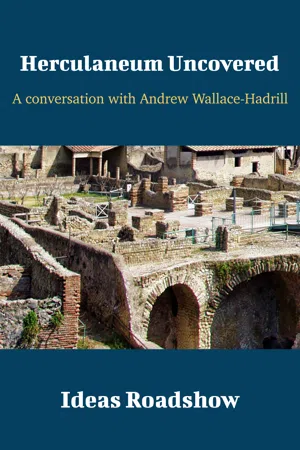
This book is based on an in-depth conversation between Howard Burton and Andrew Wallace-Hadrill, Director of Research and Honorary Professor of Roman Studies in the Faculty of Classics at the University of Cambridge. This wide-ranging conversation covers his fascinating archeological work done in Herculaneum and Pompeii, the politics of excavation, and life in the ancient Roman world.This carefully-edited book includes an introduction, Historical Value, and questions for discussion at the end of each chapter: I. What We Know - History and geologyII. Letting Sleeping Dogs Lie - Exploring historical motivationsIII. Exploring Roman Society - Housing, slavery, citizenship and statusIV. Herculaneum vs. Pompeii - Different eyes on the pastV. The Future of the Past - Excavation, preservation and spending effectivelyAbout Ideas Roadshow Conversations Series: This book is part of a series of 100 Ideas Roadshow Conversations. Presented in an accessible, conversational format, Ideas Roadshow books not only explore frontline academic research featuring world-leading researchers but also reveal the inspirations and personal journeys behind the research.
- English
- ePUB (mobile friendly)
- Available on iOS & Android
eBook - ePub
Herculaneum Uncovered - A Conversation with Andrew Wallace-Hadrill
About this book
Trusted by 375,005 students
Access to over 1.5 million titles for a fair monthly price.
Study more efficiently using our study tools.
Information
Subtopic
Roman Ancient HistoryIndex
HistoryThe Conversation
I. What We Know
History and geology
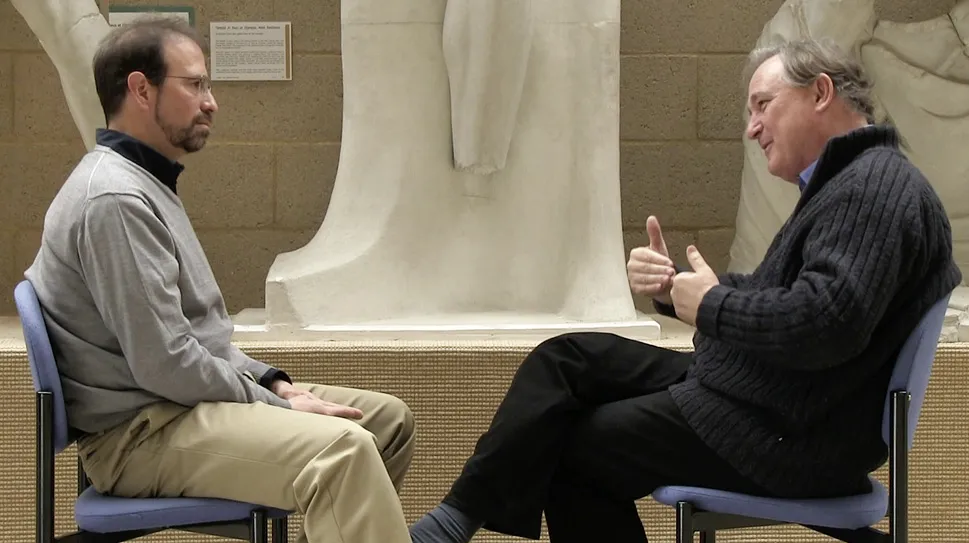
HB: Perhaps I could ask you to start us off by providing some general historical context about the history of the excavations at Herculaneum.
AWH: Well, the real excavation of Herculaneum happens under the Spanish regime of Charles Bourbon (King of Naples and Sicily from 1734-1759). That’s the great period of excavation. He took a very strong personal interest in it.
And they just explored everywhere. They started at the theatre but it’s a mining principle: you go down and then you go laterally, and they riddled the site with their tunnels—absolutely riddled it. And every now and again they would just hit something really spectacular.
They hit the Villa of Papyri at around 1750. Suddenly—boom!—statues are coming out. I think it’s a wonderful historical irony that Charles Bourbon was the inheritor of the biggest collection of ancient statues in Italy: the Farnese collection.
In his mind, the obvious thing was, Let’s find statues! And he was so lucky because, well, where do you find statues? You find them in the theatre, you find them in the public buildings and you find them in very big villas with gardens. And he manages to hit all of them.
Imagine hitting a villa, if we did it today, with a hundred statues of quality. It’s the most incredible find imaginable. And then, as if that wasn’t enough, a unique collection of carbonized papyri. It was the most unbelievable bit of luck.
Given how truly amazing that find is, the odd thing is that people later lost interest in Herculaneum. And there I blame the famous German art historian and archaeologist Johan Joachim Winckelmann, who attacked the excavations.
HB: The way they were being done.
AWH: Yes.
HB: This was after Charles had gone back to Spain, right?
AWH: Yes. Charles had gone back to Spain in 1759 to become King Charles III, leaving his son Ferdinand to succeed him as King of Naples. But Ferdinand is only eight years old when he starts—it’s an incredibly delicate regime.
And Bernardo Tannucci, Ferdinand’s prime minister, is trying to hang onto things when this damn German publishes this blast against Herculaneum. And the next thing you find is that they’ve shifted their interest to Pompeii, about which Winckelmann had very little to say because there was nothing to see when he visited. So Herculaneum sort of goes off the radar in a really interesting way; and yet they had only just begun to discover these amazing things.
HB: I’d like to talk a little bit about your background and how you became involved with Herculaneum and Pompeii, but first I’d like to highlight a few misconceptions. Reading your book, Herculaneum: Past and Present, was a particularly stimulating experience for me because so many of my preconceived notions of what Herculaneum I thought the site to be were shown to be false.
For one thing, when I thought of Herculaneum, almost the only thing that I thought was noteworthy was the Villa of Papyri. All I could think about was, We know that so much of ancient literature was lost and this could be a place where there’s a lot more that we can find, since it hasn’t been fully explored yet.
Of course I still feel enormous excitement at the prospect of being able to find lost manuscripts, but I’ve also learned through your book that there are also so many other things there that are extremely captivating.
AWH: I think that’s exactly what I want to say. The Villa has still a lot to offer, and all the work done recently on the Villa has come up with some really interesting results. But it isn’t just papyri that you can get out of Herculaneum.
I myself am particularly interested in the documentary wooden tablets—legal documents, where you have the document in triplicate all tied together, inscribed inside and with an ink version on the outside. So far we’ve found, I think, eight different bundles of these at Herculaneum. And it’s absolutely certain that if you do more excavation you will find more of them. They’re incredibly hard to read, but they’re much easier to read than the papyri because at least they were flat, not all rolled up.
The papyri are an extraordinary challenge to read, while the level of reward you get out of reading these legal documents—to me as a Roman historian—is much, much higher than what we’ve got out of the papyri. Not that Greek philosophy is of no interest—of course it’s fascinating—but here you’ve got genuine, deep insights into how Roman business life worked, which is so precious.
Of course from the lawyers we have lots of written comments on how the law ought to be working: they give their own little case studies. But actually to see it in action on the ground—real people using the Roman legal system—you suddenly understand that the Roman legal system matters to ordinary people. They are absolutely engaged with it.
HB: I’d like to get a deeper understanding of what we have found, how we can interpret these results and the consequent aspects of Roman society that you’ve been able to penetrate in a deeper way through these finds, but first I’d like to dwell a bit longer on some of my misconceptions because I suspect that some other people might have them as well.
As I said, one misconception that I had was that the importance of Herculaneum effectively boiled down to just the Villa of Papyri. And that’s clearly false.
Another misconception I had concerns what actually happened during the volcanic eruption. I don’t know how I picked this up, exactly, but somehow I had this sense that Herculaneum was buried in a wave of mud after Vesuvius erupted.
And at the beginning of your book, you mention that the Cambridge archaeologist Charles Waldstein specifically puts this forward as an explanation of what happens. But it turns out to be completely wrong. And then you go on to talk about the clear and detailed interplay between archaeology and geology while highlighting what we now know actually happened during the eruption.
AWH: That’s absolutely right. I mean, one thing that just awes me about engaging in the process of archaeological research is how you need to draw on all disciplines, particularly scientific disciplines. It’s no good, for someone like me who is a historian by training, to try to understand how volcanic eruption works. You need a volcanologist.
And, fascinatingly, volcanologists have been very engaged with this really well-preserved evidence of a past eruption. Since the early 1980s, our understanding of how the eruption actually happened, the precise dynamics, has been transformed.
Irritatingly, the idea that Herculaneum was overwhelmed with a mud flow remains so ingrained in the literature. Nowadays, most Italians still refer to the rock that covers the site as fango—mud.
And, I always say, “Well, at least it’s a two syllable word, fango, rather than the much more technical mouthful “consolidated pyroclastic flow”.
And then, even more irritatingly perhaps, more technically the rock is called tufo, which in English is frequently mispronounced as “tufa”, which is particularly problematic because tufa is actually the technical name for another completely different type of rock.
Meanwhile, Americans call tufo “tuff”, but that’s difficult for the Brits of course—we can’t go around calling something “tuff”—so that’s problematic too. All of this contributes, I think, to explain why fango—mud—sticks in the popular imagination.
HB: But it’s completely wrong.
AWH: It’s spectacularly wrong. Because what matters is not wetness and slowness, what matters is intense heat—these really hot gases swirling around, dense with ash. And without the heat you don’t get the carbonization of organic materials.
Interest...
Table of contents
- A Note on the Text
- Introduction
- The Conversation
- Continuing the Conversation
Frequently asked questions
Yes, you can cancel anytime from the Subscription tab in your account settings on the Perlego website. Your subscription will stay active until the end of your current billing period. Learn how to cancel your subscription
No, books cannot be downloaded as external files, such as PDFs, for use outside of Perlego. However, you can download books within the Perlego app for offline reading on mobile or tablet. Learn how to download books offline
Perlego offers two plans: Essential and Complete
- Essential is ideal for learners and professionals who enjoy exploring a wide range of subjects. Access the Essential Library with 800,000+ trusted titles and best-sellers across business, personal growth, and the humanities. Includes unlimited reading time and Standard Read Aloud voice.
- Complete: Perfect for advanced learners and researchers needing full, unrestricted access. Unlock 1.5M+ books across hundreds of subjects, including academic and specialized titles. The Complete Plan also includes advanced features like Premium Read Aloud and Research Assistant.
We are an online textbook subscription service, where you can get access to an entire online library for less than the price of a single book per month. With over 1.5 million books across 990+ topics, we’ve got you covered! Learn about our mission
Look out for the read-aloud symbol on your next book to see if you can listen to it. The read-aloud tool reads text aloud for you, highlighting the text as it is being read. You can pause it, speed it up and slow it down. Learn more about Read Aloud
Yes! You can use the Perlego app on both iOS and Android devices to read anytime, anywhere — even offline. Perfect for commutes or when you’re on the go.
Please note we cannot support devices running on iOS 13 and Android 7 or earlier. Learn more about using the app
Please note we cannot support devices running on iOS 13 and Android 7 or earlier. Learn more about using the app
Yes, you can access Herculaneum Uncovered - A Conversation with Andrew Wallace-Hadrill by Howard Burton in PDF and/or ePUB format, as well as other popular books in History & Roman Ancient History. We have over 1.5 million books available in our catalogue for you to explore.