This book is based on an in-depth conversation between Howard Burton and Miri Rubin, Professor of Medieval and Early Modern History at Queen Mary University of London. After behind-the-scenes insights into Miri Rubin's career path which led her from chemistry to working in an orthopaedic hospital to studying medieval history with a 'cultural anthropologist" persuasion to the subject of medieval Christianity, this wide-ranging conversation covers several books that Miri Rubin has written, including The Life and Passion of William of Norwich; Mother of God: A History of the Virgin Mary; Emotion and Devotion: The Meaning of Mary in Medieval Religious Cultures; The Middle Ages: A Very Short Introduction; and Cities of Strangers: Making Lives in Medieval Europe.This carefully-edited book includes an introduction, Cultural Contact, and questions for discussion at the end of each chapter: I. Historical Beginnings - From Jerusalem to CambridgeII. Life on the Ground - Hope, human agency and hemorrhoidsIII. William of Norwich - Fabricating hatredIV. Mother of God - An ambitious projectV. Doing History - Then, now and in the futureAbout Ideas Roadshow Conversations: This book is part of a series of 100 Ideas Roadshow Conversations. Presented in an accessible, conversational format, Ideas Roadshow books not only explore frontline academic research featuring world-leading researchers but also reveal the inspirations and personal journeys behind the research.
- English
- ePUB (mobile friendly)
- Available on iOS & Android
eBook - ePub
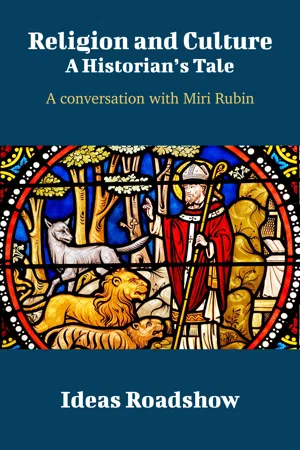
Religion and Culture: A Historian's Tale - A Conversation with Miri Rubin
About this book
Trusted by 375,005 students
Access to over 1.5 million titles for a fair monthly price.
Study more efficiently using our study tools.
Information
Subtopic
British HistoryIndex
HistoryThe Conversation
I. Historical Beginnings
From Jerusalem to Cambridge
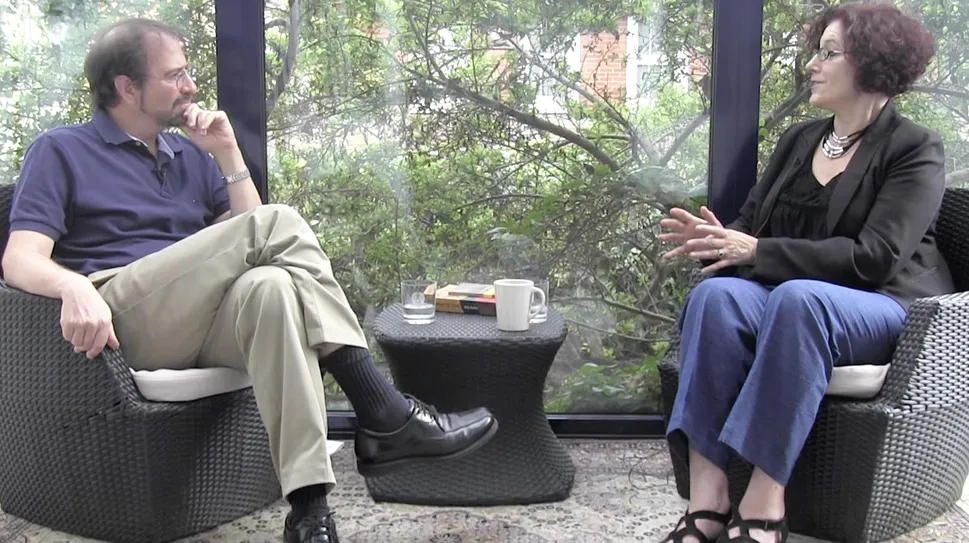
HB: I would like to start with your background, trying to get a sense of the story of how you became a medievalist.
MR: I never meant to be a historian. I actually started studying chemistry at university.
HB: Oh, really?
MR: Yes. I had a brilliant chemistry teacher. I had wonderful teachers. I went to one of the best schools in, I would say, the Middle East? Maybe the world? It’s in Jerusalem—a highly selective, really brilliant high school. And we had wonderful teachers in all subjects.
I grew up in Israel, and from the age of 12 I was in Jerusalem. I went to a brilliant high school and had fantastic teachers literally in all subjects. I’m not exaggerating. They were incredible.
HB: But you had a particularly good chemistry teacher.
MR: I had a really charismatic chemistry teacher. And at the time—we’re talking the seventies—there weren’t so many girls doing science, definitely not at university. There was a special sort of cachet to it. The sentiment was: If you can do it, you ought to pursue it—lots of people can do other things, but since there were so few women in science you should consider that if you could do it well.
So I went to university and I studied chemistry in the first year.And then we had a great and devastating war, the Yom Kippur War, which started at the beginning of October, just before the academic year was about to begin.
I was going to enter my second year, but that wasn’t going to happen because everyone was at the front. A lot of the people I knew—young people, soldiers—were killed. So with the education not starting at university, I just went and presented myself in a hospital and worked. And I worked for about 10 months in Hadassah Hospital in Jerusalem.
HB: What sort of things did you do?
MR: I just helped out as best I could. It was in the orthopaedic ward, mostly a ward that dealt with amputees, really young men who’d lost a leg or more.
I suppose nowadays it would be called “physician’s assistant” or something, I did everything and anything—you just did what you could. And that experience made me rethink everything, really.
I remember a day in the hospital where one of the top professors in another ward, who was the father of a friend of mine and used to see me regularly in the corridors, said to me, “Look, Mary, that’s enough. Things are getting back to normal (it was now winter time), you’ve done your bit. Now you have to think about your future.”
A hospital can be a very captivating environment. It’s almost like an Erving Goffman-type of total institution. You could do everything there: sleep there, eat there, shower there. You could just live there and be totally engrossed by your surroundings.
So I remember looking at the annual catalogue containing all the courses offered at Hebrew U, which is a great university. And I just fell on history, saying to myself, Actually, with wars and suffering and loss and all that makes you think about, I really want to understand. And I really want to understand what only history can give me. So I enrolled in history.
HB: So, if I can just interject for a moment: before the war broke out when you were studying chemistry, were you basically happy with your courses?
MR: They were a little bit on the dry side, and the people I met with were terrifically earnest and I was sort of young and silly. So I did find the social environment a bit boring, but it was basically fine.
HB: So you likely would have continued had it not been for these external circumstances.
MR: I probably think I would have done, yes.
There’s a very distinctive structure to the history course in Jerusalem, whereby in your first year—because they assume that you know really very little, except for perhaps the history of Israel and some Jewish history or a very thin survey of other histories—they require that you take courses on ancient, medieval, early modern and modern history, a lecture and a seminar in each.
So by the end of the first year, at least you know something about a whole lot of different periods. I’d never studied the Middle Ages before. And amongst all the excellent teachers I had that year, one simply soared. He’s a totally amazing medievalist, still active. His name is Ron Barkai.
He was then doing his own PhD, in fact, and was earning a living by teaching. We were studying the Crusades; and in addition to his deep knowledge of the Crusades he also had the advantage of knowing Islam culture very well because his family had come from North Africa and he had excellent Arabic.
So the whole vantage point we had on the Crusades was not as had traditionally been taught—this sort of amazing medieval phenomenon, one of the great achievements and events of its time—but actually much more like what we might call today “a cultural encounter”, or perhaps even “a clash of civilizations”—something much, much more textured.
And I remember that in the first class we looked at the attitude to war in Islam and Christianity. We read a bit of the Koran—nowadays, it’s par for the course, but at the time, in the seventies, it certainly wasn’t generally done. But he did it.
That was my introduction to medieval history; and I was absolutely hooked. And then in the second year I had another totally brilliant teacher, Benjamin Kedar, who introduced me to concepts of economic history as well as the general methodology of thinking through historical arguments of any kind. And then it just continued from there: I did my MA in Jerusalem as well and encountered many very brilliant teachers.
The interesting thing about Hebrew U, and it’s still true today, is that although we’re tucked away in the Middle East with all our problems and challenges, culturally Israel sees itself absolutely part, if not at the forefront, of what you might call the “Western cultural sphere”.
This is actually recognized by the EU: although Israel is clearly not a member of the EU and a lot of Europeans rightly have a lot of criticism on the state of Israel, the country is allowed to participate in all sorts of collaborative programs because it is recognized as having a lot to give.
HB: Perhaps it will replace the UK at some point.
MR: Ugh. Another painful point.
HB: Sorry.
MR: At any rate, while we recognized that we were geographically far from the centre of things, we wanted to be—and we felt that we merited being—part of that world, partly also because so many of the people who were living in Israel, had created the state, or were coming to it, were from European backgrounds. We have all the languages. It’s common still in Israel for world literature to be translated very, very quickly into Hebrew and very, very high levels of translation, because you always have native bilinguals from a given country and Hebrew.
So that meant that all the people who taught me had been educated at the world’s top universities. And there was a particular moment where the new historiography that was coming out of France, the Annales school, and its American offshoots like Princeton, was where my teachers had studied.
HB: So there was a direct influence.
MR: Absolutely. At the beginning of every academic year—I really remember this when I was an MA student—our teachers would have just returned from their summers of research in Europe.
And during the first gathering of the advanced seminars was all about hearing what’s new, what new ideas are out there: What is Jacques Le Goff doing now? What is Emmanuel Le Roy Ladurie thinking? and so on.
So one can see it as a slavish following, but actually it was a real commitment to being engaged in the history that was happening. We religiously read the Times Literary Supplement to know about new books, even if they were always so expensive ...
Table of contents
- A Note on the Text
- Introduction
- The Conversation
- Continuing the Conversation
Frequently asked questions
Yes, you can cancel anytime from the Subscription tab in your account settings on the Perlego website. Your subscription will stay active until the end of your current billing period. Learn how to cancel your subscription
No, books cannot be downloaded as external files, such as PDFs, for use outside of Perlego. However, you can download books within the Perlego app for offline reading on mobile or tablet. Learn how to download books offline
Perlego offers two plans: Essential and Complete
- Essential is ideal for learners and professionals who enjoy exploring a wide range of subjects. Access the Essential Library with 800,000+ trusted titles and best-sellers across business, personal growth, and the humanities. Includes unlimited reading time and Standard Read Aloud voice.
- Complete: Perfect for advanced learners and researchers needing full, unrestricted access. Unlock 1.5M+ books across hundreds of subjects, including academic and specialized titles. The Complete Plan also includes advanced features like Premium Read Aloud and Research Assistant.
We are an online textbook subscription service, where you can get access to an entire online library for less than the price of a single book per month. With over 1.5 million books across 990+ topics, we’ve got you covered! Learn about our mission
Look out for the read-aloud symbol on your next book to see if you can listen to it. The read-aloud tool reads text aloud for you, highlighting the text as it is being read. You can pause it, speed it up and slow it down. Learn more about Read Aloud
Yes! You can use the Perlego app on both iOS and Android devices to read anytime, anywhere — even offline. Perfect for commutes or when you’re on the go.
Please note we cannot support devices running on iOS 13 and Android 7 or earlier. Learn more about using the app
Please note we cannot support devices running on iOS 13 and Android 7 or earlier. Learn more about using the app
Yes, you can access Religion and Culture: A Historian's Tale - A Conversation with Miri Rubin by Howard Burton in PDF and/or ePUB format, as well as other popular books in History & British History. We have over 1.5 million books available in our catalogue for you to explore.