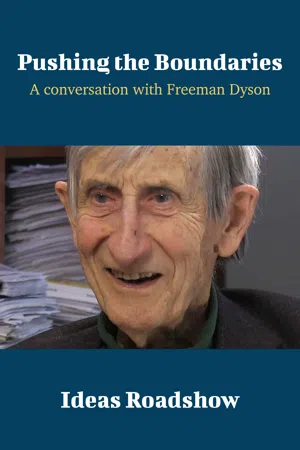
This book is based on an in-depth filmed conversation between Howard Burton and former mathematical physicist and writer Freeman Dyson, who was one of the most celebrated polymaths of our age. Freeman Dyson had his academic home for more than 60 years at the Institute for Advanced Study in Princeton. He has reshaped thinking in fields from math to astrophysics to medicine, while pondering nuclear-propelled spaceships designed to transport human colonists to distant planets. During this extensive conversation Freeman looks back on his simultaneously transformative careers in theoretical physics, mathematics, biology, rocket ship design, nuclear disarmament and writing.This carefully-edited book includes an introduction, Pure and Applied, and questions for discussion at the end of each chapter: I. Debating Exceptionalism - Personal and professionalII. In Praise of Rebels - Moving science forwardsIII. Against Reductionism - Valuing the specificIV. Foundational Issues - From the anthropic principle to free willV. Current Mysteries - From dark energy to quasicrystalsVI. The Origin of Life - RNA as a parasiteVII. Space Travel - Manned vs. unmannedVIII. Science and Society - Climate change and moreIX. Religion - Another pathX. Final Thoughts - Neuroscience and Chinese string theoristsAbout Ideas Roadshow Conversations Series: This book is part of an expanding series of 100+ Ideas Roadshow conversations, each one presenting a wealth of candid insights from a leading expert in a focused yet informal setting to give non-specialists a uniquely accessible window into frontline research and scholarship that wouldn't otherwise be encountered through standard lectures and textbooks. For other books in this series visit website: https://ideasroadshow.com/.
- English
- ePUB (mobile friendly)
- Available on iOS & Android
eBook - ePub
Pushing the Boundaries - A Conversation with Freeman Dyson
About this book
Trusted by 375,005 students
Access to over 1.5 million titles for a fair monthly price.
Study more efficiently using our study tools.
Information
Topic
Physical SciencesSubtopic
EvolutionThe Conversation
I. Debating Exceptionalism
Personal and professional
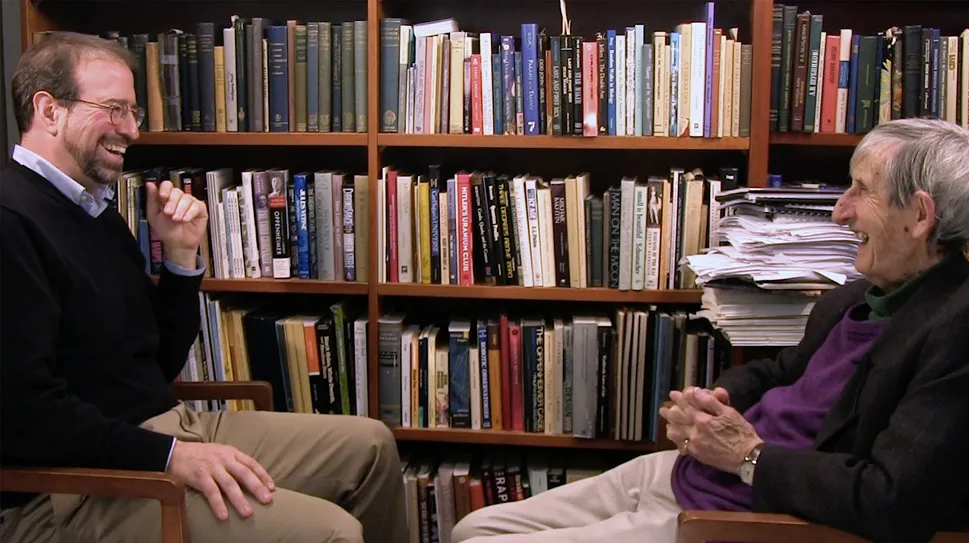
HB: I’d like to talk about the scientific temperament. One of the things that I think is so intriguing about you is that, in many ways, you seem to be the exception that proves the rule. There is this cliché that academics know more and more about less and less until they know everything about nothing. I think, from my limited experience, that there is some truth to that. There are some people who are quite narrow and deep, and then there are people who tend to be quite broad and somewhat shallow. But you strike me as both exceptionally broad and exceptionally deep. I’m not exactly sure how you manage that.
You’ve made seminal research contributions to so many different areas of physics: quantum electrodynamics, quantum many-body systems, and solid-state physics. You were involved in building spaceships. You’ve thought deeply about biology. You just co-authored a paper on game theory. And of course your intellectual upbringing, as it were, was in pure math.
Am I completely off-base here? Do you view yourself this way, or, more generally, as atypical in any particular way?
FD: I think what is different about me is that I’ve led two quite separate lives.
One is my life as a scientist, which has been very conventional. All I do as a scientist is old-fashioned mathematics. It’s applied to different problems in different areas, but they are essentially the same tools. I’m a good old-fashioned 19th-century applied mathematician; and that’s what I do professionally.
On the other side, I’m a writer. And as a writer I have a totally different point of view. I’m interested in all kinds of different things. I don’t try to be deep; I try to be broad. So that’s why you see both sides and it looks unusual.
HB: Well, I disagree, and here’s why: if you look at the contributions you’ve made within physics and mathematics alone, that strikes me as an enormously large spectrum. But rather than trying to engage in this ridiculous argument that I’m not going to win—even though I’m convinced that I’m right—let me instead give you an anecdote of something that happened to me this morning.
I had the good fortune of having breakfast with one of your Institute colleagues and I asked him if there was anything he would like me to ask you during our conversation. He thought for a while before saying, “Ask him how he does it.”
So it isn’t just me who thinks this. But let’s move on.
In the recent biography about you that came out, there was something I’d like to check up on. It concerns your work on quantum electrodynamics where it said that you were intent on “finishing off” the theory in the right way, meaning that the perturbation expansion that describes the physics of what is happening mathematically converges to some definite value.
Once you recognized that the series does not, in fact, converge, you were deeply troubled. And the book maintains—I don’t remember who was quoted—that at that point you decided you weren’t going to invest an enormous amount of intellectual energy in any one particular idea, like you had with quantum electrodynamics, because you were so disconsolate at the idea that this series wouldn’t converge.
Is that actually true?
FD: I don’t think that’s true, although I can’t remember exactly after 60 years. I’d have to make it up.
What really happened was that I didn’t contribute any new ideas to that whole discussion. The ideas were essentially all worked out by Dirac, Fermi, and Heisenberg fifteen years earlier. So what we were doing in the 40s was just cleaning it up, making it user-friendly so that you could actually use the theory. That was what I was engaged in: just cleaning up the details. It was nothing new as far as the physics was concerned.
Cleaning up the details was a job I could do, and that’s what I really enjoyed. It was great fun. That’s what I did for a couple of years.
Of course, we thought the thing was going to converge and then we would have a complete, closed, mathematically consistent theory. That would have been nice. But on the other hand, finding out it did not converge made it even more interesting in a way. I certainly wasn’t disconsolate about that; I actually viewed it as more of a challenge.
But I did decide that I’d done enough at that point. I’d worked on it for two years and I needed a change, so I decided to go off and do spin waves instead.
HB: That seems quite a change.
FD: Not really. It’s essentially the same kind of situation: I was just cleaning up the details. The physics wasn’t very different. What I’m good at is cleaning up the mathematics.
Just in the last two years I worked with Bill Press on the prisoner’s dilemma. It was the same situation: he had the ideas and I just cleaned up the mathematics.
HB: Here’s this overly self-effacing disposition once again. So I’ll just repeat myself and say that this is an argument that I shouldn’t be trying to win, because you can always be more self-effacing, not to mention the fact that we’re talking about your actual work.
FD: It’s true that there’s a style that is still the same after 60 years. When I’m doing technical work, that’s what it is.
HB: OK, let me try to generalize a bit instead of engaging in an absurd and unwinnable argument. Let me bring this back to a question related to the scientific temperament.
In my experience, there are people who work in a wide variety of fields and just scratch the surface; and then...
Table of contents
- A Note on the Text
- Introduction
- The Conversation
- Continuing the Conversation
Frequently asked questions
Yes, you can cancel anytime from the Subscription tab in your account settings on the Perlego website. Your subscription will stay active until the end of your current billing period. Learn how to cancel your subscription
No, books cannot be downloaded as external files, such as PDFs, for use outside of Perlego. However, you can download books within the Perlego app for offline reading on mobile or tablet. Learn how to download books offline
Perlego offers two plans: Essential and Complete
- Essential is ideal for learners and professionals who enjoy exploring a wide range of subjects. Access the Essential Library with 800,000+ trusted titles and best-sellers across business, personal growth, and the humanities. Includes unlimited reading time and Standard Read Aloud voice.
- Complete: Perfect for advanced learners and researchers needing full, unrestricted access. Unlock 1.5M+ books across hundreds of subjects, including academic and specialized titles. The Complete Plan also includes advanced features like Premium Read Aloud and Research Assistant.
We are an online textbook subscription service, where you can get access to an entire online library for less than the price of a single book per month. With over 1.5 million books across 990+ topics, we’ve got you covered! Learn about our mission
Look out for the read-aloud symbol on your next book to see if you can listen to it. The read-aloud tool reads text aloud for you, highlighting the text as it is being read. You can pause it, speed it up and slow it down. Learn more about Read Aloud
Yes! You can use the Perlego app on both iOS and Android devices to read anytime, anywhere — even offline. Perfect for commutes or when you’re on the go.
Please note we cannot support devices running on iOS 13 and Android 7 or earlier. Learn more about using the app
Please note we cannot support devices running on iOS 13 and Android 7 or earlier. Learn more about using the app
Yes, you can access Pushing the Boundaries - A Conversation with Freeman Dyson by Howard Burton in PDF and/or ePUB format, as well as other popular books in Physical Sciences & Evolution. We have over 1.5 million books available in our catalogue for you to explore.