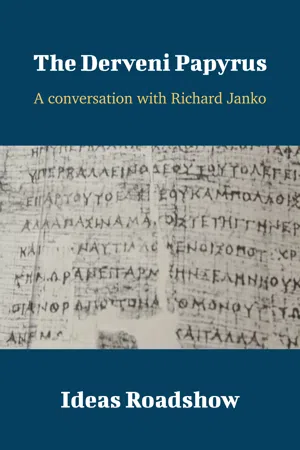
This book is based on an in-depth conversation between Howard Burton and Richard Janko, Gerald F. Else Distinguished University Professor of Classical Studies at the University of Michigan. This wide-ranging conversation covers Prof. Janko's research on the Derveni Papyrus, Europe's oldest surviving manuscript from the 4th century BCE and the most important text relating to early Greek literature, science, religion and philosophy to have come to light since the Renaissance. This carefully-edited book includes an introduction, Discovering the Past, and questions for discussion at the end of each chapter: I. A Great Discovery - Followed by unparalleled foot-draggingII. Derveni Details - Setting the sceneIII. An Ancient Culture War - Societal strains in the late 5th century AthensIV. Rose-coloured Glasses? - Democratic biasesV. Summing Up - Mathematical philology and Herculaneum speculationsAbout Ideas Roadshow Conversations Series: Presented in an accessible, conversational format, Ideas Roadshow books not only explore frontline academic research featuring world-leading researchers but also reveal the inspirations and personal journeys behind the research.
- English
- ePUB (mobile friendly)
- Available on iOS & Android
eBook - ePub
The Derveni Papyrus - A Conversation with Richard Janko
About this book
Trusted by 375,005 students
Access to over 1.5 million titles for a fair monthly price.
Study more efficiently using our study tools.
Information
Subtopic
Greek Ancient HistoryIndex
HistoryThe Conversation
I. A Great Discovery
Followed by unparalleled foot-dragging
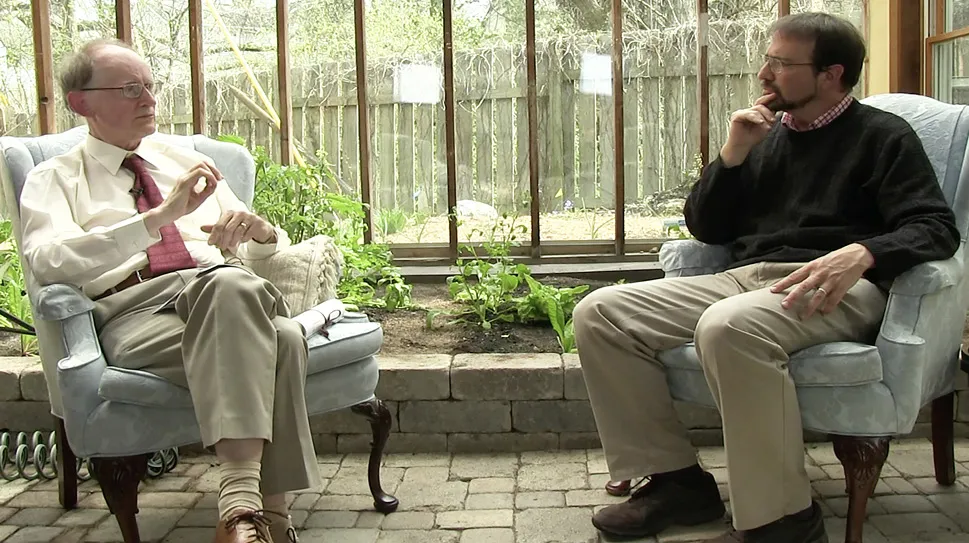
HB: I’d like to talk about the fascinating story of the Derveni papyrus, which not too long ago I had never heard of. You have your own intriguing views about the contents of the papyrus, but before we get there we should first talk about what this thing actually is.
RJ: Well, I’m happy to do that. This is the oldest European book that survives in its own physical form.
HB: Is there an older non-European book?
RJ: Yes, a lot of books from Egypt survive on papyrus, from as far back as 2400 BCE. But this is the oldest one found in Europe. It was discovered in January of 1962 in Derveni, Greece, by a Greek archaeologist, Petros Themelis, who was excavating a funeral pyre in northern Greece near Thessaloniki. The scroll had been on the funeral pyre. It was half-burned and had just rolled off to one side. When they dug it up they thought it was a stick because it was black like a piece of coal. Somehow or other, to his eternal credit, Petros Themelis recognized that it had writing on the inside, making it the oldest surviving book on papyrus found in Europe.
HB: It must have been very brittle as well, I’m thinking. I assume that you can’t just pick these things up. Once he realized what it was, what did he do?
RJ: Well, presumably he tried to touch it as little as possible. Papyrus is the ancient writing material, the equivalent of paper. It’s a very tall reed that grows in the Nile.
It grows these tall fronds, and they cut the stocks and hammer them together in two layers to make a kind of paper. When it’s burned, it becomes like a potato chip, really: it’s so brittle that you can’t bend it without breaking it. But it’s unlike a potato chip in that it’s around a tenth of a millimetre thick, so it’s very thin indeed—it’s like burnt newspaper.
When they got this out of the ground, they contacted the only person in the world who then knew how to deal with these things—an Austrian called Anton Fackelmann.
Fackelmann went to Thessaloniki and by using papyrus juice and static electricity he managed to separate the layers. He mounted them on paper—which we probably wouldn’t do now—and laid them out in the order they came off. The papyrus was split into two halves down the middle; and it came off as stacks of fragments. He lifted one layer off after another and put them in order on the paper in frames.
They’re in a museum now in Thessaloniki and you can see them as sequences of fragments. They aren’t actually next to each other, because they’re successive circumferences from half of the papyrus all the time. So it has not physically been reconstructed: it’s become 200 fragments.
HB: Just getting back to this idea of papyrus juice and static electricity for a moment: how did he actually do that?
RJ: I don’t know. I wasn’t there and I’ve never seen it done.
HB: And how did he know to do that? Had he been doing that sort of thing before?
RJ: Yes, he worked on the burned papyri from Herculaneum and he had separated quite a few of those; the layers of the Herculaneum papyri were stuck together much more firmly than they were in this case. This was a relatively easy papyrus to do compared with Herculaneum.
HB: It just seems like such a bizarre technique. I wonder how many of these you have to go through until you get it right.
RJ: I don’t know how he did it. It’s quite astonishing that a way was found to conserve this material.
HB: And half of it is burned off, right?
RJ: Yes. The bottom part of the papyrus is burned off, so you’ve only got the top 16 lines of every column of writing. It’s a scroll, written in continuous columns. The “book”, as we know it, hadn’t been invented yet, and wouldn’t be for another 500-600 years or so.
HB: Right. So then what happened?
RJ: Well, Fackelmann did this; and then a Greek philologist called Kapsomenos published the end of the text in 1964. And everyone was very excited because this was a commentary by an early philosopher or scientist on a poem ascribed to the mythical singer Orpheus. This was a very mysterious text at the time—in 1964.
Then there was a long pause until 1982 when an unauthorized edition came out, in the back of a scholarly journal on unnumbered pages, which gave the text of the whole papyrus in some early form. Nobody quite knows who did that text or how it came about.
HB: Really? A bootleg copy?
RJ: Well, there was a leak because people got impatient. This thing was clearly going to be very important, and there was great distress that it still hadn’t come out.
HB: OK, so 20 years after the original discovery there still hadn’t been an authorized translation. Actually, I’m not sure I even know what “unauthorized” means in this context. Maybe you could tell me a bit about that.
RJ: Well, normally the people who are entrusted with publishing a papyrus publish it. This thing is not enormously long: my translation that I have here amounts to not even 8 whole pages, single-spaced. It is not an enormous text. Obviously it was going to be very hard to put it together out of 200 fragments, many of which are very small. But people were anxious to see this thing.
HB: Sure. If I’m a scholar in 1982 who’s not one of the people working on this, my question would surely have been, What’s taking you guys so long to come out with this? So what would have been the response to that question, you think?
RJ: Well, I suppose the response was, “We want to get it right”. But the best can be the enemy of the good. There are people who are perfectionists, quite reasonably, and want to produce the perfect text. Maybe that’s what happened.
At any rate, then the authors wrote in reply to this leaked publication—they were very unhappy that it had come out—saying, “We’ll bring it out in 1984”.
And then in 1993—notice the date—a conference was organized in Princeton where more of it came out. The editors were persuaded to contribute a text of the first seven columns, and they vetted a translation of the remainder, in the light of what they could see on the original. So that was another step.
And when that book came out is when I got interested in this, although I did once hear a lecture about it in Cambridge from Martin West, a very great classical scholar, back in 1978. He was speaking about the fragments of the poem, and he had a text of it back then—I still have the handout from that talk.
He allegedly...
Table of contents
- A Note on the Text
- Introduction
- The Conversation
- Continuing the Conversation
Frequently asked questions
Yes, you can cancel anytime from the Subscription tab in your account settings on the Perlego website. Your subscription will stay active until the end of your current billing period. Learn how to cancel your subscription
No, books cannot be downloaded as external files, such as PDFs, for use outside of Perlego. However, you can download books within the Perlego app for offline reading on mobile or tablet. Learn how to download books offline
Perlego offers two plans: Essential and Complete
- Essential is ideal for learners and professionals who enjoy exploring a wide range of subjects. Access the Essential Library with 800,000+ trusted titles and best-sellers across business, personal growth, and the humanities. Includes unlimited reading time and Standard Read Aloud voice.
- Complete: Perfect for advanced learners and researchers needing full, unrestricted access. Unlock 1.5M+ books across hundreds of subjects, including academic and specialized titles. The Complete Plan also includes advanced features like Premium Read Aloud and Research Assistant.
We are an online textbook subscription service, where you can get access to an entire online library for less than the price of a single book per month. With over 1.5 million books across 990+ topics, we’ve got you covered! Learn about our mission
Look out for the read-aloud symbol on your next book to see if you can listen to it. The read-aloud tool reads text aloud for you, highlighting the text as it is being read. You can pause it, speed it up and slow it down. Learn more about Read Aloud
Yes! You can use the Perlego app on both iOS and Android devices to read anytime, anywhere — even offline. Perfect for commutes or when you’re on the go.
Please note we cannot support devices running on iOS 13 and Android 7 or earlier. Learn more about using the app
Please note we cannot support devices running on iOS 13 and Android 7 or earlier. Learn more about using the app
Yes, you can access The Derveni Papyrus - A Conversation with Richard Janko by Howard Burton in PDF and/or ePUB format, as well as other popular books in History & Greek Ancient History. We have over 1.5 million books available in our catalogue for you to explore.