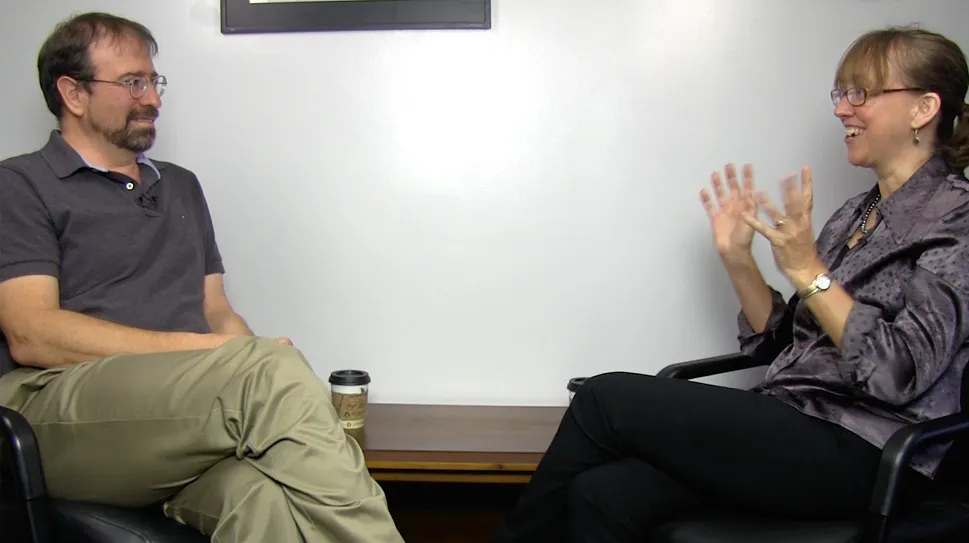
This book is based on an in-depth, filmed conversation between Howard Burton and Jennifer Groh, Professor of Psychology and Neuroscience at Duke University. After an inspiring story about how she became interested in neuroscience, this extensive conversation examines Jennifer Groh's extensive research on how the brain combines various streams of sensory input to determine where things are, together with the corresponding implications for a wide range of issues, from neuroplasticity to evolutionary mechanisms.This carefully-edited book includes an introduction, Framing Evolution, and questions for discussion at the end of each chapter: I. From Ticks to Brains - Becoming a neuroscientistII. Historical Background - On the shoulders of giantsIII. Frames of Reference - Integrating sensory systemsIV. Mysterious Overlap - Fitting the pieces togetherV. Smell - An overlooked sense?VI. Brain Maps - Making a pictureVII. Ice Cream Cones and Multiplexing - Same neurons, different functions?VIII. Navigating Rats - Place fields and memoryIX. Neuroplasticity - Phantom limbs, cochlear implants and feedbackX. Evolutionary Mechanisms? - Repeat performance?XI. The Road Ahead - Testing neurons for contrastAbout Ideas Roadshow Conversations Series: This book is part of a series of 100 Ideas Roadshow Conversations. Presented in an accessible, conversational format, Ideas Roadshow books not only explore frontline academic research featuring world-leading researchers, including 3 Nobel Laureates, but also reveal the inspirations and personal journeys behind the research.
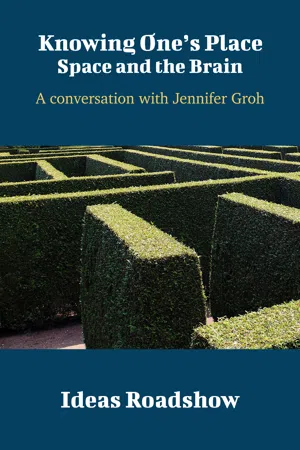
eBook - ePub
Knowing One's Place: Space and the Brain - A Conversation with Jennifer Groh
- English
- ePUB (mobile friendly)
- Available on iOS & Android
eBook - ePub
Knowing One's Place: Space and the Brain - A Conversation with Jennifer Groh
About this book
Trusted by 375,005 students
Access to over 1.5 million titles for a fair monthly price.
Study more efficiently using our study tools.
Information
The Conversation
I. From Ticks to Brains
Becoming a neuroscientist
HB: I’d like to start by talking about your scientific motivations—not necessarily regarding neuroscience, although I’d like to get there eventually—but just in terms of your general interest in science. Did you think to yourself, I’m going to be a scientist, ever since you were a little girl?
JG: I can trace it back to about age 12 when I saw a program on NOVA about the brain. It had three-dimensional views of neurons and little twinkling lights travelling along the axons of the neurons and all that. I just remember thinking, That’s really cool. That’s what I want to do.
HB: So you were particularly attracted to neuroscience.
JG: That’s right. But when I got to college, I thought, Well, I was only 12 when I developed this interest. I should make sure that I try other things. I was ready to change my mind if something else came along.
HB: And did you actively try other things? You went to Princeton for your undergraduate work, right?
JG: I did, yes.
HB: Were you in a neuroscience-oriented program right from the get-go—biology, presumably?
JG: Well, the biology program was broader than that. At Princeton everyone does a senior thesis, which you can get started on well before your senior year. I got really interested in behavioural ecology: how animal behaviour relates to the ecological constraints that the animals are operating under.
I became involved in a project studying wild horses, examining what behavioural strategies they employed to enhance their ability to survive and reproduce.
HB: What are some of those strategies?
JG: Horses, like most animals, have an equal sex ratio at birth—an equal number of males and females. But the social structure is that there’s usually one male associated with a group of females. So by the time they get to adulthood, there are naturally some males that are left out. These are called the bachelor males. I was interested in whether or not they were forming groups themselves—fraternities, if you will—of “left-out male horses”; and, if so, what advantages they were obtaining.
HB: So what did you find out?
JG: Well, I didn’t stay in the field, so I can’t say for sure how it turned out after that. But it looked like when they were in groups they were able to go to parts of the environment where the food was better and maybe hold their own a little bit more against the harem stallions, those males who are grouped with multiple females. The bachelor males were able to hold their own against the stronger males a little bit more successfully when they were congregating in groups.
HB: Do these bachelor males ever take on the harem stallions? Do they ever think, Well, there are 10 of us and there’s only one guy with all the mares. We can push him away?
JG: If they did, I didn’t see it. They probably do, because sometimes there’s turnover; and you’ll find that a male who used to be in charge of the group is no longer in this position and somebody else has come in.
In fact, I shouldn’t say they’re really “in charge”. It’s one male and multiple females, but it looks like the females are really driving the show. They’re the ones deciding where to go, what to eat, and so forth, while the male is more or less just tagging along, trying to keep the other males away.
HB: Interesting. Anyway, behavioural ecology was a real interest of yours, but then at some point you decided that it wasn’t as interesting as neuroscience. Tell me how that happened.
JG: Well, doing that kind of fieldwork is really hard. You’re camping on a barrier island, you’re living in a tent, and you’re spending 10 or 12 hours a day out in the hot sun.
HB: Where did all this happen?
JG: This was on the Outer Banks of North Carolina.
HB: There are wild horses on the Outer Banks?
JG: Yes, there are about a hundred wild horses on this particular island. They’ve been there since Spanish galleons were shipwrecked. It’s beautiful out there.
But I’d be sitting there on my little stool with my notebook, and between taking notes, I’d look down at my legs and start picking off all these ticks, which was pretty unpleasant. So I thought to myself, Hmm, the brain is really fascinating. I think I’ll go back to that.
HB: Sounds understandable. And at the time, did you have any particular research inclination with respect to neuroscience, or was it more a case of just being generally fascinated by the brain?
JG: As it happens, the first things that I learned about were the things that really grabbed my attention, but because they were first I wasn’t sure that I wasn’t going to be equally interested in other topics. So I sort of circled around and tried a few other things before coming back to what I was first interested in, which was how space is represented in the brain: how we know where stimuli are located, how we reconcile information about where visual stimuli are located with information about where sounds and things touching you on your body are located.
I was fascinated by how your brain puts together all that different kind of information to give you a coherent sense of the world, a sense that you’re moving around through one environment, independent of whatever the underlying sensory detection systems might be.
Questions for Discussion:
- How influential do you think science-oriented films or television shows, such as the one Jennifer describes in this chapter, are to motivating children to become scientists? Should we have more of them?
- Are scientists born or made?
II. Historical Background
On the shoulders of giants
HB: This brings us to your book, Making Space: How the Brain Knows Where Things Are, which I understand is based upon courses that you’ve been teaching here at Duke.
JG: That’s right. I teach about perception and the neural basis of perception, and I focus on the spatial aspects of perception.
HB: One of the things that I really enjoyed about it is that it has all sorts of scientific detail in it. I should emphasize that it’s a book that’s deliberately written for a general audience, but it nevertheless manages to do more than just talk vaguely in a high-level way about concepts—which, to be honest, is what I had expected.
In particular, the book forced me to confront all sorts of things that I had previously not thought about, concepts that I had taken for granted. Right at the very beginning, for example, you talk about how we actually see things.
I knew that we have photoreceptors in the eyes—which is roughly equivalent, I now recognize, to saying that our eyes are the things that we use to see. In other words, light comes in and impinges on our eyes, and those photons get converted to a current, and that goes to the brain, and that’s how we see. That was what I knew before I opened your b...
Table of contents
- A Note on the Text
- Introduction
- The Conversation
- Continuing the Conversation
Frequently asked questions
Yes, you can cancel anytime from the Subscription tab in your account settings on the Perlego website. Your subscription will stay active until the end of your current billing period. Learn how to cancel your subscription
No, books cannot be downloaded as external files, such as PDFs, for use outside of Perlego. However, you can download books within the Perlego app for offline reading on mobile or tablet. Learn how to download books offline
Perlego offers two plans: Essential and Complete
- Essential is ideal for learners and professionals who enjoy exploring a wide range of subjects. Access the Essential Library with 800,000+ trusted titles and best-sellers across business, personal growth, and the humanities. Includes unlimited reading time and Standard Read Aloud voice.
- Complete: Perfect for advanced learners and researchers needing full, unrestricted access. Unlock 1.5M+ books across hundreds of subjects, including academic and specialized titles. The Complete Plan also includes advanced features like Premium Read Aloud and Research Assistant.
We are an online textbook subscription service, where you can get access to an entire online library for less than the price of a single book per month. With over 1.5 million books across 990+ topics, we’ve got you covered! Learn about our mission
Look out for the read-aloud symbol on your next book to see if you can listen to it. The read-aloud tool reads text aloud for you, highlighting the text as it is being read. You can pause it, speed it up and slow it down. Learn more about Read Aloud
Yes! You can use the Perlego app on both iOS and Android devices to read anytime, anywhere — even offline. Perfect for commutes or when you’re on the go.
Please note we cannot support devices running on iOS 13 and Android 7 or earlier. Learn more about using the app
Please note we cannot support devices running on iOS 13 and Android 7 or earlier. Learn more about using the app
Yes, you can access Knowing One's Place: Space and the Brain - A Conversation with Jennifer Groh by Howard Burton in PDF and/or ePUB format, as well as other popular books in Biological Sciences & Cognitive Neuroscience & Neuropsychology. We have over 1.5 million books available in our catalogue for you to explore.