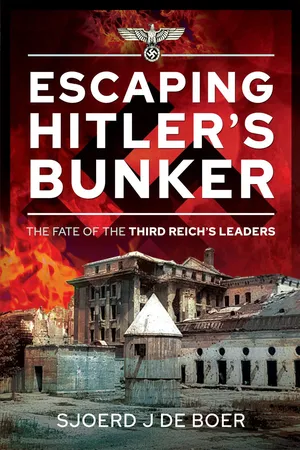
As the Soviet troops fought their way ever closer to the Reich Chancellery in the final days of the Third Reich, deep underground in Hitler’s bunker fateful decisions were being made. Hitler and some of those closest to him resolved to commit suicide, whilst others sought to try and escape. But who did manage to slip past the Russian soldiers and reach freedom? How did they escape, and what routes did they take through the ruined streets of Berlin? Equally, what became of those who escaped, where did they go, and what happened to those who did not get away? All of these questions are answered in this book. Following years of research in Berlin, the author has been able to identify the various groups and individuals that left the bunker and has traced the paths taken by those who escaped and those that perished. The final days in Hitler’s bunker are revealed in atmospheric detail, as the Red Army closed in and the inevitable end loomed menacingly nearer with the passing of every hour. Many notable persons, such as Bormann, Speer, Göring and Hanna Reitsch, went to say a last farewell to the Führer, while others, such as Goebbels, prepared themselves for suicide rather than being taken prisoner by the Russians. By using detailed maps showing the escape routes, first-hand testimony from those who survived, photographs of the devastated German capital in 1945, as well as images of the various routes as they can be followed through Berlin today, the author explores the last moments of the Third Reich in startling clarity.
- 224 pages
- English
- ePUB (mobile friendly)
- Available on iOS & Android
eBook - ePub
About this book
Trusted by 375,005 students
Access to over 1.5 million titles for a fair monthly price.
Study more efficiently using our study tools.
Information
Chapter 1
The Last Days Inside the Bunker
It’s 30 April 1945. Hitler is dead. In his Berlin bunker, where he married Eva Braun the day before, there are not many people left. But in its vicinity there are all kinds of people: soldiers, guards, senior officers, party leaders, generals, secretaries, chamber servants and a large group of boys from the Hitler Youth. Many of them still want to flee the city, preferably to the west, towards the American and British armies. But the city centre, where the bunker is located, is surrounded by the Soviet army and there are only a few ways out of the city left.
Ten days earlier Hitler had turned 56. Telegrams and telephone calls with congratulations flooded in throughout the day and into the evening Propaganda Minister Joseph Goebbels had praised him for his greatness in a radio speech.1 While the city’s airports were still accessible and a number of routes to the centre remained open, he proudly said that the Führer would never abandon his people, not even in these difficult times.

The main entrance to the ruined New Reich Chancellery, on Voßstraße. This picture was taken in July 1945, by British Lieutenant Frank Barnes of the 2nd Battalion Devonshire Regiment. (Picture: James Luto Collection)

A view of the Old Reich Chancellery and its modern extension, as seen from Wilhelmplatz, after the end of the war. Both the old and the new part of the Old Chancellery were badly damaged by bombing and the fighting in 1945. (Picture: NARA)
Several important party members and ministers visited the Führer that day. Even Hermann Göring, the man who devoted more time to his art collection and his addiction than on coordinating the air force. Heinrich Himmler, the SS leader responsible for the largest derailments of the empire inside the concentration camps, also paid a visit. Of course, Minister of Armaments Albert Speer, who after the war preferred to speak of his apolitical career as an architect than about his responsibility for the production of arms with which he had prolonged the war enormously, came to congratulate Hitler. In addition, there was Artur Axmann, the youth leader under whose command the young members of the Hitler Youth were sent to their deaths during the last days of the Third Reich. The Minister of Foreign Affairs, Joachim von Ribbentrop, who was scorned by many of his colleagues, also called on the Führer as well as the fanatical Joseph Goebbels, who would be the last to abandon his Führer. Hitler’s private secretary, Martin Bormann, had hardly ever left Hitler’s side over the years.2

The New Chancellery was built along the entire left side of Voßstraße.

The Old Chancellery on Wilhelmstraße was in ruins after the war. New flats were constructed there much later, during the last years of the German Democratic Republic.
The building complex where Hitler spent his last days consisted of the Old Chancellery on Wilhelmstraße, which had also been used by previous German leaders, and the New Chancellery, which was built by Albert Speer. It ran along the entire length of the Voßstraße. On the corner of both streets an old building stood in between both parts of the Chancellery. Behind the buildings was an enormous garden, where the Führerbunker was. It wasn’t the only bunker on the property. Right below the New Reich Chancellery was another one. The corridors and the cellars of the buildings and bunkers were connected to each other. From the New Chancellery, however, the Führerbunker was not freely accessible. In the corridor there were steel doors that were permanently guarded.
Hitler’s Last Birthday (Friday, 20 April)
Inside the bunker, Hitler’s birthday celebrations started just after midnight. It had been customary for many years for Hitler’s personal staff to congratulate him, and so they were waiting for him in the hallway near his rooms. Hitler had indicated, however, that he saw no reason to celebrate his birthday and for a while it looked like General Wilhelm Burgdorf, Himmler’s adjutant Hermann Fegelein, von Ribbentrop’s adjutant Walter Hewel, press officer Heinz Lorenz and Hitler’s adjutants Julius Schaub, Alwin-Broder Albrecht and Otto Günsche stood there in vain.3 It was only when Eva Braun urged Hitler to go out there, that he opened the door so his followers could finally congratulate him.

The rear entrance to the Führerbunker in the Reich Chancellery garden. The cone-shaped structure on the right was part of the ventilation system. It also served as a shelter for the guards. The square part of the building was an emergency exit from the bunker. The bodies of Hitler and Eva Braun were incinerated in the garden between the conical tower and the exit structure. (Picture: Historic Military Press)

Hitler’s gardens lay behind both Chancelleries. The area was part of the no-go zone on the east side of the Berlin Wall and is now made up of offices, apartment buildings, car parks and a sports field.
Just a few moments later, the first military briefing of the day took place. Field Marshal Wilhelm Keitel, Admiral Karl Dönitz and Generals Alfred Jodl and Hans Krebs also congratulated their Führer after which the meeting began. At 0900 hours Hitler went to sleep, after he had instructed his chamberlain Heinz Linge not to wake him until 1400 hours.4
After breakfast Hitler made a brief appearance in the Chancellery garden, where he handed out medals to the Hitler Youth boys who had bravely fought against the Soviet army. Their leader Axmann was there, of course, together with Goebbels, Himmler, Speer and Bormann. The young boys were lined up between the members of the recently founded army group ‘Kurland’ and the SS division ‘Frundsberg’. Hitler walked in front of them, with a crooked back and trembling hands. He spoke a few short words and when he was finished, he muttered the well-known ‘Heil’. But after his greeting, which was normally answered with a snappy ‘Heil’ back, everyone remained silent. Axmann said that the men must have been so impressed by the willpower of the Führer that they simply forgot to react.5 Nobody knows if that was the real reason.
After the ceremony Göring and the other national leaders were waiting on the edge of the garden also to congratulate Hitler. After they had done this, Hitler went back inside the bunker for the next staff meeting. The military situation was dire. The Soviet army was so close to the German capital that the sound of their infantry could be heard inside the Reich Chancellery. The Allies from the West had already arrived at the River Elbe. Göring’s chief of staff general Karl Koller therefore emphasized during the meeting that the Supreme Command of the Army had to be moved as soon as possible. And since Hitler was in command, the other attendees pointed out that, under these dangerous circumstances, Hitler had to leave for the south of Germany.6 On the Obersalzberg, Hitler had a villa with a complete bunker complex underneath it. He would be much safer there, they said. But Hitler refused. He didn’t want to leave his Berlin troops, he said.

Underneath this street and car park are the remnants of the foundations of the Führerbunker.
Farewell
After the meeting Göring spoke briefly with Hitler. Göring wanted to leave for the south, because, as he said, he would be able to command the air force much better from the Obersalzberg.7 In addition, his hunting lodge, Carinhall, would soon fall into Russian hands, and his villa in Berlin, which was very close to the endangered bunker, so he had nowhere else to go than south. But there was little future for his air force. Hitler was already dissatisfied with Göring’s performance and his ministry, but he let him go without paying much attention to it.8
Many of the other ministers, generals and civil servants now also left, because waiting any longer was far too risky for them. The best route to the south would probably remain open for just a few more hours and to the west one could still escape through the village of Nauen. Many of the important national socialists that were still in Berlin wanted to take a plane, which was very dangerous with all the artillery surrounding the city.9
But not everybody was allowed to leave. Several staff members, one of them being telephone operator Rochus Misch, stayed behind in the bunker. As long as there was a telephone connection with the outside world and Hitler was still ali...
Table of contents
- Cover
- Title
- Copyright
- Contents
- Introduction
- Chapter 1 The Last Days Inside the Bunker
- Chapter 2 After Hitler Died
- Chapter 3 The Escape to the South
- Chapter 4 The Escape to the North
- Chapter 5 Fleeing Through Berlin’s Tiergarten
- Chapter 6 The Great Escape from the Führerbunker
- Conclusion
- Notes
- Bibliography
Frequently asked questions
Yes, you can cancel anytime from the Subscription tab in your account settings on the Perlego website. Your subscription will stay active until the end of your current billing period. Learn how to cancel your subscription
No, books cannot be downloaded as external files, such as PDFs, for use outside of Perlego. However, you can download books within the Perlego app for offline reading on mobile or tablet. Learn how to download books offline
Perlego offers two plans: Essential and Complete
- Essential is ideal for learners and professionals who enjoy exploring a wide range of subjects. Access the Essential Library with 800,000+ trusted titles and best-sellers across business, personal growth, and the humanities. Includes unlimited reading time and Standard Read Aloud voice.
- Complete: Perfect for advanced learners and researchers needing full, unrestricted access. Unlock 1.5M+ books across hundreds of subjects, including academic and specialized titles. The Complete Plan also includes advanced features like Premium Read Aloud and Research Assistant.
We are an online textbook subscription service, where you can get access to an entire online library for less than the price of a single book per month. With over 1.5 million books across 990+ topics, we’ve got you covered! Learn about our mission
Look out for the read-aloud symbol on your next book to see if you can listen to it. The read-aloud tool reads text aloud for you, highlighting the text as it is being read. You can pause it, speed it up and slow it down. Learn more about Read Aloud
Yes! You can use the Perlego app on both iOS and Android devices to read anytime, anywhere — even offline. Perfect for commutes or when you’re on the go.
Please note we cannot support devices running on iOS 13 and Android 7 or earlier. Learn more about using the app
Please note we cannot support devices running on iOS 13 and Android 7 or earlier. Learn more about using the app
Yes, you can access Escaping Hitler's Bunker by Sjoerd J de Boer in PDF and/or ePUB format, as well as other popular books in History & Military Biographies. We have over 1.5 million books available in our catalogue for you to explore.