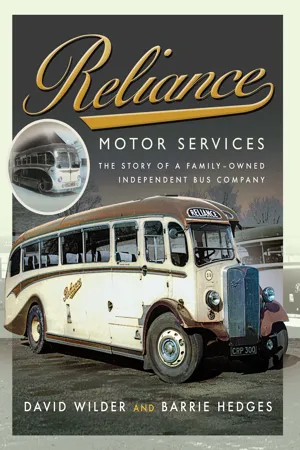
eBook - ePub
Reliance Motor Services
The Story of a Family-Owned Independent Bus Company
- 190 pages
- English
- ePUB (mobile friendly)
- Available on iOS & Android
eBook - ePub
Reliance Motor Services
The Story of a Family-Owned Independent Bus Company
About this book
The life and times of an independent, British family-owned bus company based in Berkshire that rose up following World War I.
Between the two world wars and in the years that followed, several generations relied on country buses. In the days when few could afford a car, the bus was the medium to move between homes in often remote villages and the places where they increasingly went to school, worked, and enjoyed their leisure hours.
This is the story of one such chain of villages across the Berkshire Downs—and the family-owned business that grew up around satisfying their needs.
George Hedges came back from World War I to become a horse-drawn carrier, but with ambitions to motorize his business. With his family taking the wheel in the 1950s and beyond, Reliance extended its reach nationwide and even internationally.
The small village where it all started, Brightwalton, woke in the mornings to the cough of diesel engines from both Reliance buses and a relative's lorries. When both businesses departed, the village lost many of its jobs, its two pubs, and very nearly its school.
This book is not just for bus lovers but for anyone who looks back with fondness on the era before the motor car choked free movement and changed life.
Trusted by 375,005 students
Access to over 1 million titles for a fair monthly price.
Study more efficiently using our study tools.
Information
CHAPTER 1
YOUR COUNTRY NEEDS YOU … AND YOUR HORSES

Serving customers in all weather – the Thomas carrier’s waggon. (Thomas family archive)
Most ordinary folk scraping a living in the string of small villages straddling the Berkshire Downs devoted little attention to the likelihood of a world war as the 1900s moved into their second decade. The growing tension in central Europe was of no immediate worry for men like 47-year-old James Hedges, who was the woodman and haulier at Brightwalton, or 53-year-old William Kent Thomas, who ran a local horse-drawn carrier’s business alongside his extensive farming interests on the outskirts of neighbouring Leckhampstead.
The more pressing worry for villagers was simply making a living in often desperately difficult times. In 1900, twenty-five houses in Brightwalton stood empty. Several had been pulled down due to their derelict state. Many homes were overcrowded, with poor ventilation and drainage, and water only from wells that regularly dried up. One couple lived with their two children in a shed. Pupils were regularly sent to the little village school undernourished and dirty. In 1908, the school was closed for nine weeks when life-threatening diphtheria swept through the area.
By today’s standards, it was poverty. In that era, however, it was the norm for rural areas. There were far worse conditions to be found in many of Britain’s big cities.
Conditions in rural Berkshire were, however, sufficiently challenging to persuade people to move away to find work and housing elsewhere, notably in the busy railway yards at Swindon. At their peak, these yards employed 2,000 men and output one locomotive a week. With increasing mechanisation on farms, the population of Brightwalton had fallen from 465 in 1854 to below 300 at the beginning of the new century.
One aspect of rural life people could rely upon was their local carrier. William Kent Thomas was much respected through the villages and ran two wagons from the family farm at Thicket, a hamlet on the road from Leckhampstead to Chaddleworth and Brightwalton.

The Berkshire downland villages in 1903. (By kind permission of Ordnance Survey)
He had some fine horses hauling his two wagons between those and other local villages as he fetched and carried essentials from the market towns of Newbury and Wantage. He could even take the odd passenger too, though few people had any aspiration in those days to travel outside their own village. Many were born, went to school, worked and died in that one place. Life expectancy was little more than 50, and child mortality rates were high.
Most of what villagers required beyond the vegetables they grew in their own gardens was to hand. Few had money to buy the posh clothes on offer in Newbury from Camp’s Drapery Bazaar or furniture from Joseph Hopson’s extensive store (the two businesses merged in 1921). The villages were all more than eight miles from the town and each had a shop to satisfy its basic needs. Brightwalton’s medical practice provided care for the whole district.
In addition to his horses, William Kent Thomas had what a rural business needed most in those days – three strong sons, each of whom worked with him. He also had a younger son and a daughter but they were still in their mid-teens as war broke out. The eldest son, 24-year-old William, devoted most of his attention to the family farm, while Donovan (20) and Laurence (19) both piled in on the carrying work as well as on the farm. Sixteen-year-old Charlie is said to have run away to join the circus, while sister Marjorie (15) helped their mother, Edith, around the home and on the farm.
Their father was an exacting boss who was devoted to the needs of his customers and was something of a local legend for enduring the most appalling weather on the exposed roads across the Berkshire Downs to deliver the goods he had procured for his loyal customers. He employed two men and two boys to work in pairs on the carrier service. Donovan (Don) vividly recalled having to stand in as second man on one wagon when he was just 15 years of age, when an employee fell sick during the great blizzard one icy Saturday in April 1908.
‘I and Percy Ford started off the usual journey, with one van going to Chaddleworth and the other to Brightwalton (for journeys to Newbury via Boxford),’ he said. ‘At 8am, it started to snow and did so all day until 4pm. My father, who had been caught in the great snowstorm of 1881, sensed we would be in difficulties and walked all of five miles to Boxford Station to catch a train into Newbury to help us get home.

William Kent Thomas was hard working, God-fearing and always had a kindly word for everyone. (Thomas family archive)
‘He ordered one of the men to bring horses to Boxford to meet us, but he turned back thinking we wouldn’t make it there. Fortunately, the other Chaddleworth carrier, John Uzzell, helped us out with his horses. We left the van at Bagnor and arrived back at the farm at Thicket at 8.30pm.
‘My father promptly got three horses and returned to fetch the van from Bagnor. The conditions were so bad that he put the horses into the stables at the Blackbird pub. He eventually got the wagon and horses back at 3am the next morning. Then he got us out again later that morning on horseback to deliver meat parcels to customers in Chaddleworth!’
The Thomas service ran through a string of villages to Newbury on Mondays, Thursdays and Saturdays. On Wednesdays, a day return service was operated to Wantage.
William senior also hired out horse-drawn carriages known as broughams, with passengers enclosed and the driver outside. He used them to meet trains and also for special occasions including funerals. His farming business was also a substantial one.
One place no carrier liked going after dark was the lonely road between Chaddleworth and Welford. Legend has it that a man who had stolen a sheep settled on a large stone to rest as he trudged home with his still-live booty tied around his neck. As he sat there, the animal made a last bid for freedom and its struggles tightened the rope around the poor thief’s neck. His ghost is said to haunt the road – terrified travellers insisted that it spooked their horses. The stone is now forever known as ‘Hangman’s Stone’ while the road is officially ‘Hangman’s Stone Lane’.
* * *
Britain’s declaration of war against Germany in August 1914 brought weeks of speculation to a head. What started as a tussle between Austria–Hungary and Serbia had moved quickly onto a world stage. The parochial worries of folk in the Downland villages suddenly seemed insignificant and there was initially a sense almost of excitement and adventure. There was a common belief (shared as it happens by the Germans) that it would all be over before Christmas and that life would quickly return to normal.
How wrong they were. No-one expected a conflagration that would last more than four years and claim nine million lives across all the combatants. Previous wars had been remote and fought by professional soldiers, but this one was set to demand of every village, taking not just able men but many of the horses that were at that time the lifeblood of the rural economy. It left women to fill the gaps as best they could, on farms and in factories. It was a war involving horrors never seen before, a war of rapid technological innovation, with aircraft, tanks and poison gas used in battle for the first time.
The suggestion of an early end to hostilities evaporated when it became clear that the British Expeditionary Force, as the nation’s army in France was then known, simply did not have enough men to take on the might of the Germans. It numbered just 100,000, while the Germans could call on a trained army of over a million. Emperor Wilhelm II of Germany dismissed the BEF as ‘a contemptible little army’, a name that veterans later proudly signed up to when they happily became ‘Old Contemptibles’.
There was certainly nothing contemptible about the BEF when its men fought side-by-side with French forces at the Battle of the Marne in September 1914 to halt the German advance towards Paris. What followed, however, was stalemate as the combatants dug in for four years of trench warfare on the Western Front.
It was evident that many more men would be needed to fight the British cause, and the idea was hatched of a new volunteer army. When Secretary of State for War Lord Kitchener’s famous ‘Your country needs you’ posters went up, men readily came forward from every community. The Government was hoping to attract maybe 100,000 to the immediate cause, but such was the wave of patriotism that swept across the nation that more like two million signed up by the end of 1915.
* * *
Amongst those from the Downland villages who volunteered to serve their country in that first (pre-conscription) stage of the war was George Hedges, the 22-year-old son of James. George was the second of five children and had worked as an assistant to his woodman father for a time after leaving Brightwalton School at the age of 12. It appears however, that they may have fallen out, because when war broke out George had been working for three years as a servant at a large house near Basingstoke. Another possibility is that the family needed an alternative source of income.
It was on 1 June 1915 that George said goodbye to his parents, three sisters and brother at the family home at Catmore Rectory on the outskirts of Brightwalton to become a private in the 9th Queen’s Royal Lancers. His was a horseback cavalry regiment of the British Army, a unit that had fought in India and Afghanistan and had been a key participant in the Second Boer War. In those days, cavalry charges involving men wielding lances were a familiar tactic in overpowering an enemy. Many of the men who joined the Lancers took their own horses with them and, given that George came from a family that kept horses for its haulage work, that may well have applied to him.
The 9th Lancers were commanded by Sir David Graham Muschet Campbell, nicknamed ‘Soarer’ Campbell after the horse on which he had won the Grand National in 1896. The regiment had landed in France in the early days of the new war and was assigned to the Western Front. The fighting unit George joined in 1915 had already participated in a fearsome ‘lance-on-lance’ battle at Montcel à Frétoy where it defeated the Prussian Dragoons of the Guard. Remarkably, there were only four British fatalities.

Nine former pupils from Brightwalton School volunteered to serve in the First World War. George Hedges, second left in the front row of this 1903 photo, was amongst them. (Hedges family archive)

James and Ellen Hedges with Arthur, Ida, George, Winnie and Emmie. (Hedges family archive)
The era of fighting involving swords on horseback was in fact almost over for the 9th Lancers, and through 1915 and 1916 the regiment often fought as infantry. The style of trench warfare that came to dominate the war involved skills for which men like George had not been equipped or trained. Few seriously contemplated the realities of hand-to-hand fighting nor the necessity to kill or be killed.
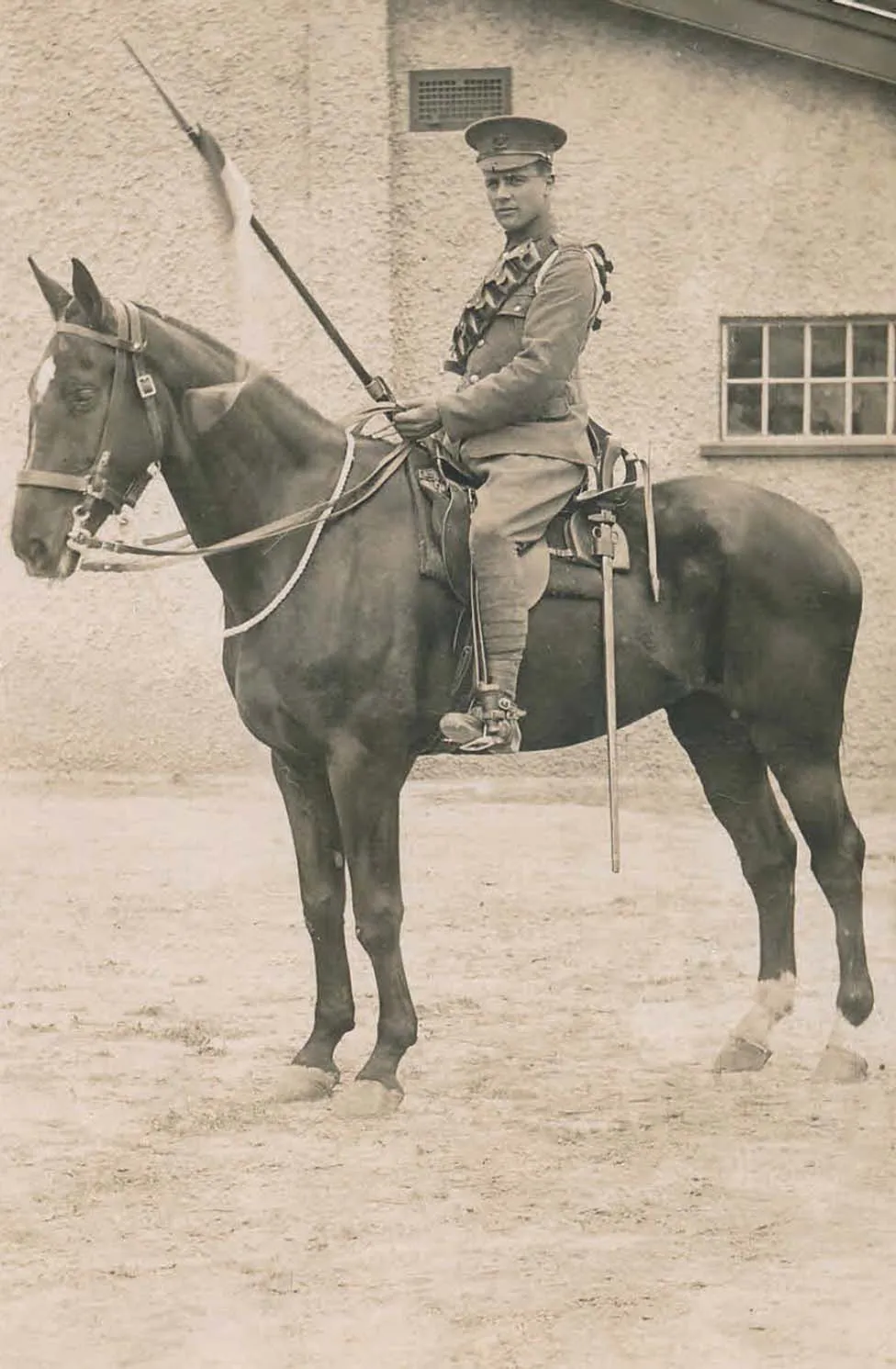
George served with the 9th Queen’s Royal Lancers in France. (Hedges family archive)
* * *
Those who volunteered from Leckhampstead included William Kent Thomas’ sons Donovan (Don) and Laurence, who together joined the Royal Artillery and fought against the Turks in the Gallipoli campaign. It was agreed within the family that elder brother William would stay to help their father manage the farm and carrying business. He was just a...
Table of contents
- Cover
- Title
- Copyright
- Contents
- Acknowledgements
- The Reliance Family Tree
- Chapter 1: Your country needs you … and your horses
- Chapter 2: The dusty day of a country carrier
- Chapter 3: Rising above the rogues
- Chapter 4: Falling in and falling out
- Chapter 5: Going it alone
- Chapter 6: Buses backing Britain
- Chapter 7: Atomic boom
- Chapter 8: An elite operator
- Chapter 9: A lifelong love affair
- Chapter 10: An extraordinary place
- Chapter 11: End of an era
- Chapter 12: A family affair
- Chapter 13: Driving force
- Chapter 14: Independent to the end
- Chapter 15: Where are they now?
- Chapter 16: Moving on
- Fleet List
Frequently asked questions
Yes, you can cancel anytime from the Subscription tab in your account settings on the Perlego website. Your subscription will stay active until the end of your current billing period. Learn how to cancel your subscription
No, books cannot be downloaded as external files, such as PDFs, for use outside of Perlego. However, you can download books within the Perlego app for offline reading on mobile or tablet. Learn how to download books offline
Perlego offers two plans: Essential and Complete
- Essential is ideal for learners and professionals who enjoy exploring a wide range of subjects. Access the Essential Library with 800,000+ trusted titles and best-sellers across business, personal growth, and the humanities. Includes unlimited reading time and Standard Read Aloud voice.
- Complete: Perfect for advanced learners and researchers needing full, unrestricted access. Unlock 1.4M+ books across hundreds of subjects, including academic and specialized titles. The Complete Plan also includes advanced features like Premium Read Aloud and Research Assistant.
We are an online textbook subscription service, where you can get access to an entire online library for less than the price of a single book per month. With over 1 million books across 990+ topics, we’ve got you covered! Learn about our mission
Look out for the read-aloud symbol on your next book to see if you can listen to it. The read-aloud tool reads text aloud for you, highlighting the text as it is being read. You can pause it, speed it up and slow it down. Learn more about Read Aloud
Yes! You can use the Perlego app on both iOS and Android devices to read anytime, anywhere — even offline. Perfect for commutes or when you’re on the go.
Please note we cannot support devices running on iOS 13 and Android 7 or earlier. Learn more about using the app
Please note we cannot support devices running on iOS 13 and Android 7 or earlier. Learn more about using the app
Yes, you can access Reliance Motor Services by David Wilder,Barrie Hedges in PDF and/or ePUB format, as well as other popular books in Business & Storia aziendale. We have over one million books available in our catalogue for you to explore.