
eBook - ePub
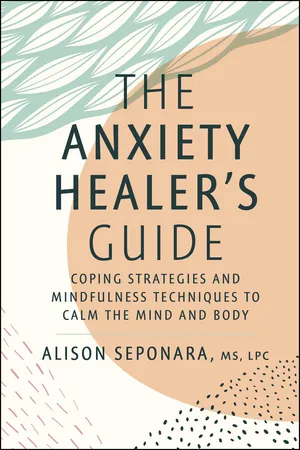
The Anxiety Healer's Guide
Coping Strategies and Mindfulness Techniques to Calm the Mind and Body
- 176 pages
- English
- ePUB (mobile friendly)
- Available on iOS & Android
eBook - ePub
The Anxiety Healer's Guide
Coping Strategies and Mindfulness Techniques to Calm the Mind and Body
About this book
Discover practical, natural, on-the-go solutions for combating anxiety with this must-have guide.
How can you begin holistically tackling your anxiety whenever the moment strikes? In The Anxiety Healer’s Guide licensed counselor and creator of the Instagram account @TheAnxietyHealer Alison Seponara brings her expertise and commitment to healing anxiety to the world. While the journey toward recovery might look different for everyone, this portable resource is full of concrete activities, tools, and techniques that have been scientifically proven to calm the sympathetic (fight-or-flight) nervous system and give sufferers a better sense of control over their minds and bodies.
This comprehensive, easy-to-use guide includes everything you need to help holistically treat your anxiety and create your own anxiety-healing tool kit, including:
-Body breakthroughs
-Mind tricks to ease anxiety
-Breathing techniques
-Grounding strategies
-Distraction ideas
-Cognitive-behavioral actions
-Natural remedies
-Gut-health practices
-Positive affirmations
-On-the-go activities
-And more!
This is an essential read for anyone who’s tired of living with anxiety and looking for helpful solutions they can apply anytime, anywhere.
How can you begin holistically tackling your anxiety whenever the moment strikes? In The Anxiety Healer’s Guide licensed counselor and creator of the Instagram account @TheAnxietyHealer Alison Seponara brings her expertise and commitment to healing anxiety to the world. While the journey toward recovery might look different for everyone, this portable resource is full of concrete activities, tools, and techniques that have been scientifically proven to calm the sympathetic (fight-or-flight) nervous system and give sufferers a better sense of control over their minds and bodies.
This comprehensive, easy-to-use guide includes everything you need to help holistically treat your anxiety and create your own anxiety-healing tool kit, including:
-Body breakthroughs
-Mind tricks to ease anxiety
-Breathing techniques
-Grounding strategies
-Distraction ideas
-Cognitive-behavioral actions
-Natural remedies
-Gut-health practices
-Positive affirmations
-On-the-go activities
-And more!
This is an essential read for anyone who’s tired of living with anxiety and looking for helpful solutions they can apply anytime, anywhere.
Frequently asked questions
Yes, you can cancel anytime from the Subscription tab in your account settings on the Perlego website. Your subscription will stay active until the end of your current billing period. Learn how to cancel your subscription.
No, books cannot be downloaded as external files, such as PDFs, for use outside of Perlego. However, you can download books within the Perlego app for offline reading on mobile or tablet. Learn more here.
Perlego offers two plans: Essential and Complete
- Essential is ideal for learners and professionals who enjoy exploring a wide range of subjects. Access the Essential Library with 800,000+ trusted titles and best-sellers across business, personal growth, and the humanities. Includes unlimited reading time and Standard Read Aloud voice.
- Complete: Perfect for advanced learners and researchers needing full, unrestricted access. Unlock 1.4M+ books across hundreds of subjects, including academic and specialized titles. The Complete Plan also includes advanced features like Premium Read Aloud and Research Assistant.
We are an online textbook subscription service, where you can get access to an entire online library for less than the price of a single book per month. With over 1 million books across 1000+ topics, we’ve got you covered! Learn more here.
Look out for the read-aloud symbol on your next book to see if you can listen to it. The read-aloud tool reads text aloud for you, highlighting the text as it is being read. You can pause it, speed it up and slow it down. Learn more here.
Yes! You can use the Perlego app on both iOS or Android devices to read anytime, anywhere — even offline. Perfect for commutes or when you’re on the go.
Please note we cannot support devices running on iOS 13 and Android 7 or earlier. Learn more about using the app.
Yes, you can access The Anxiety Healer's Guide by Alison Seponara in PDF and/or ePUB format, as well as other popular books in Personal Development & Mental Health in Psychology. We have over one million books available in our catalogue for you to explore.
Information
Part I BODY BREAKTHROUGHS
CHAPTER 1 The Breathing Solution
If you’re reading this, chances are you have experienced a panic attack at some point in your life. Or, if you have not experienced a panic attack, then you have probably experienced an anxiety attack. The difference between the two is not widely known, but there is one. Panic attacks often come on suddenly and involve an intense and often overwhelming fear. They are accompanied by a number of physical symptoms, including racing heartbeat, dizziness, shortness of breath, and nausea. On the other hand, an anxiety attack is usually related to the anticipation of a stressful situation, experience, or event and may be less intense and come on gradually.
Because anxiety attacks are not recognized as a diagnosis in the DSM-5 (the DSM is basically the essential guide for how psychotherapists diagnose their clients), the signs and symptoms of those who experience one may look very different. Two people may suffer an “anxiety attack” but have completely different physical, behavioral, or emotional symptoms. One thing that is for sure: whether you are having a panic attack or an anxiety attack, the body always responds physically. Some of these physical symptoms include an upset stomach, racing heart, dizziness, heart palpitations, muscle tension, throat tightness, light-headedness, and the one that never fails to scare us the most: shortness of breath! So in these moments it is important to remember that the mind and the body are connected! As much as you may think it at the time, the physical symptoms we experience when we are in a state of high anxiety are not dangerous at all, and you will never die from a panic attack.
THE SCIENCE OF BREATHING
There are two parts of the autonomic nervous system: the sympathetic nervous system (fight or flight) and the parasympathetic nervous system (rest and digest). When you have a panic attack or an anxiety attack, the sympathetic nervous system is activated and you experience a whole range of physical symptoms, including rapid heart rate, heart palpitations, and shortness of breath.7 This response sometimes occurs so fast that people often don’t realize it’s happening! As discussed in the introduction, stimulating the vagus nerve can help activate the parasympathetic nervous system. To stimulate the vagus nerve, it’s important to practice lengthening and deepening our breathing patterns. This is why creating a daily habit of breathwork is so important in healing anxiety.
When you’re faced with a dangerous situation, your brain floods your nervous system with chemicals such as adrenaline and cortisol, which are designed to help you respond to a threat. When these chemicals are released, your pulse and breathing rate increase. The only problem is, when you’re in a state of high anxiety, there is most likely no threatening situation. You are perceiving it as such… thus creating this intense fear and activating the sympathetic nervous system (fight or flight). To come back down to a calm and balanced state, you need to practice strategies that activate the parasympathetic nervous system (rest and digest)—especially deep, slow breathing. When you practice deep breathing the oxygen breathed in stimulates the body’s parasympathetic nervous system.
This, in turn, produces a feeling of calmness and body connectedness that diverts attention from stressful, anxious thoughts and quiets what’s going on in the mind. When the parasympathetic nervous system is activated your metabolism decreases, your heart beats slower, your muscles relax, your breathing becomes slower, and even your blood pressure decreases.
The breathing techniques in this chapter have been shown to help calm the nervous system, counteract stress, and reduce negative emotions.8 It is suggested to practice at least one to two of these breathing techniques daily (even when not feeling anxious) to get into the habit of breathing from your diaphragm more slowly and deeply.
HEALING IN ACTION
RECTANGLE BREATHING
How to Practice Rectangle Breathing
Recommended practice: any time you begin to feel anxious. Rectangle breathing is a technique used to help slow down your heart rate. This method helps to divert your attention from the irrational thought patterns that create anxiety. While this may not be a long-term solution to healing anxious thoughts, this breathing technique can at least help with shortness of breath.
- Breathe in through your nose for a count of 4.
- Breathe out through your mouth for a count of 6.
- Breathe in through your nose for a count of 4.
- Breathe out through your mouth for a count of 6.
LION’S BREATH
How to Practice Lion’s Breath
Recommended practice: practice lion’s breath two to three times a day to help alleviate stress, eliminate toxins, and stimulate your throat and upper chest. Lion’s breath involves exhaling forcefully through your mouth, as if you were roaring like a lion.
- Sit in a comfortable position with your hands on your knees and your ankles crossed.
- Stretch out your arms and your fingers.
- Take a deep breath in through your nose.
- During exhale… open your mouth as wide as you can and stick your tongue out, stretching it down toward your chin as far as it will go and release the breath while making a HA sound.
- Focus on the middle of your forehead or the end of your nose while exhaling.
- Relax your face as you inhale again.
- Repeat the practice up to six times, changing the cross of your ankles when you reach the halfway point.
Google keywords: lion’s breath for anxiety
Bonus Healing Activity
Practice lion’s breath at least three times per day. Schedule specific times when you will practice lion’s breath daily and set a timer in your smartphone.
DIAPHRAGMATIC (BELLY) BREATHING
Diaphragmatic breathing or “belly” breathing is one of my favorite breathing tools. This specific type of breathwork can help to activate your relaxation response and allows the respiratory system to function correctly. When anxiety arises, our breathing can become shallow and erratic. Practicing belly breathing allows the mind and body to slow down and relax. When we breathe deeply through our abdominals, the oxygen taken in stimulates the body’s parasympathetic nervous system and activates the rest and digest part of our brain. This then creates a feeling of calm within our body and mind, which diverts attention from stressful, anxious thoughts. According to the American Institute of Stress, practicing diaphragmatic breathing or “belly” breathing for twenty to thirty minutes a day can help reduce anxiety.9
How to Practice Diaphragmatic (Belly) Breat...
Table of contents
- Cover
- Title Page
- Dedication
- Introduction
- Part I: Body Breakthroughs
- Part II: Mind Tricks to Ease Anxiety
- Part III: Create Your Healing Tool Kit
- Acknowledgments
- About the Author
- Bibliography
- Index
- Copyright

