Volume2 of History of Construction Cultures contains papers presented at the 7ICCH – Seventh International Congress on Construction History, held at the Lisbon School of Architecture, Portugal, from 12 to 16 July, 2021. The conference has been organized by the Lisbon School of Architecture (FAUL), NOVA School of Social Sciences and Humanities, the Portuguese Society for Construction History Studies and the University of the Azores. The contributions cover the wide interdisciplinary spectrum of Construction History and consist on the most recent advances in theory and practical case studies analysis, following themes such as: - epistemological issues; - building actors; - building materials; - building machines, tools and equipment; - construction processes; - building services and techniques; -structural theory and analysis; - political, social and economic aspects; - knowledge transfer and cultural translation of construction cultures. Furthermore, papers presented at thematic sessions aim at covering important problematics, historical periods and different regions of the globe, opening new directions for Construction History research. We are what we build and how we build; thus, the study of Construction History is now more than ever at the centre of current debates as to the shape of a sustainable future for humankind. Therefore, History of Construction Cultures is a critical and indispensable work to expand our understanding of the ways in which everyday building activities have been perceived and experienced in different cultures, from ancient times to our century and all over the world.

eBook - ePub
History of Construction Cultures Volume 2
Proceedings of the 7th International Congress on Construction History (7ICCH 2021), July 12-16, 2021, Lisbon, Portugal
- 788 pages
- English
- ePUB (mobile friendly)
- Available on iOS & Android
eBook - ePub
History of Construction Cultures Volume 2
Proceedings of the 7th International Congress on Construction History (7ICCH 2021), July 12-16, 2021, Lisbon, Portugal
About this book
Trusted by 375,005 students
Access to over 1 million titles for a fair monthly price.
Study more efficiently using our study tools.
Information
Open session: Construction processes
Early Greek temple design and roof construction
University of Notre Dame, Notre Dame, USA
DOI 10.1201/9781003173434-112
ABSTRACT: Beginning in the 8th century BC, large temples appeared across the Greek world. In continental regions, this large size was achieved through length, resulting in narrow, elongated ground plans. In most of the Aegean islands, the temples had a more compact aspect ratio, with broader interiors. Several scholars have associated this difference to limitations in the span of thatched roofs, which were common in continental Greece. However, the nature of these limitations has not been investigated. Using modern structural theory and wind engineering studies, this paper examines how the aspect ratio of temple ground plans related to roof construction. It concludes that excessive width made steep thatched roofs susceptible to buckling and damage due to wind force, while width did not affect the stability of the flat roofs prevalent in the Aegean islands.
1 Introduction
This paper addresses the design of the first monumental Greek temples in relation to their construction. Specifically, it examines how the aspect ratio of temple ground plans related to roof construction. Beginning in the late 8th century BC, large temples appeared across the Greek world. In continental regions, an increase in the length of temples resulted in an elongated aspect ratio. The largest temples reached over 30 m long (or c. 100 ft., hence the archeological term hekatompedon) (Figure 1a–d), while their width rarely exceeded 7 m. Temples in most of the Aegean islands typically had ground plans with a more compact aspect ratio. Particularly in the Cyclades, they were remarkably broad in relation to their length. For example, the second and third temples at Yria on Naxos (c. 730 and 680 BC) were about 11 m wide by 16.50 long (Figure 1e, f), and the so-called Pre-oikos of the Naxians on Delos (first half of the 7th century BC) was about 10 m wide by 24 m long (Figure 1g). The broad interiors of these temples raise the question as to why Cycladic builders chose to emphasize the temple’s width.

Figure 1. Some of the largest Greek temples built in the late 8th and early 7th centuries BC. A: first Hekatompedon in the sanctuary of Hera on Samos; B: Building Ed2 (Hekatompedon) in the sanctuary of Apollo Daphnephoros at Eretria; C: temple of Apollo at Halieis; D: Temple of Artemis Aontia at Ano Mazaraki; E–F: second and third temples at Iria on Naxos; G: pre-Oikos of the Naxians in the sanctuary of Apollo on Delos.
Vassilis Lambrinoudakis (1991, 185) has suggested that, unlike other areas of the Greek world, Cycladic builders were concerned with the spatial quality of the interior rather than the exterior. Such an explanation is plausible but unprovable. It is also possible that the width of island temples served a functional purpose. Animal remains and pottery found in several of these temples show that their interiors served as communal dining halls. Yet, in continental Greece, a number of elongated temples served a similar purpose. In both regions, participants are assumed to have dined on benches along the perimeter. We do not know how the central space might have been used differently, therefore the functional reasons remain hypothetical. Turning the question on its head, some scholars have asked what may have limited the span of continental temples. A connection between their narrow ground plans and the spanning limitations of the sloped roofs of thatch common to continental Greece is generally accepted (Snodgrass 1980, 58). What exactly may have limited the span of these roofs has not been thoroughly investigated, but this question can be answered on technical grounds.
This paper examines the different aspect ratios of continental and insular Greek temples in relation to roof construction by using modern structural theory and wind engineering studies. It begins by examining the evidence for the connection between the aspect ratio of temple ground plans and roof construction. It then explores the technical features of roofs in continental and insular Greece based on the archaeological evidence and ethnographic accounts of traditional roofing in those areas. Next, it discusses the frame that supported the roof and how an increase in width would have affected structural behavior depending on the regional roof technologies. As the conclusion will show, excessive width made steep thatch roofs prone to instability due to buckling and wind force, while width did not affect the stability of the flat roofs prevalent in the Aegean islands.
2 Plan Aspect Ratio and Roof Construction. Geographical Distribution
Before the adoption of terracotta roof tiles in the mid-seventh century BC, the roofs of Greek temples (like the roofs of houses) were either steep and thatched or flat and covered with clay. According to Vitruvius (2.1.5) and other ancient authors, roofs of thatch or clay could still be seen in first-century Rome and Athens. The thatch-covered hut of Romulus on the Palatine Hill, preserved as a relic, was repeatedly and faithfully reconstructed, while the Athenians preserved the venerable, clay-roofed building on the Areopagos.
The geographical distribution of the two roof types in the ancient Greek world suggests a connection between the plan aspect ratio and roof technology. Built mostly of perishable materials, the roofs themselves have not survived. Contemporary or slightly later terracotta and stone votive models of buildings, which have been found at sanctuaries across the Greek world, are the principal sources of information on Greek roofs of the eighth and early seventh centuries BC. The roofs and find places of these architectural models give a fairly clear idea of the geographical distribution of pitched vs. flat roofs. Models from continental Greece, such as those from the sanctuaries of Hera at Argos and Perachora, or Poseidon at Nikoleika (Figure 2), feature steeply pitched roofs. By contrast, models from Crete and the Cyclades have flat roofs. Excavations at the sanctuary of Hera on the island of Samos, in East Greece, have produced models with both flat and pitched roofs (Figure 3). Here, the first two temples of Hera (Hekatompedon 1 and 2) had elongated plans and probably pitched roofs, while the small shrines (naiskoi) found around the altar presumably had flat roofs.

Figure 2. Left: house model from the sanctuary of Hera at Argos (first quarter of the seventh century). Photo by the author. Right: temple model from the sanctuary of Poseidon at Nikoleika (ancient Helike) (late eighth century). Drawing by the author after Gadolou and Paschalidis 2020, fig. 4.9.4b.
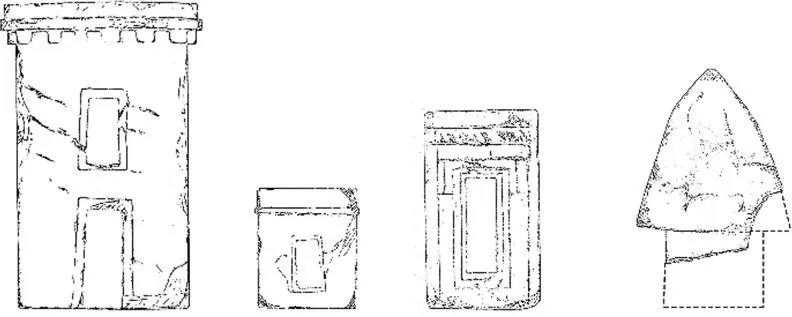
Figure 3. Architectural models from the sanctuary of Hera at Samos (seventh and sixth centuries BC). Drawing by the author after Schattner 1990, figs 26, 28, 20, 17.
The distribution of the models suggests that pitched roofs were mostly, although not exclusively, concentrated in continental regions while flat ones were dominant on the Aegean islands. Climate is a main factor influencing roof technology. Pitched roofs, which allow rain water to run off quickly, are necessary in areas where rainfall is intense. Flat clay roofs, structurally simpler and requiring fewer timbers, are more resistant against the powerful Aegean winds. While flat–covered structures also existed in some coastal areas of the mainland, for example at Thorikos in Attica (Coulton 1988, 62), the flat roof has been the dominant type in the dry, windy climate of Crete and the Cyclades from antiquity to the present day.
3 Technical Features of Flat and Pitched Roofs
In addition to flat-roofed architectural models, there is direct evidence at several Aegean sites that roofs were flat and covered with clay. Layers of clayey earth found above the floors of many late eighth to early 7th century buildings at Emporio on the island of Chios, near the coast of Eastern Greece, are probably the remains of collapsed clay roofs (Boardman 1967, 36). The excavations at Iria on the Cycladic island of Naxos have produced a marble waterspout (Lambrinoudakis 1996, 55) that belonged to the third temple (c. 680 BC). The excavators restored it on top of a flat clay roof bordered by a low stone wall. Several contemporary flat-roofed architectural models from Samos have a similar border (Schattner 1990, 177–80, and 168 fig. 46; Walter et al. 2019, ch. 10 and pls 37–41). Ethnographic accounts of traditional clay roofing in modern times explain that this border prevents rain from quickly washing the clayey layer away (Minke 2000, 133 fig. 14.6-3). Moreover, the border allows water to be collected and potentially conveyed into storage containers. Considering the scarcity of water on many Aegean islands, particularly Delos in the Cyclades, this was an important factor (Mays et al. 2013, 1921). Ethnography can also help us reconstruct the technical features of the roof coat. Whether horizontal or moderately sloped, clay roofs consist of a thick layer of clay (up to or over 40–50 cm) that rests on planks, reeds, twigs, or flat stone slabs laid on the roof’s joists (Schattner 1990, 177–8; Rapoport 69, 106). Such a coat is remarkably heavy. With clay density being around 1.75 T/m3, a coat 40 cm thick weighs around 700 kg/m2, and even more once it has absorbed rainwater.
Both literary and archeological evidence support the idea that pitched roofs in pre-Archaic continental Greece were thatched. The Iliad provides the first reference to thatch roofing (24.451). The Myrmidons make a shelter for their king, Achilles, with thatch from the meadows. Here, the Greek word for thatch is orophos, which in Homer, as in later Greek texts, is also a word generally used for roof. Direct archaeological evidence is admittedly scant, consisting of a few finds of carbonized reeds such as those from South Temple 5 at Kalapodi (9th century BC), in Phokis (Niemeier 2017, 327). The steep pitch of the model roofs (up to c. 65°) is telling, as it is characteristic of thatching (Schattner 1990, 182). Other than this evidence provided by the slope, Greek votive models are poor in construction details. Among the few exceptions are two models from Perachora and one from Tegea (Nordquist 2014; Schattner 1990, 33–4, 37). A twisted rooftop, a feature still found on modern thatched roofs, appears on one of the Perachora models and that from Tegea (Figure 4). The eaves of the second Perachora model gently curve upwards, a feature also sometimes used today to prevent tha...
Table of contents
- Cover
- Half Title
- Title Page
- Copyright Page
- Table of contents
- Introduction: History of Construction Cultures
- Committees
- Organizing and supporting institutions
- Open session: Construction processes
- Open session: Building services and techniques
- Open session: Structural theory and analysis
- Open session: Political, social and economic aspects
- Open session: Knowledge transfer
- Author index
Frequently asked questions
Yes, you can cancel anytime from the Subscription tab in your account settings on the Perlego website. Your subscription will stay active until the end of your current billing period. Learn how to cancel your subscription
No, books cannot be downloaded as external files, such as PDFs, for use outside of Perlego. However, you can download books within the Perlego app for offline reading on mobile or tablet. Learn how to download books offline
Perlego offers two plans: Essential and Complete
- Essential is ideal for learners and professionals who enjoy exploring a wide range of subjects. Access the Essential Library with 800,000+ trusted titles and best-sellers across business, personal growth, and the humanities. Includes unlimited reading time and Standard Read Aloud voice.
- Complete: Perfect for advanced learners and researchers needing full, unrestricted access. Unlock 1.4M+ books across hundreds of subjects, including academic and specialized titles. The Complete Plan also includes advanced features like Premium Read Aloud and Research Assistant.
We are an online textbook subscription service, where you can get access to an entire online library for less than the price of a single book per month. With over 1 million books across 990+ topics, we’ve got you covered! Learn about our mission
Look out for the read-aloud symbol on your next book to see if you can listen to it. The read-aloud tool reads text aloud for you, highlighting the text as it is being read. You can pause it, speed it up and slow it down. Learn more about Read Aloud
Yes! You can use the Perlego app on both iOS and Android devices to read anytime, anywhere — even offline. Perfect for commutes or when you’re on the go.
Please note we cannot support devices running on iOS 13 and Android 7 or earlier. Learn more about using the app
Please note we cannot support devices running on iOS 13 and Android 7 or earlier. Learn more about using the app
Yes, you can access History of Construction Cultures Volume 2 by João Mascarenhas-Mateus, Ana Paula Pires, João Mascarenhas-Mateus,Ana Paula Pires in PDF and/or ePUB format, as well as other popular books in Technology & Engineering & Civil Engineering. We have over one million books available in our catalogue for you to explore.