eBook - ePub
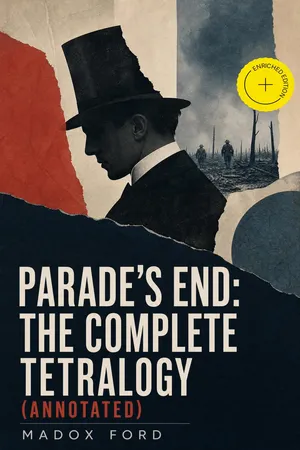
Parade's End: The Complete Tetralogy (Annotated)
Enriched Edition. (All 4 related novels: Some Do Not + No More Parades + A Man Could Stand Up + Last Post)
- 912 pages
- English
- ePUB (mobile friendly)
- Available on iOS & Android
eBook - ePub
Parade's End: The Complete Tetralogy (Annotated)
Enriched Edition. (All 4 related novels: Some Do Not + No More Parades + A Man Could Stand Up + Last Post)
About this book
Parade's End: The Complete Tetralogy gathers Ford Madox Ford's four great modernist novels—Some Do Not…, No More Parades, A Man Could Stand Up—, and Last Post—into a single, devastating panorama of Edwardian collapse and wartime disillusion. Centered on Christopher Tietjens, the "last Tory," his destructive marriage to Sylvia, and his morally fraught love for Valentine Wannop, the work blends psychological realism, fractured chronology, and ironic social comedy. Its dense, impressionistic style places it beside Joyce, Woolf, and Proust as a landmark of interwar fiction. Ford Madox Ford, novelist, critic, editor, and collaborator with Joseph Conrad, brought to the tetralogy both technical daring and intimate historical knowledge. Having served on the Western Front, he understood the war not as spectacle but as trauma, bureaucracy, and moral derangement. His cosmopolitan literary career and acute awareness of class, politics, and language enabled him to anatomize a civilization losing faith in its own codes. This is essential reading for those interested in modernism, the First World War, and the novel as an instrument of historical consciousness. Patient readers will find a profound study of honor, memory, desire, and survival.
This enriched edition has been carefully crafted to add value to your reading experience.
- A comprehensive Introduction outlines these selected works' unifying features, themes, or stylistic evolutions.
- The Author Biography highlights personal milestones and literary influences that shape the entire body of writing.
- A Historical Context section situates the works in their broader era—social currents, cultural trends, and key events that underpin their creation.
- A concise Synopsis (Selection) offers an accessible overview of the included texts, helping readers navigate plotlines and main ideas without revealing critical twists.
- A unified Analysis examines recurring motifs and stylistic hallmarks across the collection, tying the stories together while spotlighting the different work's strengths.
- Reflection questions inspire deeper contemplation of the author's overarching message, inviting readers to draw connections among different texts and relate them to modern contexts.
- Lastly, our hand?picked Memorable Quotes distill pivotal lines and turning points, serving as touchstones for the collection's central themes.
Information
Subtopic
Literature General
Some Do Not
Table of Contents
Part One
1
Table of Contents
The two young men—they were of the English public official class—sat in the perfectly appointed railway carriage. The leather straps to the windows were of virgin newness; the mirrors beneath the new luggage racks immaculate as if they had reflected very little; the bulging upholstery in its luxuriant, regulated curves was scarlet and yellow in an intricate, minute dragon pattern, the design of a geometrician in Cologne. The compartment smelt faintly, hygienically of admirable varnish; the train ran as smoothly—Tietjens remembered thinking—as British gilt-edged securities. It travelled fast; yet had it swayed or jolted over the rail joints, except at the curve before Tonbridge or over the points at Ashford where these eccentricities are expected and allowed for, Macmaster, Tietjens felt certain, would have written to the company. Perhaps he would even have written to The Times.
Their class administered the world, not merely the newly created Imperial Department of Statistics under Sir Reginald Ingleby. If they saw policemen misbehave, railway porters lack civility, an insufficiency of street lamps, defects in public services or in foreign countries, they saw to it, either with nonchalant Balliol voices or with letters to The Times, asking in regretful indignation: ‘Has the British This or That come to this?’ Or they wrote, in the serious reviews of which so many still survived, articles taking under their care, manners, the Arts, diplomacy, inter-Imperial trade, or the personal reputations of deceased statesmen and men of letters.
Macmaster, that is to say, would do all that: of himself Tietjens was not so certain. There sat Macmaster; smallish; Whig; with a trimmed, pointed black beard, such as a smallish man might wear to enhance his already germinated distinction; black hair of a stubborn fibre, drilled down with hard metal brushes; a sharp nose; strong, level teeth; a white, butterfly collar of the smoothness of porcelain; a tie confined by a gold ring, steel-blue speckled with black—to match his eyes, as Tietjens knew.
Tietjens, on the other hand, could not remember what coloured tie he had on. He had taken a cab from the office to their rooms, had got himself into a loose, tailored coat and trousers, and a soft shirt, had packed, quickly, but still methodically, a great number of things in an immense two-handled kit-bag, which you could throw into a guard’s van if need be. He disliked letting that ‘man’ touch his things; he had disliked letting his wife’s maid pack for him. He even disliked letting porters carry his kit-bag. He was a Tory—and as he disliked changing his clothes, there he sat, on the journey, already in large, brown, hugely welted and nailed golf boots, leaning forward on the edge of the cushion, his legs apart, on each knee an immense white hand—and thinking vaguely.
Macmaster, on the other hand, was leaning back, reading some small, unbound printed sheets, rather stiff, frowning a little. Tietjens knew that this was, for Macmaster, an impressive moment. He was correcting the proofs of his first book.
To this affair, as Tietjens knew, there attached themselves many fine shades. If, for instance, you had asked Macmaster whether he were a writer, he would have replied with the merest suggestion of a deprecatory shrug.
‘No, dear lady!’ for of course no man would ask the question of anyone so obviously a man of the world. And he would continue with a smile: ‘Nothing so fine! A mere trifle at odd moments. A critic, perhaps. Yes! A little of critic.’
Nevertheless Macmaster moved in drawing rooms that, with long curtains, blue china plates, large-patterned wallpapers and large, quiet mirrors, sheltered the long-haired of the Arts. And, as near as possible to the dear ladies who gave the At Homes, Macmaster could keep up the talk—a little magisterially. He liked to be listened to with respect when he spoke of Botticelli, Rossetti, and those early Italian artists whom he called ‘The Primitives.’ Tietjens had seen him there. And he didn’t disapprove.
For, if they weren’t, these gatherings, Society, they formed a stage on the long and careful road to a career in a first-class Government office. And, utterly careless as Tietjens imagined himself of careers or offices, he was, if sardonically, quite sympathetic towards his friend’s ambitiousnesses. It was an odd friendship, but the oddnesses of friendships are a frequent guarantee of their lasting texture.
The youngest son of a Yorkshire country gentleman, Tietjens himself was entitled to the best—the best that first-class public offices and first-class people could afford. He was without ambition, but these things would come to him as they do in England. So he could afford to be negligent of his attire, of the company he kept, of the opinions he uttered. He had a little private income under his mother’s settlement; a little income from the Imperial Department of Statistics; he had married a woman of means, and he was, in the Tory manner, sufficiently a master of flouts and jeers to be listened to when he spoke. He was twenty-six; but, very big, in a fair, untidy, Yorkshire way, he carried more weight than his age warranted. His chief, Sir Reginald Ingleby, when Tietjens chose to talk of public tendencies which influenced statistics, would listen with attention. Sometimes Sir Reginald would say: ‘You’re a perfect encyclopaedia of exact material knowledge, Tietjens,’ and Tietjens thought that that was his due, and he would accept the tribute in silence.
At a word from Sir Reginald, Macmaster, on the other hand, would murmur: ‘You’re very good, Sir Reginald!’ and Tietjens thought that perfectly proper.
Macmaster was a little the senior in the service, as he was probably a little the senior in age. For, as to his roommate’s years, or as to his exact origins, there was a certain blank in Tietjens’ knowledge. Macmaster was obviously Scotch by birth, and you accepted him as what was called a son of the manse. No doubt he was really the son of a grocer in Cupar or a railway porter in Edinburgh. It does not matter with the Scotch, and as he was very properly reticent as to his ancestry, having accepted him, you didn’t, even mentally, make enquiries.
Tietjens always had accepted Macmaster—at Clifton, at Cambridge, in Chancery Lane and in their rooms at Gray’s Inn. So for Macmaster he had a very deep affection—even a gratitude. And Macmaster might be considered as returning these feelings. Certainly he had always done his best to be of service to Tietjens. Already at the Treasury and attached as private secretary to Sir Reginald Ingleby, whilst Tietjens was still at Cambridge, Macmaster had brought to the notice of Sir Reginald Tietjens’ many great natural gifts, and Sir Reginald, being on the look-out for young men for his ewe lamb, his newly founded department, had very readily accepted Tietjens as his third in command. On the other hand, it had been Tietjens’ father who had recommended Macmaster to the notice of Sir Thomas Block at the Treasury itself. And, indeed, the Tietjens family had provided a little money—that was Tietjens’ mother really—to get Macmaster through Cambridge and install him in Town. He had repaid the small sum—paying it partly by finding room in his chambers for Tietjens when in turn he came to Town.
With a Scots young man such a position had been perfectly possible. Tietjens had been able to go to his fair, ample, saintly mother in her morning-room and say:
‘Look here, mother, that fellow Macmaster! He’ll need a little money to get through the University,’ and his mother would answer:
‘Yes, my dear. How much?’
With an English young man of the lower orders that would have left a sense of class obligation. With Macmaster it just didn’t.
During Tietjens’ late trouble—for four months before Tietjens’ wife had left him to go abroad with another man—Macmaster had filled a place that no other mart could have filled. For the basis of Christopher Tietjens’ emotional existence was a complete taciturnity—at any rate as to his emotions. As Tietjens saw the world, you didn’t ‘talk.’ Perhaps you didn’t even think about how you felt.
And, indeed, his wife’s flight had left him almost completely without emotions that he could realize, and he had not spoken more than twenty words at most about the event. Those had been mostly to his father, who, very tall, very largely built, silver-haired and erect, had drifted, as it were, into Macmaster’s drawing-room in Gray’s Inn, and after five minutes of silence had said:
‘You will divorce?’
Christopher had answered:
‘No! No one but a blackguard would ever submit a woman to the ordeal of divorce.’
Mr Tietjens had suggested that, and after an interval had asked:
‘You will permit her to divorce you?’
He had answered:
‘If she wishes it. There’s the child to be considered.’ Mr Tietjens said:
‘You will get her settlement transferred to the child?’ Christopher answered:
‘If it can be done without friction.’
Mr Tietjens had commented only:
‘Ah!’ Some minutes later he had said:
‘Your mother’s very well.’ Then: ‘That motor-plough didn’t answer,’ and then: ‘I shall be dining at the club.’ Christopher said:
‘May I bring Macmaster in, sir? You said you would put him up.’
Mr Tietjens answered:
‘Yes, do. Old General ffolliot will be there. He’ll second him. He’d better make his acquaintance.’ He had gone away.
Tietjens considered that his relationship with his father was an almost perfect one. They were like two men in the club—the only club; thinking so alike that there was no need to talk. His father had spent a great deal of time abroad before succeeding to the estate. When, over the moors, he went into the industrial town that he owned, he drove always in a coach-and-four. Tobacco smoke had never been known inside Groby Hall: Mr Tietjens had twelve pipes filled every morning by his head gardener and placed in rose bushes down the drive. These he smoked during the day. He farmed a good deal of his own land; had sat for Holdernesse from 1876 to 1881, and had not presented himself for election after the redistribution of seats; he was patron of eleven livings; rode to hounds every now and then, and shot fairly regularly. He had three other sons and two daughters, and was now sixty-one.
To his sister Effie, on the day after his wife’s elopement, Christopher had said over the telephone:
‘Will you take Tommie for an indefinite period? Mar-chant will come with him. She offers to take charge of your two youngest as well, so you’ll save a maid, and I’ll pay their board and a bit over.’
The voice of his sister—from Yorkshire—had answered: ‘Certainly, Christopher.’ She was the wife of a vicar, near Groby, and she had several children.
To Macmaster Tietjens had said:
‘Sylvia has left me with that fellow Perowne.’ Macmaster had answered only: ‘Ah!’
Tietjens had continued:
‘I’m letting the house and warehousing the furniture. Tommie is going to my sister Effie. Marchant is going with him.’
Macmaster had said:
‘Then you’ll be wanting your old rooms.’ Macmaster occupied a very large storey of the Gray’s Inn buildings. After Tietjens had left him on his marriage he had continued to enjoy solitude, except that his man had moved down from the attic to the bedroom formerly occupied by Tietjens.
Tietjens said:
‘I’ll come in to-morrow night if I may. That will give Ferens time to get back into his attic.’
That morning, at breakfast, four months having passed, Tietjens had received a letter from his wife. She asked, without any contrition at all, to be taken back. She was fed-up with Perowne and Brittany.
Tietjens looked up at Macmaster. Macmaster was already half out of his chair, looking at him with enlarged, steel-blue eyes, his beard quivering. By the time Tietjens spoke Macmaster had his hand on the neck of the cut-glass brandy decanter in the brown wood tantalus.
Tietjens said:
‘Sylvia asks me to take her back.’
Macmaster said:
‘Have a little of this!’
Tietjens was about to say: ‘No,’ automatically. He changed that to:
‘Yes. Perhaps. A liqueur glass.’
He noticed that the lip of the decanter agitated, tinkling on the glass. Macmaster must be trembling. Macmaster, with his back still turned, said:
‘Shall you take her back?’
Tietjens answered:
‘I imagine so.’ The brandy warmed his chest in its descent. Macmaster said:
‘Better have another.’
Tietjens ...
Table of contents
- Introduction
- Author Biography
- Historical Context
- Synopsis (Selection)
- Parade's End: The Complete Tetralogy (All 4 related novels: Some Do Not + No More Parades + A Man Could Stand Up + Last Post)
- Analysis
- Reflection
- Memorable Quotes
Trusted by 375,005 students
Access to over 1.5 million titles for a fair monthly price.
Study more efficiently using our study tools.
Frequently asked questions
Yes, you can cancel anytime from the Subscription tab in your account settings on the Perlego website. Your subscription will stay active until the end of your current billing period. Learn how to cancel your subscription
No, books cannot be downloaded as external files, such as PDFs, for use outside of Perlego. However, you can download books within the Perlego app for offline reading on mobile or tablet. Learn how to download books offline
We are an online textbook subscription service, where you can get access to an entire online library for less than the price of a single book per month. With over 1.5 million books across 990+ topics, we’ve got you covered! Learn about our mission
Look out for the read-aloud symbol on your next book to see if you can listen to it. The read-aloud tool reads text aloud for you, highlighting the text as it is being read. You can pause it, speed it up and slow it down. Learn more about Read Aloud
Yes! You can use the Perlego app on both iOS and Android devices to read anytime, anywhere — even offline. Perfect for commutes or when you’re on the go.
Please note we cannot support devices running on iOS 13 and Android 7 or earlier. Learn more about using the app
Please note we cannot support devices running on iOS 13 and Android 7 or earlier. Learn more about using the app
Yes, you can access Parade's End: The Complete Tetralogy (Annotated) by Madox Ford in PDF and/or ePUB format. We have over 1.5 million books available in our catalogue for you to explore.