- 132 pages
- English
- ePUB (mobile friendly)
- Available on iOS & Android
eBook - ePub
Yarn Counts And Calculations
About this book
YARN COUNTS AND CALCULATIONS. Originally published in 1921. ONE of the first essential or desirable requirements in the preparation and spinning of yarn, as well as in the subsequent operations of cloth structure and weaving, is an adequate knowledge of the subject of Yarn Counts and of Calculations relating thereto. This treatise, gives consideration to many different fibres, and to yarns made from them, by an elucidation of twenty-two different systems of counting yarns as practised in the various districts of the United Kingdom, on the Continent, and in America. The value of the work is that it not only provides the textile student of any branch with practically all that is required to prepare him for his examinations, but also acts as a reference book for spinners, manufacturers, and merchants. Many of the earliest books on weaving, textiles and needlework, particularly those dating back to the 1900s and before, are now extremely scarce and increasingly expensive. We are republish
Information
Subtopic
Design della modaCHAPTER VI
THE PRICE OF TWISTED YARNS AND MIXTURES
A VERY important phase in yarn calculations is that which deals with the price of yarns when two or more threads are twisted together, and when two or more different fibres are used in the composition of a single yarn. As already indicated, such a composition might involve two or more different materials, each in its pure or unadulterated state. On the other hand, some or all of the materials might be in the form of a mixture of two or more different fibres, or two or more different qualities of_ the same fibre. No absolute instructions can be given as to the exact quantity and price of each individual material, since so much depends upon the result to be achieved in the yarn, and, ultimately, in the fabric, not only as regards appearance, but also in respect of price, durability, and supply.
A common and general rule adopted with regard to the cost of a two-ply or two-fold twist yarn, in which the prices of the two yarns differ, is as follows: Multiply the highest count by the price of the lowest; add the result to the product of the lowest count and the price of the highest count, and divide this sum by the sum of the counts. Thus, suppose that a 10’s yarn at 6d. per pound is twisted with a 12’s yarn at 8d. per pound, the cost of the compound yarn, neglecting the take-up in twisting, would be

Although the above method gives the correct result under the given conditions, the reason for its correctness might not be sufficiently clear. The formula is really an abbreviation of a general rule based upon the definitions and examples which have already been enunciated.
The product of the above two counts is 12 × 10 = 120.
Adopting 120 hanks as the number for calculation purposes, we have
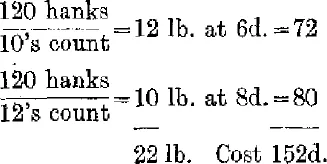
It will thus be seen that the twist yarn is composed of 12 lb. of 10’s and 10 lb. of 12’s, or 22 lb. in all, and the full formula is obviously
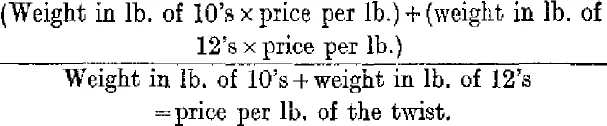
The complete numerical formula for the above yarns and prices is, consequently,
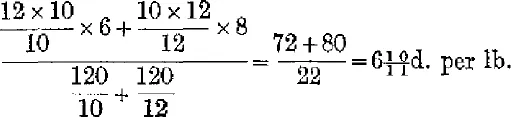
The above formula, after cancellation, is exactly as shown above.
Now, the above method is evidently applicable in every case, no matter how many threads are combined in the twisted product. The product of all the counts might be taken for the number of hanks as demonstrated in the above example; or, if it should happen to be simpler, the least common multiple of the counts could be taken.
The general formula for any number of threads is as under:
Let a, b, c . . . n = the different counts; pa, pb, pe . . . Pn= the price per pound of the different counts; and P = the price per pound of the twist. Then
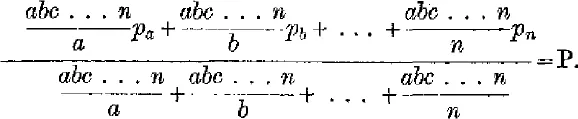
We supplement the formula with a numerical example in which three threads are twisted together, the counts and prices being as below:
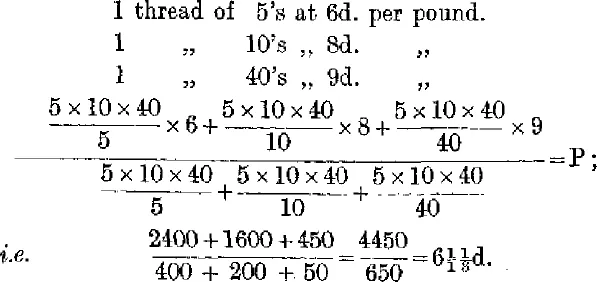
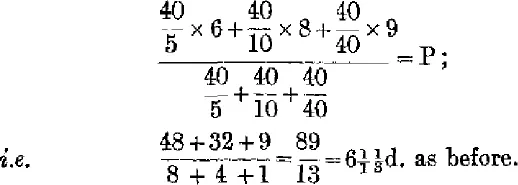
A rather quicker way in this case would be to take the L.C.M. of 5’s, 10’s, and 40’s—that is, 40—instead of the product of the three counts. Then the example becomes
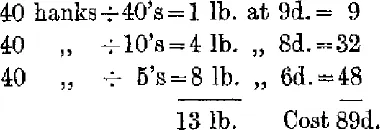
An even quicker way to solve such problems, and perhaps the simplest and safest way in all cases, is as under:
and

When a single yarn is to be manufactured to come within a specified price, it is often necessary, especially in the lower grades of the woollen industry, and also in some of the very high grades in the same industry, to effect a mixture of various kinds of fibres in the one case, and a somewhat similar but modified mixture of different fibres, or a mixture of various shades of the same fibre in the other case. This operation is termed “blending” and “mixing” in some industries, and “batching” in other industries, and in certain cases it demands an extensive knowledge of yarn structure, and sometimes of cloth structure, together with good judgment in regard to other matters. The arithmetical methods which are usually exhibited in text-books and in textile literature in general are theoretically sound, but in practice there are other extremely important functions to consider —functions which often render some of the above-mentioned methods impracticable. It must, of course, be admitted at once that, whatever else obtains, the price of the mixture must come within the specified amount, or otherwise the manufacture of the yarn will result in a loss. On the other hand, there is the equally important condition that the yarn must fulfil the purpose for which it is intended, or the trade will be diverted to some other quarter.
No hard-and-fast rule can be observed with regard to blending, as conditions of manufacture, supply, and price make frequent changes essential; but we think it is only fair to menti...
Table of contents
- Cover
- Title
- Copyright
- A History of Textiles and Weaving
- Preface
- Contents
- I. Definitions
- II. Yarn Tables: Systems of Counting
- III. Conversion of Counts from One System to Another System
- IV. Multiple-Ply Yarns: Shrinkage Neglected
- V. Multiple-Ply Yarns: Shrinkage Considered
- VI. The Price of Twisted Yarns and Mixtures
- VII. The Turns Per Inch or Twist of Yarns
- VIII. The Angle of Twist
- Index
Trusted by 375,005 students
Access to over 1.5 million titles for a fair monthly price.
Study more efficiently using our study tools.
Frequently asked questions
Yes, you can cancel anytime from the Subscription tab in your account settings on the Perlego website. Your subscription will stay active until the end of your current billing period. Learn how to cancel your subscription
No, books cannot be downloaded as external files, such as PDFs, for use outside of Perlego. However, you can download books within the Perlego app for offline reading on mobile or tablet. Learn how to download books offline
Perlego offers two plans: Essential and Complete
- Essential is ideal for learners and professionals who enjoy exploring a wide range of subjects. Access the Essential Library with 800,000+ trusted titles and best-sellers across business, personal growth, and the humanities. Includes unlimited reading time and Standard Read Aloud voice.
- Complete: Perfect for advanced learners and researchers needing full, unrestricted access. Unlock 1.5M+ books across hundreds of subjects, including academic and specialized titles. The Complete Plan also includes advanced features like Premium Read Aloud and Research Assistant.
We are an online textbook subscription service, where you can get access to an entire online library for less than the price of a single book per month. With over 1.5 million books across 990+ topics, we’ve got you covered! Learn about our mission
Look out for the read-aloud symbol on your next book to see if you can listen to it. The read-aloud tool reads text aloud for you, highlighting the text as it is being read. You can pause it, speed it up and slow it down. Learn more about Read Aloud
Yes! You can use the Perlego app on both iOS and Android devices to read anytime, anywhere — even offline. Perfect for commutes or when you’re on the go.
Please note we cannot support devices running on iOS 13 and Android 7 or earlier. Learn more about using the app
Please note we cannot support devices running on iOS 13 and Android 7 or earlier. Learn more about using the app
Yes, you can access Yarn Counts And Calculations by Thomas Woodhouse in PDF and/or ePUB format, as well as other popular books in Tecnologia e ingegneria & Design della moda. We have over 1.5 million books available in our catalogue for you to explore.