eBook - ePub
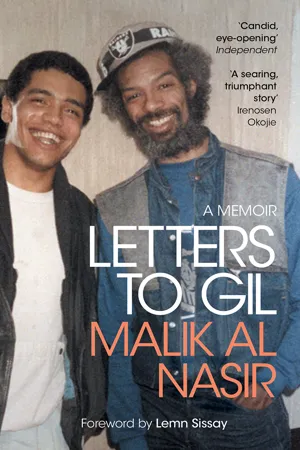
Letters to Gil
Tools to learn more effectively

Saving Books

Keyword Search

Annotating Text

Listen to it instead
Information
CHAPTER 1
THE MEETING
The air was thick with cigarette smoke and expectation. It was 1984, and Liverpool’s Royal Court Theatre was packed.
My name is Malik Al Nasir, but that wasn’t always so. In 1984, I was called Mark Watson. I was homeless, bereft of hope, and searching for some inspiration.
I’d heard that Gil Scott-Heron was performing in Liverpool. Everybody in our community – the city’s black community, that is – had turned out to see him. The show was the latest in a worldwide tour in opposition to Ronald Reagan’s re-election campaign. Gil’s music was politically charged and talked of social struggles; this struck a chord with the thousands of fans who had turned out to see him, especially the Toxteth community groups, such as the Liverpool Black Caucus, which formed during the Toxteth riots of 1981. I’d turned up at the show with no ticket and no cash, just a determination to get in. As I approached the stage door, I saw Penny Potter in the line, and I called out to her and asked if she could get me in. Penny was my brother’s mate’s girlfriend, and she was also a photographer. Thankfully she had a backstage pass, and she told the doorman that I was her assistant. It worked. We entered the backstage area while everyone else was queuing up. Throngs of people were corralled outside the main entrance. We passed through the security cordon and into the theatre’s main hall from the stage side, which put us in the press pit, just below the stage, between the crowd barriers and the stage itself. It was a prime vantage point, allowing me to watch the whole show from the front row.
I was utterly mesmerised throughout. Gil was a captivating, luminous figure, with his signature 1970s black-power afro hair bulging out of the sides of his rimmed denim bucket hat. Tellingly, Gil was wearing a Black Caucus T-shirt on the night of the gig. This tall, thin man, with a light brown complexion – derived of his Jamaican ancestry, no doubt mixed with a few colonial European genes – had walked out on stage to rapturous applause. You could hardly hear yourself think. Then, like a world leader, he raised his hand and the crowd fell silent. You could hear a pin drop.
‘How’s everybody doing?’ he asked, raising the roof once again. It was as if he’d already played the show and won over the crowd, but he hadn’t even stroked the keys on his piano.
There was something in the atmosphere that night, a sense of anticipation, and I could tell that this was special. We were a generation looking for something, though I honestly couldn’t say what that was. We wanted change, but we didn’t know where it would come from. Gil represented much more than simply an artist coming to do a show; people expected something more from him. He was a symbol of their resistance: people wanted him to know that, and he did.
Gil came on stage alone, and started the show by cracking a few jokes, mostly at the expense of then prime minister, Margaret Thatcher. Thatcher was regarded with utter contempt in the city of Liverpool, where no Conservative had won a seat in Parliament, or on the City Council, in decades. This contempt wasn’t confined to the Militant Labour Council led by Derek Hatton (whom we referred to as ‘Degsy’) and the unions. Everyone despised Thatcher and her government’s plans to put Liverpool into what was termed ‘managed decline’. Liverpool’s grand if somewhat run-down architecture in the city centre pointed to its prosperous past, but that was long behind it, and the region’s shipbuilding and other industries were collapsing. Just as Thatcher had shown no pity for the destruction her policies were wreaking on the rest of the industrial North, she showed no sympathy at all for this city’s plight.
Thatcher’s friendship with the US Republican president, Ronald Reagan, was another source of rancour. Gil’s satirical mockery of Reagan’s career on his new single, ‘Re-Ron’, provided a soundtrack for political rebellion that many people in Britain could relate to. The two leaders were seen to have taken their respective nations’ ‘special relationship’ beyond its stated purpose as ‘strategic allies’ to form a right-wing ideological alignment between the British Conservatives and the US Republicans, and furthermore, to take that relationship into the realms of the absurd.
As Gil continued to enthral the local crowd with his quick-witted repartee, his band emerged onto the stage and began plugging in. For this tour, Gil had brought over a new band. His collaboration with jazz pianist and flautist Brian Jackson was now over, and his former group – The Midnight Band – was replaced with a drummer, bass player, guitarist, tenor saxophonist and percussionist. They operated under the name Amere Facade.
The band’s definitive sound came from Gil’s 1960s analogue Fender Rhodes electric piano, on which he produced a haunting whirlwind of diminished jazz and blues chords. You got a sense that he was taking you out of your musical comfort zone as your ears tried to render the melody into something familiar. When the band kicked in, you resigned yourself to the reality that you’d never heard anything like this music before. You found yourself submitting to its evocative ambience and allowed it to take you to wherever Gil wanted it to go.
It was hard to describe Gil’s performance – he rapped, he played jazz piano, he sang and he recited poetry. In between songs, you could have mistaken him for a stand-up comedian; his jokes, however, had a very serious side – they would make you laugh and pause for thought at the same time. He might have been just singing a song, but it was as if he was part of a collective soul that existed in the room. You could almost feel it in the atmosphere surrounding you. Gil had a name for it – ‘The Vibosphere’.
On the night of the show, I was eighteen years old. I’d had a traumatic childhood in local authority care, from which I’d just recently emerged. I had no prospects. A year or so before, my older brother Reynold had introduced me to one of Gil’s albums, Moving Target. It had a picture of Gil running through the streets but seen through the telescopic lens of a gun sight.
Reynold was politically engaged and well-read, unlike me. I didn’t take life too seriously, partly because I couldn’t face up to what had happened to me. Reynold, on the other hand, was ‘deep’ – a sort of ghetto philosopher. He could see through the veneer of life and cut through all the bullshit to get to the kernels of truth that lay within. Some people were unnerved by this, as he had no problem working you out in about two seconds flat and then telling you exactly what you were, and he’d always be spot on. It was like being stripped in public; suddenly you’d feel like your inner self was somehow exposed, he could disarm you with words and would deliver them with the poise of a cobra, gazing attentively before spitting venom in a deadly strike. We’d often joke about the fact that in Chinese astrology, he was born in the year of the snake.
I looked up to Reynold. He was not only clever but artistic. He could see an object and just draw it and it would look exactly like the real thing. He used to create crazy cartoon characters and then bring them to life on the page. It was Reynold who shaped my musical tastes in my late teens, I just tended to follow his lead.
One day, he had sat me down and started to pick me apart, as he was apt to do. As we spoke, we listened to Gil Scott-Heron’s song ‘Washington D.C.’, from Moving Target, on Reynold’s stack system.
In those days, you either had a ‘stack’ or a ‘rack’ system to play music. Most working-class kids had racks – cheap, all-in-one hi-fi units pioneered by Alan Sugar’s Amstrad company, in which everything – the amplifier, speakers, tape deck and turntable – was integrated. With a stack system, you bought all the individual components and stacked them on top of each other. An amplifier alone could cost you the same or more than a whole rack system. Black kids were obsessed with having a proper stack system, and you’d save every penny you had just to buy one component.
‘Washington D.C.’ sounded amazing on Reynold’s stack. I was so consumed by the music – its heavy funky bassline filled with ‘slapping’ and ‘popping’, a style of bass-playing made famous around that time by musicians such as Stanley Clarke and Funkadelic’s Bootsy Collins – that I barely listened to the lyrics at first.
But then I listened intently. At the end of the song, Reynold asked me: ‘What did that mean to you?’ I looked up at him from my perch on the couch, as he lifted the arm on the turntable to select another track on the record. I felt like I should say something profound, but in truth, because I was concentrating on that bassline, the words and their meanings had gone over my head. ‘I really don’t know,’ I replied.
‘Gil is talking about the urban ghettos that surround the White House, the bits the tourists don’t see, the reality of the city’s ghetto life.’ My brother explained what the song really meant. He drew a parallel between what Gil was talking about in America and what we were facing in post-riot Toxteth in Liverpool. We were the invisible minority here; poor black people, living on the doorsteps of the rich whites. Reynold was trying to wake me up politically by relating the lyrics to the life I was then living. He was also concerned about my future. I had already got in with the wrong crowd, and he was concerned that if I didn’t dissociate myself from them, it would only be a matter of time before I would be incarcerated again – and this time not in a care home.
So when Reynold heard Gil Scott-Heron was performing in Liverpool, he encouraged me to go to the show. He figured, I guess, that I might get a little positive inspiration. Little did he or I know the extent to which that very encounter with Gil Scott-Heron was about to change my life.

Gil’s 1984 performance at Liverpool’s Royal Court Theatre. © Penny Potter
After the gig, I went backstage with Penny. Gil was standing there with loads of people around him; photographers snapping away, reporters stuffing mics under his nose, promoters carrying bags of cash, the band members waiting to get paid. I stood by the door feeling very unsure of myself, and then the promoter decided there were too many people backstage and shuffled everyone out.
I’ll never forget how a security guard, a friend of mine called John ‘Robbo’, helped me out in that moment. Robbo, with his clean-shaven head, hobnailed boots, white T-shirt and black braces with half-mast trousers, had a classic skinhead look – and as any black person knew in the 1970s and 1980s, if you saw a skinhead, you had two choices: fight or run. But while Robbo may have looked like a racist thug, he was the total opposite. He recognised me. ‘Mark, wha’ppen, man?’ he said. ‘Wha’ppen, Robbo, what are you doing here?’ I asked.
‘Working security for the theatre.’ A light went on in my head. ‘Listen, Robbo, I’ve got to see Gil. Help me out, man?’
‘Look,’ said Robbo, ‘go and wait on the top of that spiral staircase, when all these guys have cleared out, come back down and I’ll let you in.’
I ran up to the top of the black wrought-iron spiral stairs and waited. I could see a guy in a long trenchcoat, his jet-black hair neatly gelled and slicked back meticulously into a ponytail, as he waved everybody out of the backstage area, except for Gil, the band and a few girls who were with their entourage. I remember sitting there on those cold, cast-iron stairs for what seemed an eternity, but in reality was just a few short minutes. My sense of anticipation and excitement was almost overwhelming.
I was still intoxicated with the magic of the performance I’d witnessed. It was like nothing I’d ever seen or heard. I’d been to a few concerts before, but the bands playing usually sounded better on their records. This was different. The songs that Reynold had played me on the album were amazing, but the live experience was nothing short of spectacular. Soon enough, I heard a whistling sound, looked below and saw Robbo’s bald head. He was motioning me to come down. Robbo swung open the dressing-room door and there was Gil.
Gil exuded a kind of presence that can’t easily be put into words, like he was shrouded in a sort of invisible aura that connected to the souls of those who came into contact with him. It’s one of those things you can’t quite put your finger on, but everybody feels it.
I’d tried to meet artists before at the Empire Theatre, people like the Moody Blues and AC/DC, but they always pushed past the crowd on their way to their tour bus. But here there were still people buzzing round. Everybody seemed to want something from Gil. I remember feeling a slight unease at this, that the man had just given his all and people still wanted more from him. I decided that I didn’t want anything from him. I wanted to give him something, a compliment. I walked purposefully across the room, apparently unnoticed by his entourage. Gil, who was sitting down, looked up at me and cast a heart-warming smile, which immediately put me at ease and made me feel welcome. I reached out, shook his hand and said: ‘Thank you, man, you really moved me and that was a great performance, I appreciate it.’
As I turned around to leave, I heard his deep distinctive baritone voice call out, ‘Hold on a minute, brother.’ He got up and walked towards me. ‘What’s going on round here?’ he asked. ‘I heard y’all had some riots?’
I started to tell him about Toxteth, then the heart of Liverpool’s black community, and how people here – and across black communities in England – had rioted, in what the newspapers came to refer to as ‘the long hot summer of 1981’.
Gil said: ‘Yeah, we had some riots back in DC.’ He wanted to know about our struggles. I was thrilled to be in conversation with him. It felt surreal. Imagine, my whole community – and what seemed like the whole city – had turned out to see this guy; and there I was, seemingly the most insignificant person there, or so I felt at that time, homeless, broke, unemployed, traumatised, having a one-to-one with this titan of the US black protest movement. It has taken me years to come to terms with the gravity of what was happening in that moment to this eighteen-year-old kid. In some ways, I’m still coming to terms with it.
When it came time to leave the venue, we were deep in conversation. Gil said, ‘C’mon with us, brother. Pick up some drums or something.’ So I grabbed a set of drums, carried them out of the stage door and packed them into the back of the tour bus. Gil motioned for me to jump in. He said, ‘Get on the bus and come with us.’
We drove to the Atlantic Towers Hotel on Liverpool’s waterfront.
The band was buzzing after a great show, and there were some journalists hanging around in the lobby, chatting with members of the band. Gil said to me, ‘Hey, brother, we have a day off tomorrow, why don’t you come on down?’ I happily agreed.
Gil’s road manager was a guy called Phil Rainford. He was the figure I’d seen looming backstage in a long trenchcoat and with hair slicked back into a ponytail.
Gil and the band, I was to discover, called him ‘Count Rainford’ or else just ‘the Count’. Despite his vampiric look, he was actually a really nice guy, polite and courteous. I’m sure he was wondering who I was, to be getting so much of Gil’s attention, but he didn’t say anything. Phil passed pleasantries with me, until Gil announced, ‘Count! This here is brother Mark.’ I was shocked that he’d remembered my name. ‘He’s been telling me about Toxteth and the riots. I wanna see for myself. Can you drive us?’ ‘Sure,’ replied the Count.
We left the band at the hotel and a few minutes later we were back on the tour bus, just Gil, the Count and me. I gave them a guided tour of the riot zone. By now it was late and the roads were deserted, so we had a run of the streets, unencumbered by the daytime hustle and bustle. I took Gil to Parliament Street and Lodge Lane, where there were still a lot of burnt-out buildings among other evidence of the unrest. I gave him a running commentary of the week-long chaos and the aftermath of the uprising of 1981.
I explained to Gil that this hadn’t been the first racially charged riot in Liverpool’s history. There’d been one in 1919, in the same area, after white soldiers had returned from the First World War to a decimated local economy. I told Gil this was history people in the black community had learned about through local research, and from knowledge that had been passed down through generations via oral history.
I told him how black people, drafted in from the Empire’s colonies, had fought for the British in the trenches of the First World War. They were known as ‘Black Tommies’. There had been a Black Tommy called Walter Tull, a footballer who had played for several British teams before the war, including Tottenham Hotspur. He was killed in the war but was only really known for his football career, as black soldiers were rarely memorialised.
The Black Tommies who returned to Britain after the war were persecuted, as were their black comrades from Africa and the Caribbean, who’d been drafted in to work on the docks and in the factories. Rather than being honoured for their considerable contribution to the war effort, they were maligned for having jobs that white servicemen felt they deserved. Returning white soldiers had started to push to get the local government to ‘send the Ethiopians back’.
All black people were referred to as Ethiopians in those days, regardless of where they actually came from. The lord mayor had requested funds to ‘repatriate the Ethiopians’ but the government refused this, so they were stuck here. The clamour to throw them out of the factories and the docks to make way for returning white servicemen grew and eventually erupted. A mob of white locals chased a 2...
Table of contents
- Title Page
- Copyright
- Dedication
- Contents
- FOREWORD
- PROLOGUE
- BLACK & BLUE
- CHAPTER 1: THE MEETING
- CHAPTER TWO: BLACK TO WHITE
- CHAPTER 3: WARD OF THE STATE
- CHAPTER 4: CRIME OR MUSIC
- CHAPTER 5: BEYOND PARENTAL CONTROL
- CHAPTER 6: RIOT AND REVOLUTION
- CHAPTER 7: ‘MAHOGANY SUNSHINE AND TEARS’
- CHAPTER 8: DEEP SEA
- CHAPTER 9: BLACK HISTORY MONTH
- CHAPTER 10: GIL FIRED ME
- CHAPTER 11: THE LAST POETS
- CHAPTER 12: HUSTLERS CONVENTION LIVE
- CHAPTER 13: THE COURT CASE
- CHAPTER 14: A TRIP UPSTATE
- CHAPTER 15: THE DRESSING ROOM
- CHAPTER 16: THE LAST TOUR
- EPILOGUE
- ACKNOWLEDGEMENTS
- About the Author
- About the Publisher
Frequently asked questions
Yes, you can cancel anytime from the Subscription tab in your account settings on the Perlego website. Your subscription will stay active until the end of your current billing period. Learn how to cancel your subscription
No, books cannot be downloaded as external files, such as PDFs, for use outside of Perlego. However, you can download books within the Perlego app for offline reading on mobile or tablet. Learn how to download books offline
Perlego offers two plans: Essential and Complete
- Essential is ideal for learners and professionals who enjoy exploring a wide range of subjects. Access the Essential Library with 800,000+ trusted titles and best-sellers across business, personal growth, and the humanities. Includes unlimited reading time and Standard Read Aloud voice.
- Complete: Perfect for advanced learners and researchers needing full, unrestricted access. Unlock 1.4M+ books across hundreds of subjects, including academic and specialized titles. The Complete Plan also includes advanced features like Premium Read Aloud and Research Assistant.
We are an online textbook subscription service, where you can get access to an entire online library for less than the price of a single book per month. With over 1 million books across 990+ topics, we’ve got you covered! Learn about our mission
Look out for the read-aloud symbol on your next book to see if you can listen to it. The read-aloud tool reads text aloud for you, highlighting the text as it is being read. You can pause it, speed it up and slow it down. Learn more about Read Aloud
Yes! You can use the Perlego app on both iOS and Android devices to read anytime, anywhere — even offline. Perfect for commutes or when you’re on the go.
Please note we cannot support devices running on iOS 13 and Android 7 or earlier. Learn more about using the app
Please note we cannot support devices running on iOS 13 and Android 7 or earlier. Learn more about using the app
Yes, you can access Letters to Gil by Malik Al Nasir in PDF and/or ePUB format, as well as other popular books in Social Sciences & Social Science Biographies. We have over one million books available in our catalogue for you to explore.