Multidisciplinary research involving crystallography, kinetic studies, molecular docking, genetics and other techniques in biochemistry has yielded a wealth of knowledge about the reaction mechanisms in cellular processes. This knowledge has allowed researchers to understand, in a better way, the normal functioning of the cell process, which is used as a reference point for learning about and preventing or correcting pathologies that cause diseases.
This enzymology reference is a thorough compendium about reaction mechanisms occurring between the major enzymes related to the biosynthetic pathways of 3 important types of biological compounds – 6-carbon carbohydrates, fatty acids and amino acids – and their substrates, cofactors and residues. Readers will gain an understanding of the interaction between substrates or ligands with specific amino acid residues in biosynthetic enzymes. This understanding builds a foundation for learning about the biochemistry of different inhibitors used in the treatment of several diseases such as cancer, infectious diseases, and metabolic syndrome alterations such as diabetes and obesity.
Enzymes covered in the book include aldolases, isomerases, kinases, mutases, synthases, dehydrogenases, reductases, transferases, hydrolases, lyases among others, all of which are wide spread in biochemical transformations.
This reference, with its insights on common biochemical enzymes serves as a handy guide for students, researchers and professionals involved academia or industry related to pharmaceutical development, healthcare, food chemistry and other disciplines.
eBook - ePub
Enzymes Involved in Glycolysis, Fatty Acid and Amino Acid Biosynthesis: Active Site Mechanisms and Inhibition
- English
- ePUB (mobile friendly)
- Available on iOS & Android
eBook - ePub
Enzymes Involved in Glycolysis, Fatty Acid and Amino Acid Biosynthesis: Active Site Mechanisms and Inhibition
About this book
Trusted by 375,005 students
Access to over 1.5 million titles for a fair monthly price.
Study more efficiently using our study tools.
Information
Aminoacid Biosynthesis
Marco Brito-Arias*
Unidad Profesional Interdisciplinaria de Biotecnología, Instituto Politécnico Nacional (UPIBI-IPN), Mexico
Amino acids are biomolecules composed of an amino group and carboxylic acid as common features and different R substituents attached to a chiral carbon with L-configuration for the biologically active enantiomer in humans except for glycine devoid of chirality (Fig. 129). Biosynthetically, the amino acids are derived from glycolysis, Krebs cycle or the pentose phosphate pathway.
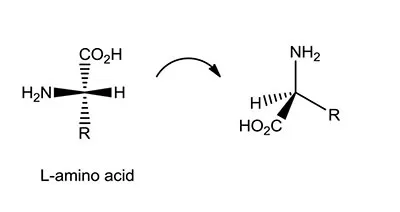
Tetrahedral projection of amino acids.
Based on additional functionalities present in the amino acids, they can be classified in aliphatic, aromatic, polar (hydroxyl and thiol groups), cationic, anionic, and heterocyclic groups (Fig. 130).
1. GLYCINE BIOSYNTHESIS
Glycine is the simplest amino acid having hydrogen as R substituent, and therefore not presenting chirality. It is an amino acid with important implications in brain excitatory and inhibitory activities, and in the synthesis of other essential molecules such as muscle supplement creatine, antioxidant glutathione, and as an abundant component in the structural protein collagen. This amino acid is synthesized from amino acids serine, threonine or nutrient choline, and its detailed biosynthesis is described in the following sections (Fig. 131).
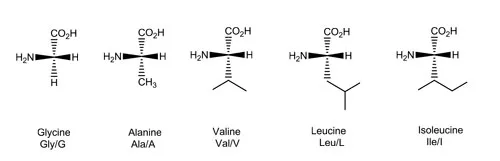


Classification and structure of amino acids.

General scheme of glycine biosynthetic precursors.
Glycine biosynthesis from serine as starting material is carried out by the catalysis of the enzyme serine hydroxyl methyl transferase (SHMT) with participation of tetrahydropteroylglutamate (H4PteGlu), which is converted to 5,10-methylene tetrahydropteroylglutamate (5,10-MH4PteGlu), and pyridoxal phosphate (B6) as cofactors (Fig. 132).


General scheme of glycine biosynthesis from serine in the presence of tetrahydrofolate and pyridoxal phosphate cofactors.
An early mechanism suggested that the conversion of L-serine to glycine involved formaldehyde formation, however further studies with mutants determined that instead of formaldehyde formation, a direct nucleophile displacement of the serine hydroxyl by N5 of tetrahydropteroylglutamate (H4PteGlu) occurs, giving place to glycine and 5,10-methylene-H4PteGlu. The reaction mechanism satisfying this transformation proposes a retroaldol from N5 of THF making an attack on C3 serine resulting in C3-C2 cleavage of serine (Fig. 133) [141].


Proposed reaction mechanism for glycine formation involving PLP and H4PteGlu.
1.1. Serine Hydroxyl Methyl Transferase (SHMT)
The crystal structure of SHMT from Methanocaidococcus jannaschii in the apo form (mjSHMT without cofactor PLP) and holo form (mjSHMT with PLP) was determined, showing the catalytic domain in purple, the C-terminal in green, the N-terminal α-helix in yellow, and cofactor PLP in red spheres (Fig. 134) [142, 143].
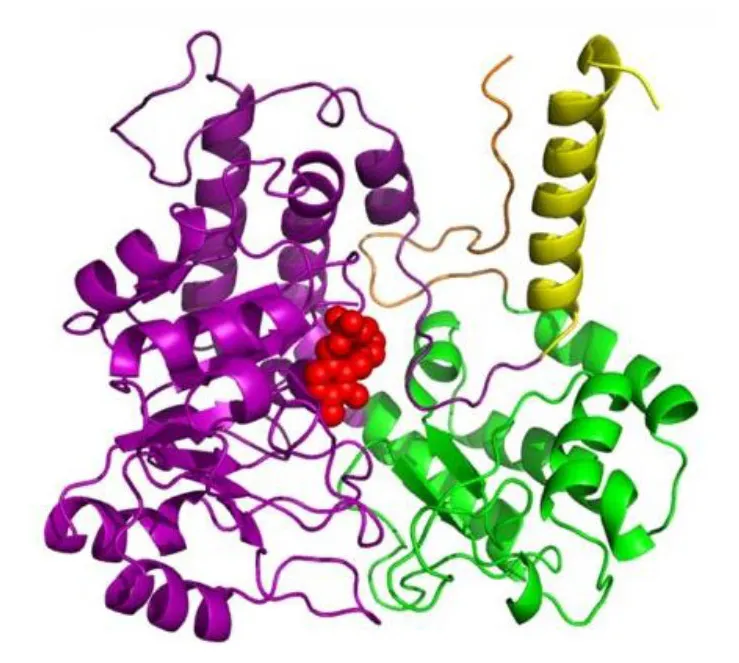
The ribbon structure of G monomer SHMT from Methanocaidococcus jannaschii G monomer showing the catalytic domain in purple, the C-terminal in green, and PLP as spheres in red (PDB: 4BHD).
Native serine hydroxymethyltransferase from Bacillus stearothermophilus complexed with serine has been described, allowing the identification of the residues and the cofactors participating. The SHMT stereoview shows the aldimide and THF interacting with serine and glycine (Fi...
Table of contents
- Welcome
- Table of Content
- Title
- BENTHAM SCIENCE PUBLISHERS LTD.
- PREFACE
- ACKNOWLEDGEMENTS
- Glycolysis
- Citric Acid Cycle (Krebs)
- Fatty Acid Biosynthesis
- Aminoacid Biosynthesis
- References
Frequently asked questions
Yes, you can cancel anytime from the Subscription tab in your account settings on the Perlego website. Your subscription will stay active until the end of your current billing period. Learn how to cancel your subscription
No, books cannot be downloaded as external files, such as PDFs, for use outside of Perlego. However, you can download books within the Perlego app for offline reading on mobile or tablet. Learn how to download books offline
Perlego offers two plans: Essential and Complete
- Essential is ideal for learners and professionals who enjoy exploring a wide range of subjects. Access the Essential Library with 800,000+ trusted titles and best-sellers across business, personal growth, and the humanities. Includes unlimited reading time and Standard Read Aloud voice.
- Complete: Perfect for advanced learners and researchers needing full, unrestricted access. Unlock 1.5M+ books across hundreds of subjects, including academic and specialized titles. The Complete Plan also includes advanced features like Premium Read Aloud and Research Assistant.
We are an online textbook subscription service, where you can get access to an entire online library for less than the price of a single book per month. With over 1.5 million books across 990+ topics, we’ve got you covered! Learn about our mission
Look out for the read-aloud symbol on your next book to see if you can listen to it. The read-aloud tool reads text aloud for you, highlighting the text as it is being read. You can pause it, speed it up and slow it down. Learn more about Read Aloud
Yes! You can use the Perlego app on both iOS and Android devices to read anytime, anywhere — even offline. Perfect for commutes or when you’re on the go.
Please note we cannot support devices running on iOS 13 and Android 7 or earlier. Learn more about using the app
Please note we cannot support devices running on iOS 13 and Android 7 or earlier. Learn more about using the app
Yes, you can access Enzymes Involved in Glycolysis, Fatty Acid and Amino Acid Biosynthesis: Active Site Mechanisms and Inhibition by Marco Brito-Arias in PDF and/or ePUB format, as well as other popular books in Biological Sciences & Biochemistry. We have over 1.5 million books available in our catalogue for you to explore.