an integrated approach to electron transfer phenomena
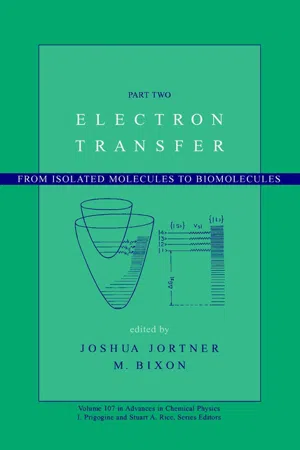
This two-part stand-alone volume in the prestigious Advances in Chemical Physics series provides the most comprehensive overview of electron transfer science today. It draws on cutting-edge research from diverse areas of chemistry, physics, and biology-covering the most recent developments in the field, and pointing to important future trends. This second volume offers the following sections:
* Solvent control, including ultrafast solvation dynamics and related topics
* Ultrafast electron transfer and coherence effects
* Molecular electronics
* Electron transfer and exciplex chemistry
* Biomolecules-from electron transfer tubes to kinetics in a DNA environment
Part One addresses the historical perspective, electron transfer phenomena in isolated molecules and clusters, general theory, and electron transfer kinetics in bridged compounds.
Electron transfer science has seen tremendous progress in recent years. Technological innovations, most notably the advent of femtosecond lasers, now permit the real-time investigation of intramolecular and intermolecular electron transfer processes on a time scale of nuclear motion. New scientific information abounds, illuminating the processes of energy acquisition, storage, and disposal in large molecules, clusters, condensed phase, and biophysical systems.
Electron Transfer: From Isolated Molecules to Biomolecules is the first book devoted to the exciting work being done in nonradiative electron transfer dynamics today. This two-part edited volume emphasizes the interdisciplinary nature of the field, bringing together the contributions of pioneers in chemistry, physics, and biology. Both theoretical and experimental topics are featured. The authors describe modern approaches to the exploration of different systems, including supersonic beam techniques, femtosecond laser spectroscopy, chemical syntheses, and methods in genetic and chemical engineering. They examine applications in such areas as supersonic jets, solvents, electrodes, semi- conductors, respiratory and enzymatic protein systems, photosynthesis, and more. They also relate electron transfer and radiationless transitions theory to pertinent physical phenomena, and provide a conceptual framework for the different processes.
Complete with over two hundred illustrations, Part Two opens with solvent control issues, including electron transfer reactions and ultrafast solvation dynamics. Other topics include ultrafast electron transfer and coherence effects, molecular electronics, and electron transfer in exciplex chemistry. This volume concludes with a section on biomolecules-from electron transfer tubes to experimental electron transfer and transport in DNA.
Timely, comprehensive, and authoritative, Electron Transfer: From Isolated Molecules to Biomolecules is an essential resource for physical chemists, molecular physicists, and researchers working in nonradiative dynamics today.
eBook - PDF
Electron Transfer
From Isolated Molecules to Biomolecules, Volume 107, Part 2
- 758 pages
- English
- PDF
- Available on iOS & Android
eBook - PDF
Electron Transfer
From Isolated Molecules to Biomolecules, Volume 107, Part 2
About this book
Trusted by 375,005 students
Access to over 1.5 million titles for a fair monthly price.
Study more efficiently using our study tools.
Information
Table of contents
- ELECTRON TRANSFER FROM ISOLATED MOLECULES TO BIOMOLECULES
Frequently asked questions
Yes, you can cancel anytime from the Subscription tab in your account settings on the Perlego website. Your subscription will stay active until the end of your current billing period. Learn how to cancel your subscription
No, books cannot be downloaded as external files, such as PDFs, for use outside of Perlego. However, you can download books within the Perlego app for offline reading on mobile or tablet. Learn how to download books offline
Perlego offers two plans: Essential and Complete
- Essential is ideal for learners and professionals who enjoy exploring a wide range of subjects. Access the Essential Library with 800,000+ trusted titles and best-sellers across business, personal growth, and the humanities. Includes unlimited reading time and Standard Read Aloud voice.
- Complete: Perfect for advanced learners and researchers needing full, unrestricted access. Unlock 1.5M+ books across hundreds of subjects, including academic and specialized titles. The Complete Plan also includes advanced features like Premium Read Aloud and Research Assistant.
We are an online textbook subscription service, where you can get access to an entire online library for less than the price of a single book per month. With over 1.5 million books across 990+ topics, we’ve got you covered! Learn about our mission
Look out for the read-aloud symbol on your next book to see if you can listen to it. The read-aloud tool reads text aloud for you, highlighting the text as it is being read. You can pause it, speed it up and slow it down. Learn more about Read Aloud
Yes! You can use the Perlego app on both iOS and Android devices to read anytime, anywhere — even offline. Perfect for commutes or when you’re on the go.
Please note we cannot support devices running on iOS 13 and Android 7 or earlier. Learn more about using the app
Please note we cannot support devices running on iOS 13 and Android 7 or earlier. Learn more about using the app
Yes, you can access Electron Transfer by Joshua Jortner, M. Bixon, Joshua Jortner,M. Bixon, Ilya Prigogine,Stuart A. Rice in PDF and/or ePUB format, as well as other popular books in Physical Sciences & Chemistry. We have over 1.5 million books available in our catalogue for you to explore.