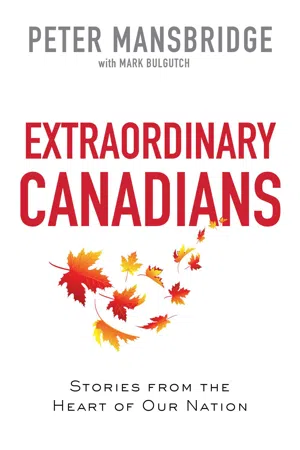
Extraordinary Canadians
eBook - ePub

Extraordinary Canadians

Stories from the Heart of Our Nation

  1. 304 pages
  2. English
  3. ePUB (mobile friendly)
  4. Available on iOS & Android
eBook - ePub

Extraordinary Canadians

Stories from the Heart of Our Nation

About this book

From Peter Mansbridge, the beloved former anchor of CBC's The National, and Mark Bulgutch, former CBC producer, comes a collection of first-person stories about remarkable Canadians who embody the values of our great nation—kindness, compassion, courage, and freedom—and inspire us to do the same. In this timely and heartwarming volume of personal stories, Peter Mansbridge and former CBC producer Mark Bulgutch bring together inspiring Canadians from across the country, who in their own way, are making Canada a better place for all.Hear Gitxsan activist Cindy Blackstock describe her childhood in northern British Columbia where she straddled two communities—Indigenous and non-Indigenous—and her subsequent fight for equitable health care for all children as the executive director of the First Nations Child and Family Caring Society. Meet Matt Devlin, the US broadcaster who found a new home in Canada when he got a job with the Toronto Raptors, and read how he helped calm the crowd when a gunman began shooting in Nathan Phillips Square after the team's NBA championship win. From the young woman living with Crohn's disease—and proudly modeling her ostomy bag—to the rabbi whose family fled Nazi Germany—and who now gives the benediction on Parliament Hill each Remembrance Day— Extraordinary Canadians celebrates the people who have overcome adversity and broken down barriers to champion the rights and freedoms of everyone who calls Canada home.Featuring voices from all walks of life—advocates, politicians, doctors, veterans, immigrants, business leaders, and more—this collection gets to the heart of what it means to be Canadian. These stories will change the way you see your country and make you fall in love with Canada all over again.
Frequently asked questions

Yes, you can cancel anytime from the Subscription tab in your account settings on the Perlego website. Your subscription will stay active until the end of your current billing period. Learn how to cancel your subscription.
No, books cannot be downloaded as external files, such as PDFs, for use outside of Perlego. However, you can download books within the Perlego app for offline reading on mobile or tablet. Learn more here.
Perlego offers two plans: Essential and Complete
  • Essential is ideal for learners and professionals who enjoy exploring a wide range of subjects. Access the Essential Library with 800,000+ trusted titles and best-sellers across business, personal growth, and the humanities. Includes unlimited reading time and Standard Read Aloud voice.
  • Complete: Perfect for advanced learners and researchers needing full, unrestricted access. Unlock 1.4M+ books across hundreds of subjects, including academic and specialized titles. The Complete Plan also includes advanced features like Premium Read Aloud and Research Assistant.
Both plans are available with monthly, semester, or annual billing cycles.
We are an online textbook subscription service, where you can get access to an entire online library for less than the price of a single book per month. With over 1 million books across 1000+ topics, we’ve got you covered! Learn more here.
Look out for the read-aloud symbol on your next book to see if you can listen to it. The read-aloud tool reads text aloud for you, highlighting the text as it is being read. You can pause it, speed it up and slow it down. Learn more here.
Yes! You can use the Perlego app on both iOS or Android devices to read anytime, anywhere — even offline. Perfect for commutes or when you’re on the go.
Please note we cannot support devices running on iOS 13 and Android 7 or earlier. Learn more about using the app.
Yes, you can access Extraordinary Canadians by Peter Mansbridge,Mark Bulgutch in PDF and/or ePUB format, as well as other popular books in Social Sciences & North American Literary Collections. We have over one million books available in our catalogue for you to explore.

CINDY BLACKSTOCK The Fight for Change

Image
I really was a child living two lives. One was much harder and much more painful than the other. And living the difference set me on a course for a lifetime.
There is something magical about children. About their sense of the world, their wonder, their limitless possibilities. And how, in those opening moments of life, they’re all equal. Until they’re not.
I was about five years old when I overheard a discussion at my parents’ dinner table that would influence the rest of my life. My mom had invited her sister and her sister’s son, my cousin, to join us that night for dinner at our house in Topley, a very small town, home to a couple of hundred people, in northern British Columbia. My cousin loved to talk and it wasn’t long before he had the attention of the table, and even though I was kind of running around the room, I was listening to every word he had to say. He was older than me, and he was describing what seemed, to me at least, to be an imaginary place.
ā€œIt’s a wonderful spot,ā€ he said. ā€œA place where you can learn about everything, and discuss anything, that you find interesting. A place where others join with you and share their knowledge and experience.ā€
Image
Here I am at age four with my sister, Sheila, practicing looking after ā€œlittleā€ kids.
I decided right then and there that I wanted to go to that place. I stopped running and asked him, ā€œWhat is this place?ā€
ā€œUBC,ā€ he answered. He was talking about the University of British Columbia, though at the time I had no idea what he meant. To me it sounded like: ā€œYou Be See.ā€ But even at that age I was determined to find it. I was going to go there. I listened carefully as he went on.
ā€œIt’s an expensive place and it costs a lot of money to go there.ā€
My courage faltered for a moment. I knew our family didn’t have a lot of money. How could I make my dream come true? This was the late 1960s, and I only knew one way to make money back then. In the part of northern British Columbia where we lived, my father, a forest ranger, had taught me to go out in the forest and pick up pine cones. If you saved enough of them to fill a gunnysack you could sell them for reforestation. In my little five-year-old mind, playing near the dinner table, I thought, ā€œHow many gunnysacks will I need to fill to go to that wonderful place called ā€˜You Be See’?ā€
Despite my worry about money, even then my world seemed full of possibility. However, it was around that same age that I realized something else. Something about the way others saw my family.
My mother worked as a BC Tel operator, and between her job and my dad’s, my brother, my sister, and I were always moving from town to small town to smaller town among the huckleberry bushes of British Columbia’s north. No matter where we were, I noticed that when I went out with my mom everything was normal; people were friendly and talked to us openly. But when I went out with my dad, it was very different. We’d go to a local diner and sit for a long time before we got served, and even then, it seemed to me, we were served grudgingly.
You see, my dad was Gitxsan, but most people just called him Indian. My mom wasn’t. She was non-Indigenous. So when I was with my mother the future seemed kind of limitless—I was seen as someone who could grow up to be a nurse or a teacher, something productive in society. But when I was with my father and associated with my First Nations family and friends, the future suddenly looked so much bleaker.
I was only five, but I was already feeling caught between two worlds.
When it was time for me to go to school, I went to public schools while almost all my Indigenous friends went to residential schools. It would be decades before we realized the horrors my friends were going through, but I was spared that experience. I was very lucky, and even to this day I’m not sure why. At the time, it was up to government-appointed Indian agents to determine where Indigenous kids like me went to school. The Indian Act dictated that those kids living on reserve went to residential schools, and those living off reserve did not. We moved a lot, sometimes living in the bush, sometimes in nearby communities, so perhaps the Indian agents lost track of me or simply didn’t notice. Whatever the case, I attended public school, often the only First Nations kid in my class, and it was there, sometimes from schoolyard gossip, that I would hear non-Indigenous people say that all Indians were on welfare, that all Indians were drunks. To me, with a First Nations father, hearing this often was horrifying. It was, as I look back on it now, a constant form of bullying—in fact, constant racism.
What made these moments worse was when our family travels would take me onto a reserve because I would see so many things that backed up those stereotypes. I would see people who were drunk. I would see people whose only source of income was welfare.
From early childhood, these things shaped my views of what a First Nations person was. Of who I was. I was fighting a battle within myself, trying to determine which side of my identity I should lean to.
When I was young, a local Gitxsan reserve invited everyone in the area to come and visit in an attempt to ease tensions between the Indigenous and non-Indigenous peoples. It was a kind of festival atmosphere, and the idea was to raise awareness about traditional customs, culture, and food. I was immedately impressed, especially with the totem poles. Each giant pole told stories, and the elders would explain the legends by talking about each figure carved into the pole from top to bottom. I’d never seen one before, and the history behind the poles that had stood for decades was inspiring.
Then my sweet tooth started to have a craving. I could see one of the tables set up for visitors was serving what looked to me like strawberry ice cream. I love strawberry ice cream. I quickly manoeuvred myself to be first in line and was rewarded with a cone. I brought it to my lips and as I took a bite, I thought, ā€œOh my God, this is not strawberry ice cream.ā€ It sure wasn’t. It was soapberry ice cream! And soap is not strawberry. It’s bitter. Very bitter. That was my first taste of traditional food, and I didn’t like it and I didn’t finish it!
That day had its dark side as well. Again, I saw drunkenness and everything that goes with it. Even with all the fun going on around me, those were scenes I could not unsee.
On the way home, the events of the day ran through my head. Some of what I had seen and heard had made me feel very uncomfortable with half of my heritage, and I came to the conclusion that these two extremes of First Nations life were like the night sky, a profound darkness that could also include beautiful sparkles. As hard as it is for me to admit it now, I became racist against myself in some ways.
I really was a child living two lives. One was much harder and much more painful than the other. And living the difference set me on a course for a lifetime.
From my vantage point of having two childhoods, I began to realize that I was in the best possible position to ask: ā€œWhy are we different?ā€ ā€œAre we really different?ā€ ā€œWhy should we be different?ā€ ā€œWhat makes us different?ā€
By the time I was in my mid-teens, I was reading Nelson Mandela, Martin Luther King Jr., and Mahatma Gandhi in search of the answers to those very questions. They talked about freedom in a way that I fully understood. Even though they were from a different time and place, what they were saying about equality had lasting resonance. Their power was in communicating truths that were accessible and meaningful to everyone, no matter their age, race, or circumstance.
Slowly my perception of myself began to change through education and I came to know from that early age that we, the Indigenous ā€œweā€ in my blood, really weren’t any different from the ā€œweā€ on my non-Indigenous side. That only because we were seen to be different, the system treated us differently and not in a way that was good. The rules were racist, plain and simple. Why were Indigenous kids shipped off to faraway schools? Why were we living on reserves? Why were we offered different health care? How was it acceptable that we didn’t have clean drinking water? The accepted image of our ā€œdifferenceā€ was echoed in the media that influenced so much of our lives. I never saw a First Nations person be a teacher or a doctor or an engineer or anything like that. The only people I saw on TV in those roles, whether they were real or dramatic, were white people.
I was determined to change things. I was convinced I could make a difference. And I knew part of my goal would have to start by getting to ā€œYou Be See.ā€
It wasn’t long after that dining room conversation with my cousin that I realized that ā€œYou Be Seeā€ wasn’t some faraway, unattainable, mystical place. It was real and it was something reachable, even for me. It was, of course, UBC, the University of British Columbia. And a dozen years after I’d heard my cousin talking about it, I was there, studying and learning in the same classrooms that had educated the likes of prime ministers, Supreme Court chief justices, Olympic athletes, business leaders, authors, architects, and opera singers.
Now it was time for Cindy Blackstock.
UBC was just as wonderful as I had expected. My cousin had been correct. It was a place for ideas and passion. And when I walked out of that institution in 1987, I had an Arts degree in one hand and a job offer in the other. I was twenty-one and ready for work with the BC government’s Child Protection Services to make a real difference in people’s lives. I had been deeply affected by my experiences growing up, and I had never been able to accept that in this great country—and we have a great country—there are such historic inequities in the way we treat our citizens. As far as I was concerned those who suffer the most are those who should suffer least. Those who were here first, those who were living off this land before anyone else even knew there was land here to live off. My particular passion was for Indigenous children and to ensure they had the same basic rights as non-Indigenous kids.
I thought I was ready, but I’m not sure anyone can ever be ready for the front lines of child protection. I saw a lot of things I wished I hadn’t, a lot of things that shaped my view of society.
I’d barely started working when I was confronted with what was to be an all-too-regular part of the job: making a decision about whether to take a child out of their home and away from their parent or parents.
Image
I made it! This is my UBC graduation photo, taken in 1987. Favourite memory of UBC? The legendary UBC cinnamon buns!
We’d received a call from a woman who was very concerned about the well-being of the kids in the apartment next door to her and I was sent to determine what should be done. It was an apartment in a low-income building in downtown Vancouver. I knocked on the door and a little First Nations girl appeared. She was barely five years old, but she had an air of confidence that suggested she was clearly in charge. Her two younger siblings were playing on the carpet behind her. One looked about three, the other about four.
ā€œCan I see your mom?ā€ I asked.
She said yes and began to lead me down a bleak-looking hallway, but suddenly she stopped, turned, and asked me, ā€œDo you want to see what my mom does?ā€
Before I could answer, she started staggering as she walked and slurring her words. I was shocked and felt sickened. Already I was concerned that this was no place to raise a child, but now I was watching a five-year-old mimic what she saw in her mother. We got to the room where her mom was, and she was out cold. Drunk. We could not wake her and I had to call for paramedics. Later I discovered that she had severe addiction issues.
When it came time to make the decision whether to keep the children with her, my decision was easy, perhaps too easy. I took those three little First Nations girls out of their home and had them placed in foster care. It was the hardest thing I’ve ever done. Eventually, I was able to find an extended family member who took them in. I felt relieved about that, but I couldn’t escape the fact that I’d separated them from their mother. They say you never forget your first. I don’t. But sadly there were many more that followed.
What I quickly discovered was that when I was working ā€œoff reserveā€ doing more general child protection for non-Indigenous kids, there were food banks, youth programs, baseball diamonds, and lots of other places to provide support and a healthy environment for families who were struggling. But when I went ā€œon reserve,ā€ none of those resources existed. There were no nonprofit groups providing food at food banks, and the schools and community centres were run-down and in disarray. The pieces that were fundamentally expected in mainstream society did not happen for First Nations. That, I decided, was driving a lot of the disadvantage.
I developed a new theme to my learning and it’s stuck with me ever since. I repeat it to myself all the time: ā€œI have to stop paying so much attention to all the stuff I can see, and instead pay more attention to the stuff I can’t see.ā€ So I tried paying less attention to things like the drunkenness, and more attention to the fact that those affected by alcohol simply didn’t have the services, the facilities, and the benefits that their non–First Nations counterparts did have.
It’s not only about equality among citizens. It’s not just about the fair treatment of Indigenous and non-Indigenous populations. This is about kids. About the most innocent and vulnerable members of our society. Children. And there are children in this country who have been treated and continue to be treated as worth less than others.
In 2002, I became the executive director of the First Nations Child and Family Caring Society, a national nonprofit organization developed by First Nations child and family service agencies to ensure the safety and well-being of our youth and their families through education initiatives, public policy campaigns, and quality resources to support communities. It’s from here that I feel I can make a difference by fighting in court, by lobbying government officials both elected and unelected, and by standing up for those who can’t find a way to stand up for themselves. I was convinced that a strong relationship with bureaucracy could lead to the implementation of successful new policies that would provide a solution to First Nations childhood issues.
When I started, quite frankly, I didn’t know where to begin. But I went to my Indigenous strength, the one I finessed thanks to the writings of my heroes: Mandela, King, and Gandhi. Express complex things simply. That would be the best way to reach people with the truth and evoke change. This was the path I’d been on since I was a little girl. Address inequalities. Especially for children.
One case still haunts me. Just before Christmas 2012, a little four-year-old First Nations girl was admitted for dental surgery, but things went terribly wrong and she was left with ter...

Table of contents

  1. Cover
  2. Title Page
  3. Dedication
  4. Introduction
  5. 1. The Fight for Change
  6. 2. The Power of a Name
  7. 3. Second Chances
  8. 4. On the Front Lines
  9. 5. Trust
  10. 6. Who I Am Now
  11. 7. Deeds, Not Words
  12. 8. Fighting for Equality
  13. 9. From the Heart
  14. 10. Canadian Women for Women in Afghanistan
  15. 11. Equality and Justice for All
  16. 12. A Day to Remember
  17. 13. Providing Life’s Necessities
  18. 14. The Reason I’m Alive
  19. 15. A Life of Service
  20. 16. True Riches
  21. 17. Wild at Heart
  22. Acknowledgments
  23. About the Authors
  24. Copyright